Universe Today
You’re on the fourth human mission to Mars, and you’re told the Odyssey spacecraft designed to take you there will be the smoothest ride you’ll ever take. It features a newly christened electric propulsion engine which was in the late stages of testing during the first three missions. The mission starts and the spacecraft travels at a crawl, and you wonder if it’s broken. A week goes by and you’re now traveling at more than 400,000 kilometers (250,000 miles) per hour, and your mind is blown as to how fast you’re going, how quickly that happened, and that this mission might be more awesome than you thought.
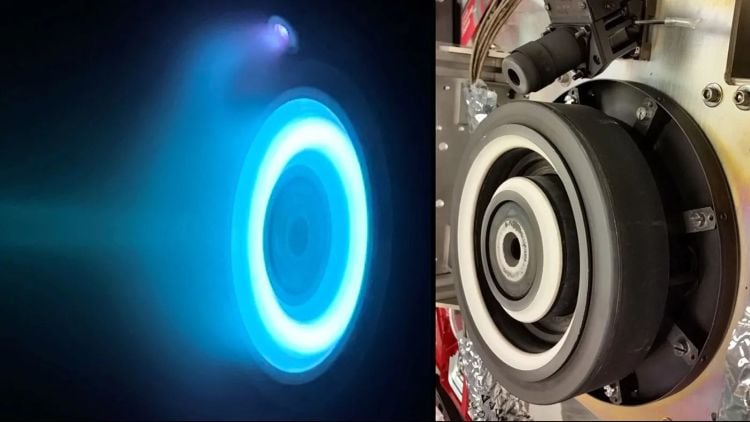
This scenario is quite possibly a decade away, at minimum, but that’s not stopping the bright minds at NASA from building and testing next generation propulsion systems designed to take humans to Mars one day and send spacecraft across the solar system. This is because NASA engineers recently tested a next generation electric propulsion system that achieved new records while requiring lithium metal vapor for fuel and holds the potential to be a gamechanger in propulsion systems for the future of space exploration.
In a remarkable achievement, the tests successfully set a new record in the United States of 120 kilowatts of power, which is estimated to be 25 times greater than NASA’s Psyche spacecraft, which is currently en route to asteroid 16 Psyche and contains the most powerful electric thrusters ever built. While Psyche is currently traveling at approximately 135,000 kph (84,000 mph), its maximum speed near the end of its cruise to asteroid 16 Psyche is estimated to be 200,000 kph (124,000 mph). Aside from the speed, which gradually builds during the thrusters’ continuous operation, electric propulsion systems save a considerable amount of fuel, up to 90 percent, compared to chemical rockets currently being used.
“Designing and building these thrusters over the last couple of years has been a long lead-up to this first test,” said James Polk, who is a senior research scientist at NASA Jet Propulsion Laboratory. “It’s a huge moment for us because we not only showed the thruster works, but we also hit the power levels we were targeting. And we know we have a good testbed to begin addressing the challenges to scaling up.”
While 120 kilowatts is a new record, NASA estimates it a future human mission to Mars will require 2 to 4 megawatts of power consisting of several thrusters and requiring more than 23,000 hours (958 days/2.6 years) of operation. To accomplish this, the thrusters would have to withstand more than 2,800 degrees Celsius (5,000 degrees Fahrenheit), which the thrusters achieved during testing.
The reason for the extended operation is due to the estimated time of an entire human mission to Mars, which is estimated to be approximately 2.6 years. This is because the launch window to Mars only opens once every two years due to the orbital behaviors of both planets. While no mission has ever returned from the Red Planet, this same launch window works from Mars to Earth, too. When launched within this window, robotic spacecraft have traditionally taken approximately 6-7 months to reach Mars.
However, a human mission would require a much larger spacecraft to accommodate the astronauts, food, fuel, water, and other mission-essential items. For the approximate 2.6-year mission, this would entail approximately 6-9 months traveling to Mars, followed by approximately 18 months on the surface of Mars until the next launch window opens, then another approximate 6-9 months back to Earth. However, having much less fuel due to the electric propulsion system could potentially alter this timeframe.
How will this new next-generation electric propulsion engine help propel astronauts to Mars and other spacecraft throughout the solar system in the coming years and decades? Only time will tell, and this is why we science!
As always, keep doing science & keep looking up!