Universe Today
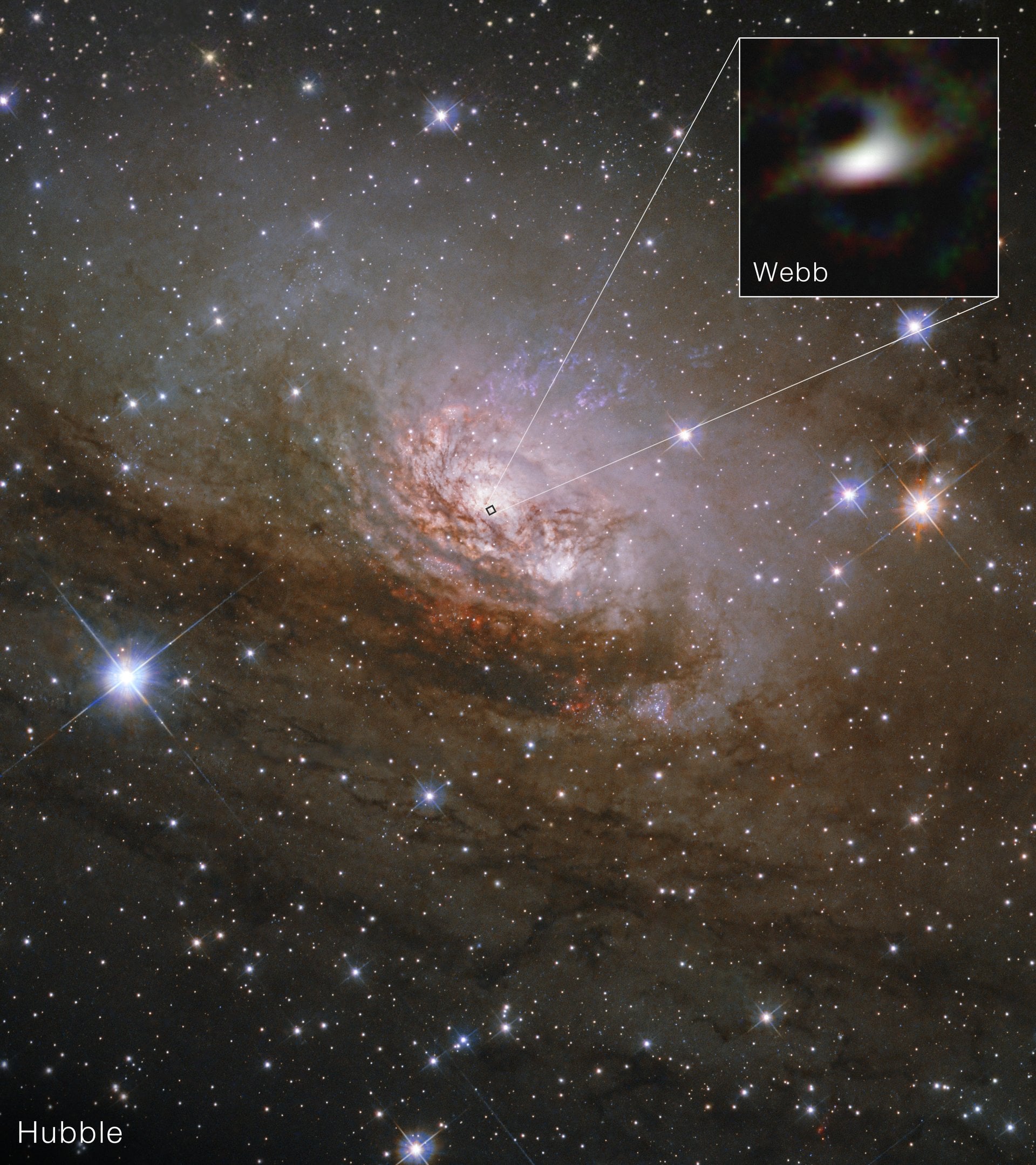
Supermassive Black Holes (SMBHs), which reside at the center of many galaxies, play a central role in the evolution of these cosmic structures. This includes how they power Active Galactic Nuclei (AGNs), in which the core region emits enough radiation and light to temporarily outshine all the stars in the disk. They also "seesaw" between relativistic jets emanating from their poles to outflows of jets that suppress star formation in the surrounding core. Despite this broad understanding, scientists have been waiting for the day when they can peer directly into the heart of a galaxy's core and see what's going on there.
Now, thanks to new observations by the NASA/ESA/CSA James Webb Space Telescope (JWST), which have provided the deepest and clearest views into the Circinus Galaxy, located about 13 million light-years away, that contains an SMBH. These observations have also led to a surprising discovery that challenges some previously held theories. In the past, the largest source of infrared light from the core region was thought to be outflows of superheated material, whereas the new observations show that most of the material is feeding the black hole.
Studying AGNs is challenging because their disks are so bright that it is difficult to resolve features in the parent galaxy's interior. In addition, the material in these disks is so dense that the inner region of infalling material is obscured. In the case of Circinus, matters are complicated further by the interference of its bright starlight. For decades, scientists worked to create improved models by assigning different spectra to specific regions, ranging from the inner accretion disk to the outflows. However, since the interior region could not be fully resolved, certain wavelengths (such as certain excesses of infrared light) could not be properly assigned.
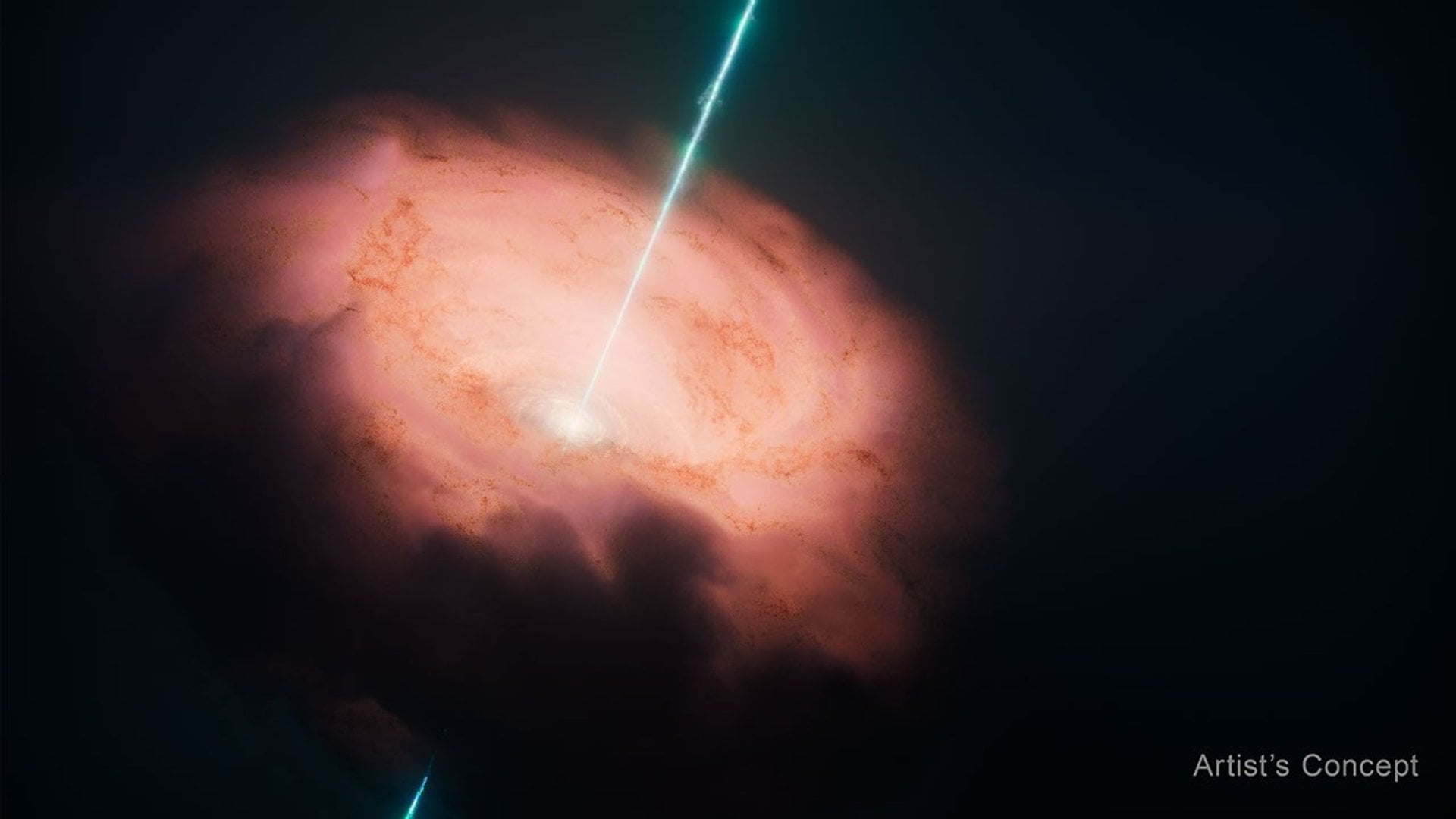 This artist’s concept depicts the central engine of the Circinus galaxy, visualizing the supermassive black hole fed by a thick, dusty torus that glows in infrared light. Credit: NASA/ESA/CSA/Ralf Crawford (STScI)
Enrique Lopez-Rodriguez, the lead author of the University of South Carolina, explained in a NASA press release:
In order to study the supermassive black hole, despite being unable to resolve it, they had to obtain the total intensity of the inner region of the galaxy over a large wavelength range and then feed that data into models. Since the ‘90s, it has not been possible to explain excess infrared emissions that come from hot dust at the cores of active galaxies, meaning the models only take into account either the torus or the outflows, but cannot explain that excess.
Previous models found that most of the infrared emission from the center of Circinus could be traced to outflows. To test this theory, astronomers needed instruments that could filter out the obscuring starlight and distinguish the torus's infrared emission from that of the outflows. Fortunately, Webb was able to meet both challenges thanks to the Aperture Masking Interferometer on its Near-Infrared Imager and Slitless Spectrograph (NIRISS) instrument. Using a special aperture with seven hexagonal holes, the instrument can combine light from multiple sources, creating interference patterns that can be analyzed to reconstruct the size, shape, and features of distant objects in exceptional detail.
This data allowed the research team to construct an image of Circinus' central region, which they compared to previous observations to confirm there were no artifacts. These observations constitute the first extragalactic observation from a space-based infrared interferometer and the sharpest image of a black hole’s surroundings ever taken. Said co-author Joel Sanchez-Bermudez of the National University of Mexico:
These holes in the mask are transformed into small collectors of light that guide the light toward the detector of the camera and create an interference pattern. By using an advanced imaging mode of the camera, we can effectively double its resolution over a smaller area of the sky. This allows us to see images twice as sharp. Instead of Webb’s 6.5-meter diameter, it’s like we are observing this region with a 13-meter space telescope.
The team's observations also revealed that, contrary to previous models' predictions, the infrared excess arises from outflows. They also showed that 87% of the infrared emission from hot dust comes from regions closest to the galaxy's SMBH, and less than 1% from hot dusty outflows. The remaining 12% are caused by hot dust located farther from the black hole, which previously could not be differentiated from the rest. This same technique could also be used to analyze the outflow and accretion components of other nearby black holes. Said Lopez-Rodriguez:
The intrinsic brightness of Circinus’ accretion disk is very moderate. So it makes sense that the emissions are dominated by the torus. But maybe, for brighter black holes, the emissions are dominated by the outflow. We need a statistical sample of black holes, perhaps a dozen or two dozen, to understand how mass in their accretion disks and their outflows relate to their power.
"It is the first time a high-contrast mode of Webb has been used to look at an extragalactic source," added co-author Julien Girard, a senior research scientist at the Space Telescope Science Institute (STScI). "We hope our work inspires other astronomers to use the Aperture Masking Interferometer mode to study faint, but relatively small, dusty structures in the vicinity of any bright object." Studying additional black holes could help astronomers build a catalog of emission data to determine whether Circinus is unique or representative of a broader pattern.
The team's research was detailed in a paper published on January 13th in Nature Communications.
Further Reading: NASA, Nature Communications