Universe Today
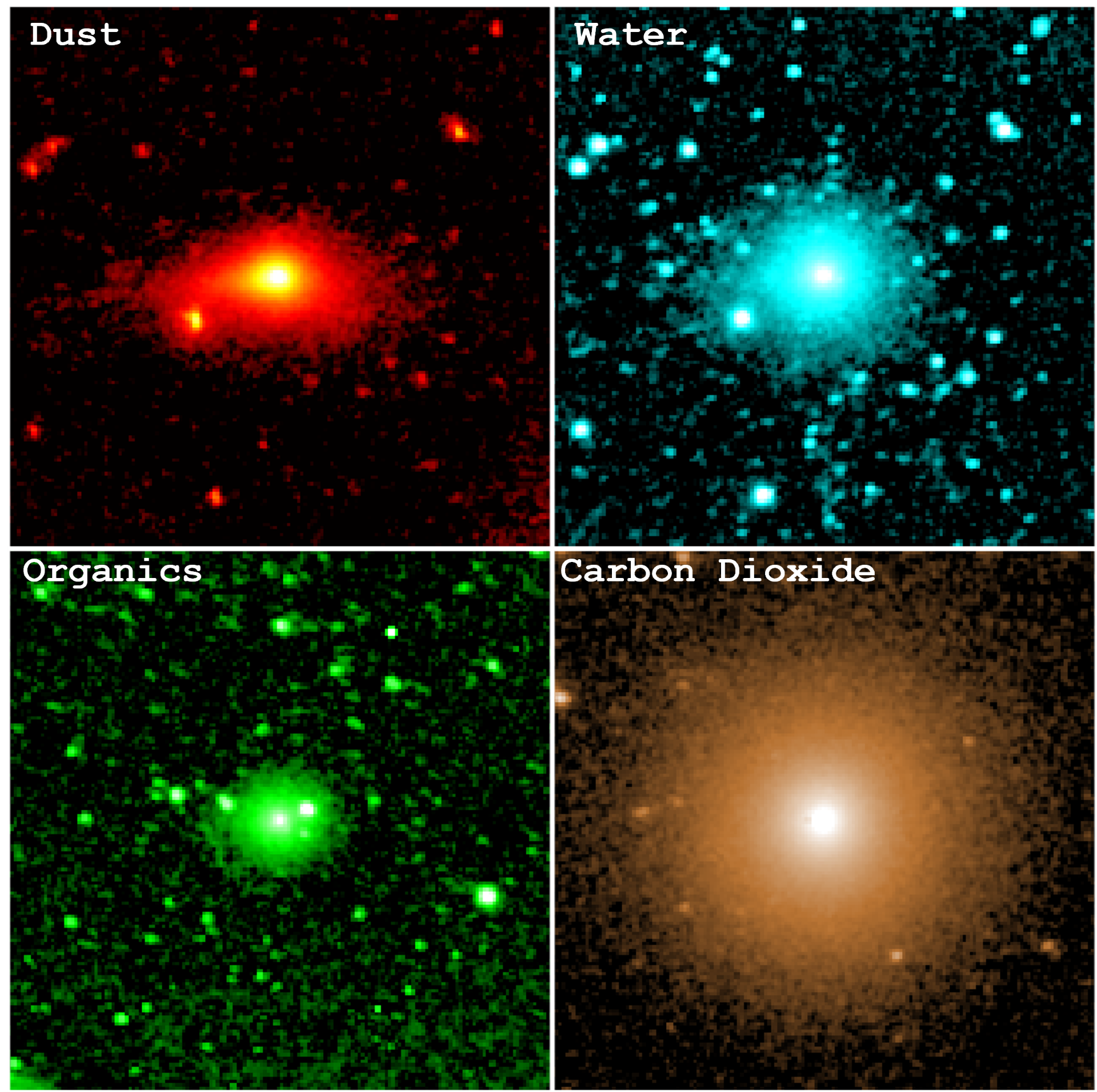
NASA's Spectro-Photometer for the History of the Universe, Epoch of Reionization and Ices Explorer (SPHEREx) was built for the ambitious purpose of performing an all-sky survey. The data it collects from more than 450 million galaxies and 100 million stars in the Milky Way over its two-year mission will help scientists explore the origins of the Universe and its evolution over time. But that doesn't mean scientists can't occasionally take a break from investigating the deepest cosmological mysteries to take a peek at an interstellar object (ISO), right?
That's precisely what the mission team did in December of last year as 3I/ATLAS, the third interstellar object detected in our Solar System, emerged from behind the Sun and began making its way toward the outer Solar System. The collage of images above illustrates what SPHEREx captured using its advanced triple-mirror telescope, which can observe the sky in 102 colors, each representing a different infrared (IR) wavelength. Ordinarily, this enables the probe to obtain unique information about galaxies, stars, planet-forming regions, and other cosmic features.
But on this occasion, they revealed the composition of 3I/ATLAS' coma, the bright gaseous envelop around a comet that forms as they approach the Sun. This causes water and other frozen volatiles to sublimate and also releases dust, metals, and other material from deeper inside the comet. The IR images are broken down by wavelength to highlight some of the key elements SPHEREx observed - including water vapor, carbon dioxide, dust, and organic molecules. This data will help scientists understand 3I/ATLAS's composition and how its ices react to the Sun's heating as it journeys through the Solar System.
Since 3I/ATLAS disappeared behind our Sun in late October, scientists were eagerly awaiting the moment it would be visible to our instruments again. Having completed its closest pass, they knew the ISO would be experiencing increased outgassing, revealing more about its composition and what is locked up inside. Observations made with SPHEREx and other missions while 3I/ATLAS is still visible to our instruments will help astronomers learn more about its system of origin. The data may also shed light on how complex organic molecules (COMs)
Further Reading: NASA