Universe Today
Deep space is far away. Really far away, and getting there quickly with conventional chemical rockets is like trying to cross an ocean in a rowing boat, technically possible but painfully slow and severely limited in what you can carry. NASA has just taken a major step toward changing that equation entirely.
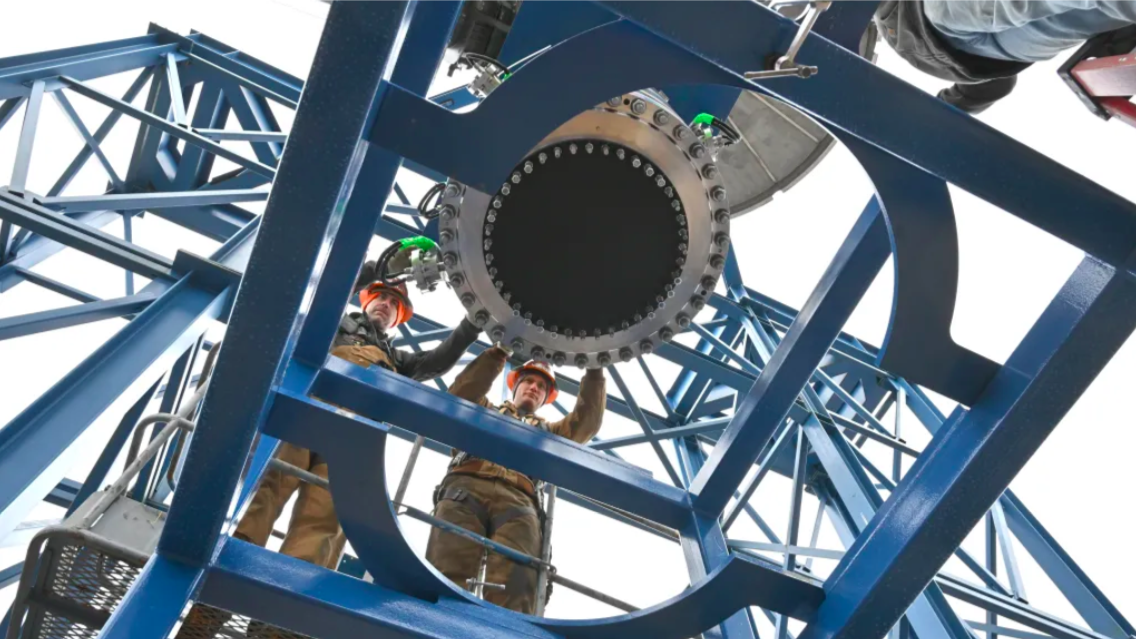
At Marshall Space Flight Center in Alabama, engineers have completed the first significant testing of flight scale nuclear reactor hardware since the 1960s. Over several months in 2025, they ran more than 100 tests on a barrel sized engineering development unit that simulates how liquid hydrogen propellant would flow through an actual nuclear reactor powering a spacecraft.
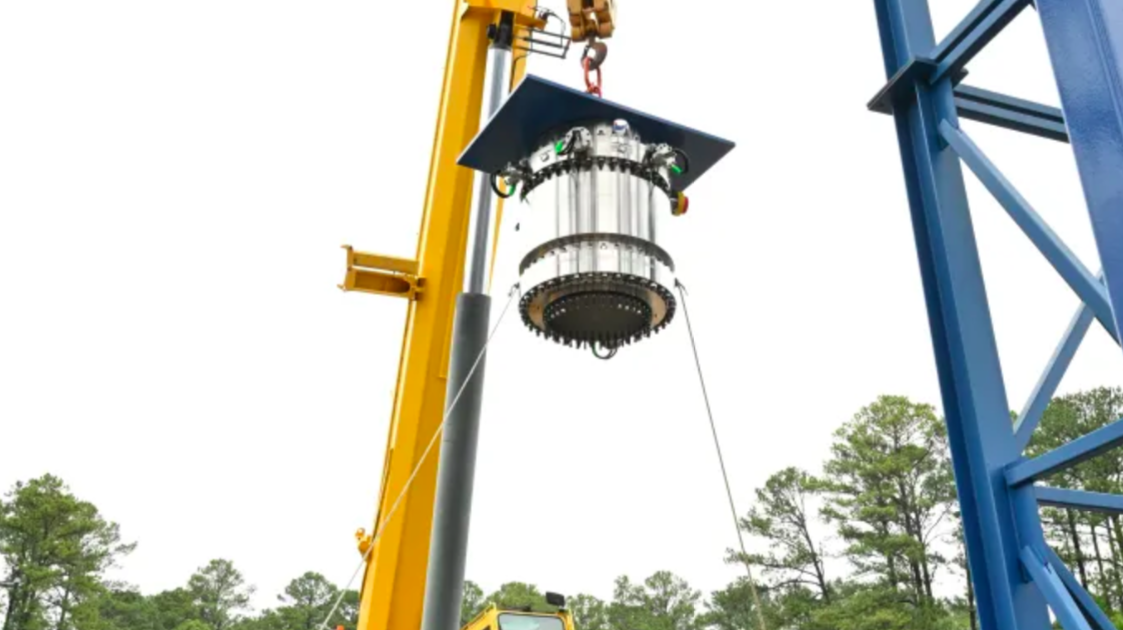 The flight ready reactor unit is lifted into position (Credit : NASA)
The tests weren't using radioactive materials, a process known as "cold-flow" testing so the study can focus purely on understanding how fluids behave as they pass through the reactor design. The 44 inch by 72 inch unit, built by BWX Technologies, represents a full scale, flight capable design that could one day propel spacecraft across the Solar System.
The team chose nuclear because chemical rockets work by burning fuel, which has fundamental limits on how fast you can go and how much mass you can push. Nuclear propulsion heats propellant using a reactor rather than combustion, achieving much higher exhaust velocities and dramatically better efficiency. In other words you can go faster, carry more scientific instruments, and have plenty of power for communication and experiments.
For a Mars mission, this could mean shaving months off the journey time. That's not just about impatience, shorter trips mean less exposure to cosmic radiation for astronauts, reduced life support requirements, and fresher crews arriving at their destination. For robotic missions to the outer Solar System, nuclear propulsion could enable entirely new categories of science that simply aren't feasible with current technology.
The Marshall tests allowed engineers to confirm that the reactor design won't experience destructive oscillations or vibrations from fluid flow. They gathered detailed performance data that will inform the design of flight control systems and perhaps most importantly, they validated computer models that predict how these systems will behave in space.
"We're doing more than proving a new technology, the test series generated extraordinarily detailed flow response data for a flight like space reactor design” - Jason Turpin from NASA's Space Nuclear Propulsion Office.
NASA isn't building this system for a specific mission yet, but rather developing the technology that will make future deep space exploration genuinely practical. Each milestone, like these cold flow tests, inches us closer to spacecraft that can venture farther and faster than ever before, expanding the boundaries of what's possible in Solar System exploration.
Source : NASA Testing Advances Space Nuclear Propulsion Capabilities