Universe Today
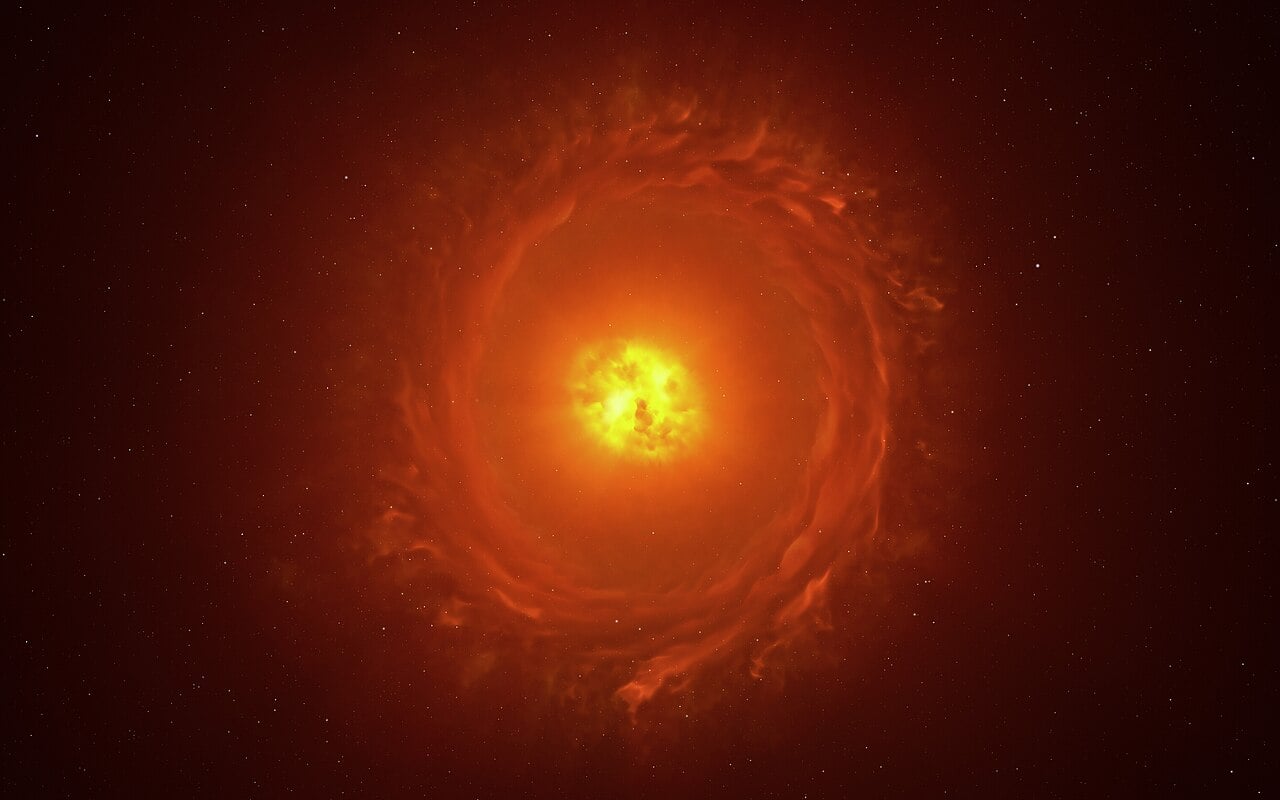
WOH G64 has never been an ordinary star. Located in the Large Magellanic Cloud, a satellite galaxy orbiting the Milky Way, this red supergiant holds multiple records as the most luminous, coolest, and dustiest of its kind in that galaxy. These stellar beasts live fast and die young, ending their brief lives in catastrophic supernova explosions that can briefly outshine entire galaxies.
But starting a few years ago, WOH G64 faded considerably with Its characteristic pulsations significantly weakened. Most intriguingly, its spectrum changed fundamentally, switching from the cool absorption features typical of red supergiants to emission from hot ionised gas. When astronomers discovered a newly formed dust cloud obscuring the star in 2024, many wondered if they were witnessing a rare evolutionary leap into the yellow hypergiant phase, a brief and unstable stage that can immediately precede a supernova.
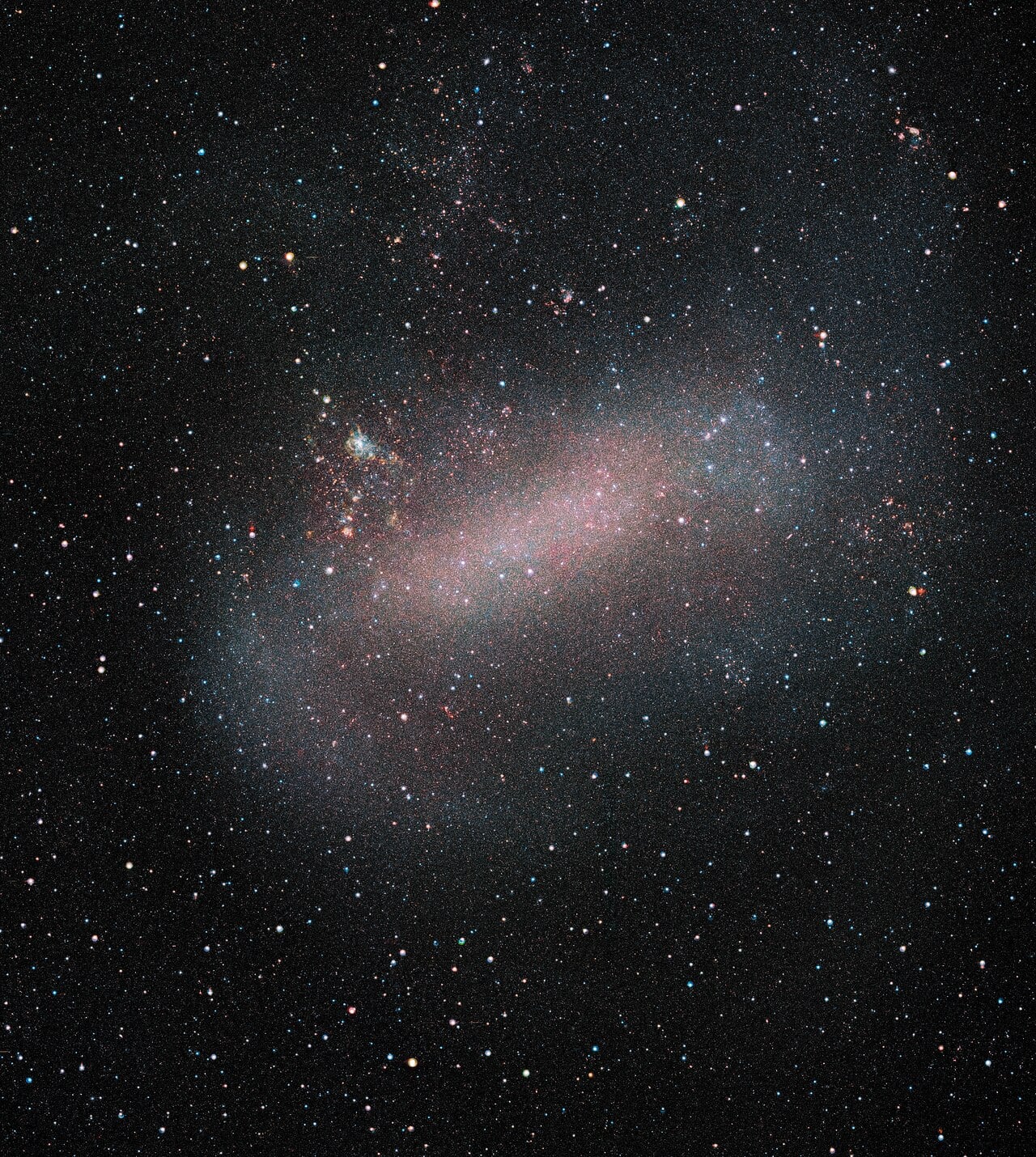 The Large Magellanic Cloud, home to WOH G64 (Credit : ESO/VMC Survey)
Yellow hypergiants are extraordinarily rare with only a handful known and they represent a fleeting transition stage lasting perhaps just a few thousand years. If WOH G64 had genuinely transformed into one, astronomers would have had a front-row seat to watch a star's final act before its explosive demise.
Dr Jacco van Loon from Keele University and his international team weren't convinced. Between November 2024 and December 2025, they used the Southern African Large Telescope to obtain detailed optical spectra of the fading system. What they found settled the question definitively.
Hidden within those spectra were absorption bands from titanium oxide molecules, proof that WOH G64 remains cool enough to be a red supergiant. These molecules simply cannot survive at the higher temperatures of a yellow hypergiant though. The star hadn't evolved, it has somehow acquired a companion.
The new scenario seems to explain everything. WOH G64 isn't alone but exists in a binary system with a smaller, hotter companion star. As this companion approaches during its orbit, it stretches the red supergiant's atmosphere outward, spreading stellar material across the system. Some of this material forms a disc around the hot companion, producing the ionised emission lines that puzzled astronomers. The newly formed dust cloud? Probably created by material shed from the disrupted atmosphere.
"We are essentially witnessing a 'phoenix' rising from the ashes. The red supergiant's atmosphere is being dramatically altered by binary interaction, but the star itself persists in its current evolutionary stage.” Dr Jacco van Loon from Keele University
The findings highlight how binary companions can create spectacular changes that mimic evolutionary transitions. WOH G64 will eventually explode as a supernova, but that drama remains for now a future event rather than an imminent one.
Source : Keele led team reveals massive star WOH G64 is still a red supergiant