 Universe Today
Scientists know that plate tectonics play an important role in maintaining Earth's habitability. Plate tectonics enable the carbon-silicate cycle that regulates the planet's temperature over geologic timescales. Tectonics also recycles important nutrients like phosphorous and sulphur that would otherwise remain locked in ocean sediments. It affects habitability in other ways, like by generating different types of environments that let life resist mass extinctions.
But whether plate tectonics is necessary for life is not clear.
Planets without plate tectonics—like Mercury, Venus, and Mars—are called 'stagnant lid' planets. Of those, Mars is easily the most well-studied. Multiple orbiters, rovers, and landers have studied the world for decades, and are still exploring it. One of these was the InSIGHT lander, where InSIGHT stands for Interior Exploration using Seismic Investigations, Geodesy and Heat Transport. The name makes it clear that unlike other missions, it was solely designed to study Mars' interior.
That mission ended in early 2022 when the solar panels became covered in dust. Before it ended, InSIGHT also had trouble deploying one of its instruments properly. But it still gathered important new data on the Martian interior.
Some of that data showed that there's an intracrustal discontinuity inside the planet's crust. New research shows that this discontinuity is a sign of magmatism on Mars, even though the planet is a stagnant lid planet.
The research is titled "Seismic evidence for a melt-depleted lower crust and transcrustal magmatism on Mars," and it's published in Nature Astronomy. The lead author is Dr. Tobermory Mackay-Champion who was from the Department of Earth Sciences at the University of Oxford at the time of the study.
"The crust of Mars preserves a record of early planetary evolution in the absence of plate tectonics, offering crucial insights into the development of terrestrial planets," the researchers write. "Seismic data from NASA’s InSight mission reveal a stratified crust with an intracrustal seismic discontinuity at ~24 km, overlying the crust–mantle boundary at ~38 km." They also write that so far, the nature of this discontinuity is unexplained.
Seismic study is based mostly on p-waves and s-waves, the two main types of seismic waves that travel through planets. P-waves are primary or pressure waves, and are the fastest. They expand in the same direction they travel. S-waves are secondary or shear waves, are slower, and are transverse waves. That means the particle motion is perpendicular to their travel direction. Critically, S-waves can't travel through liquids like magma, because liquids have no shear strength. Measuring s-waves is how scientists figured out that Earth has a liquid core. By measuring both types of waves, seismologists can understand the nature of a planetary interior.
While the discontinuity or layer has been recognized in previous research, its nature hasn't been clear. To determine if the boundary was between two different types of rock, the researchers compared the seismic data to hundreds of different types of rock.
The properties of the rock above the discontinuity match those of mafic rock, which contains higher levels of silica. The properties of the rock below the discontinuity more closely match ultramafic rock, which is lower in silica but higher in magnesium and iron. (Mafic comes from magnesium and ferric iron.)
"Mafic compositions retain a 64.0% probability for layer 3, compared with 36.0% for ultramafic compositions," the authors write. "Conversely, ultramafic compositions retain a 60.7% probability for layer 4, compared with 39.3% for mafic compositions. Consequently, our results indicate that the intracrustal layer 3–layer 4 interface at 24.5 ± 8.3 km marks a transition from mafic to ultramafic compositions."
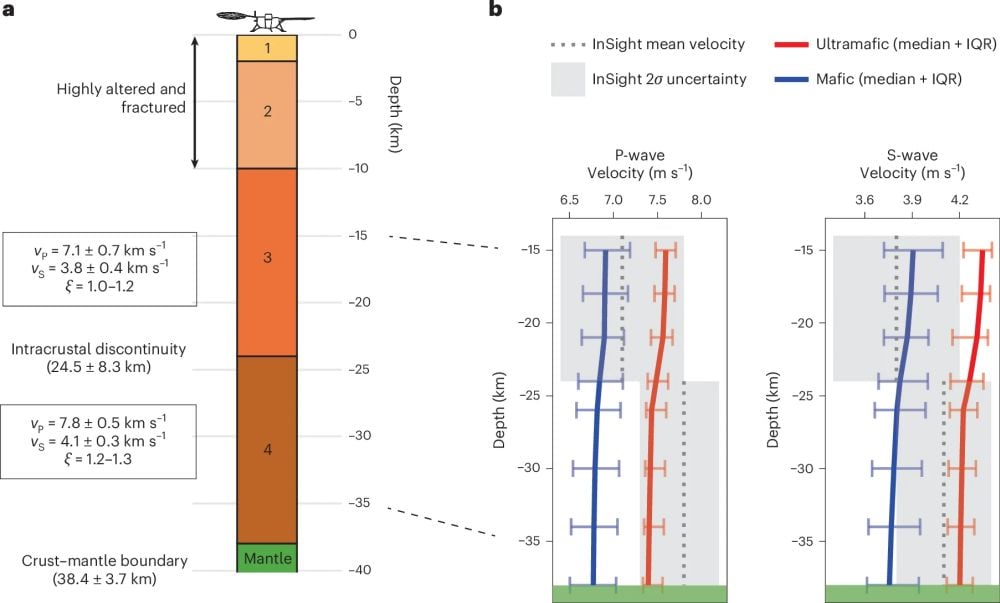 (a) shows the discontinuity and its context in the Martian crust. The discontinuity is at 24.5 km deep. (b) shows seismic profiles and forward-model comparisons for p-waves (left) and s-waves (right). The dashed grey lines show mean velocities, and the grey shaded regions show uncertainty envelopes. The red and blue lines show forward-modelled envelopes for ultramafic (red) and mafic (blue) rock compositions. Overall, the figures show that layer 3 in (a) above the discontinuity is consistent with ultramafic compositions, while layer 4 below the discontinuity is consistent with mafic compositions. Image Credit: Mackay-Champion et al. 2026. NatAstr.
"Together with prior evidence for evolved melts and upper-crustal differentiation, our results indicate that Mars once hosted vertically integrated transcrustal magmatic systems akin to those common on Earth," the authors write. "This demonstrates that these systems and their attendant geochemical differentiation can form without plate tectonics, offering a universal mechanism for building secondary and tertiary crust on hot rocky planets."
According to the authors, this buried layer probably formed when molten rock pooled underground. Over time, the rock gradually separated into the two types seen above and below the boundary. This is similar to processes under volcanic arcs on Earth and is related to the formation of continents.
This feature likely extends for hundreds of thousands of kilometers across Mars' northern hemisphere. If that's true, then the planet may have harboured a vast interconnected magma system instead of just isolated volcanoes. It's called transcrustal magmatism, and until now, it was thought to be only present on Earth.
“One of the big questions in planetary science is whether Earth is unique," said co-author Associate Professor Jon Wade, from the Department of Earth Sciences at the University of Oxford. "If Mars could develop this kind of complex crust without plate tectonics, then maybe the conditions needed for habitability can emerge on more planets than we realised, including those previously dismissed based on size or their apparent lack of tectonic activity."
The processes involved are closely linked to how Earth developed habitability with its atmosphere and oceans. Geological cycling like the carbon-silicate cycle and different nutrient cycles help the Earth maintain its climate and keep nutrients avalable for living things. But even if Mars has this magma system, it's very different from Earth's magma system and plate tectonics. Magma upwellings on Mars could bring nutrients to the surface, but it's a one way trip. On Earth, it's a cycle. The same is true of Earth's carbon-silicate cycle.
But Mars' magma system could still affect the planet's surface in another way: mineral availability.
"We've traditionally assumed that volcanism on Mars was relatively simple compared to that on Earth," said lead author Mackay-Champion. "But this discovery suggests the planet could sustain massive, long-lived magmatic systems capable of evolving and reprocessing molten rock throughout the crust. Because these systems are known to generate large metal deposits, Mars may hold significantly more near-surface mineral wealth than previously recognised - boosting its potential for future mining, crewed missions and eventually, permanent settlements."

