 Universe Today
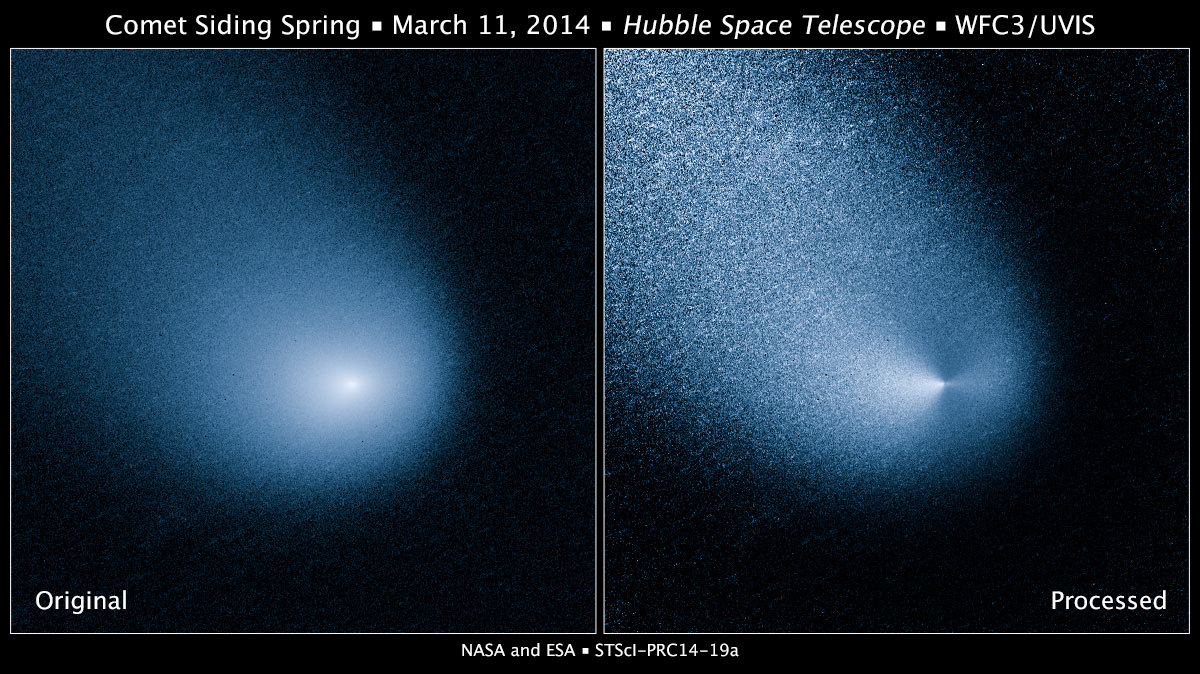
Comet Siding Spring, on its way to a close brush with Mars on October 19, has been kicking up a storm lately. New images from Hubble Space Telescope taken on March 11, when the comet was just this side of Jupiter, reveal multiple jets of gas and dust.
Discovered in January 2013 by Robert H. McNaught at Siding Spring Observatory in Australia, the comet is falling toward the sun along a roughly 1 million year orbit. It will gradually brighten through spring and summer until reaching binocular brightness this fall when it passes 130 million miles (209 million km) from Earth.
Astronomers were particularly interested in getting images when Earth crossed the comet's orbital plane, the path the comet takes as it orbits the sun. The positioning of the two bodies allowed Hubble to make crucial observations of how fast dust particles streamed off the nucleus.
"This is critical information that we need to determine whether, and to what degree, dust grains in the coma of the comet will impact Mars and spacecraft in the vicinity of Mars," said Jian-Yang Li of the Planetary Science Institute in Tucson, Arizona.
On October 19 this year, Comet Siding Spring will pass within 84,000 miles (135,000 km) of Mars or less than half the distance of our moon. There's a distinct possibility that orbiting Mars probes like NASA's Mars Reconnaissance Orbiter and the European Mars Express might be enveloped by the comet's coma (hazy atmosphere) and pelted by dust.
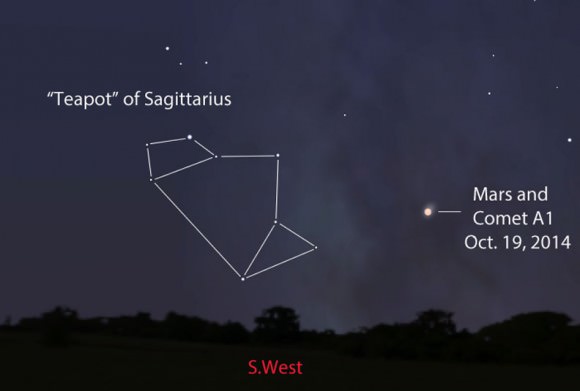
While comet dust particles are only 1 to 1/10,000 of a centimeter wide, they'll be moving at 124,000 mph (200,000 km/hr). At that speed even dust motes small can be destructive. Plans are being considered to alter the orbits of the spacecraft to evade the worst of the potential blast. On the bright side, the Red Planet may witness a spectacular meteor storm! Protected by the atmosphere, the Martian rovers aren't expected to be affected.
I know where I'll be on October 19 - in the front yard peering at Mars through my telescope. Even if the comet doesn't affect the planet, seeing the two overlap in conjunction will be a sight not to miss.
