Universe Today
Douglas Adams told us the answer to life, the universe and everything is 42. If only cosmology were so straightforward. Astronomers have been arguing for years about a number every bit as fundamental, and they still can't agree on it.
That number is the Hubble constant. It describes how fast the universe is expanding, and the frustrating truth is that when you measure it different ways, you get different answers. Measure it using the cosmic microwave background, the ancient afterglow of the Big Bang and you get around 67 kilometres per second per megaparsec. Measure it using nearby supernovae and you get closer to 73. Those two numbers shouldn't disagree. That they do has kept cosmologists awake at night for the better part of a decade.
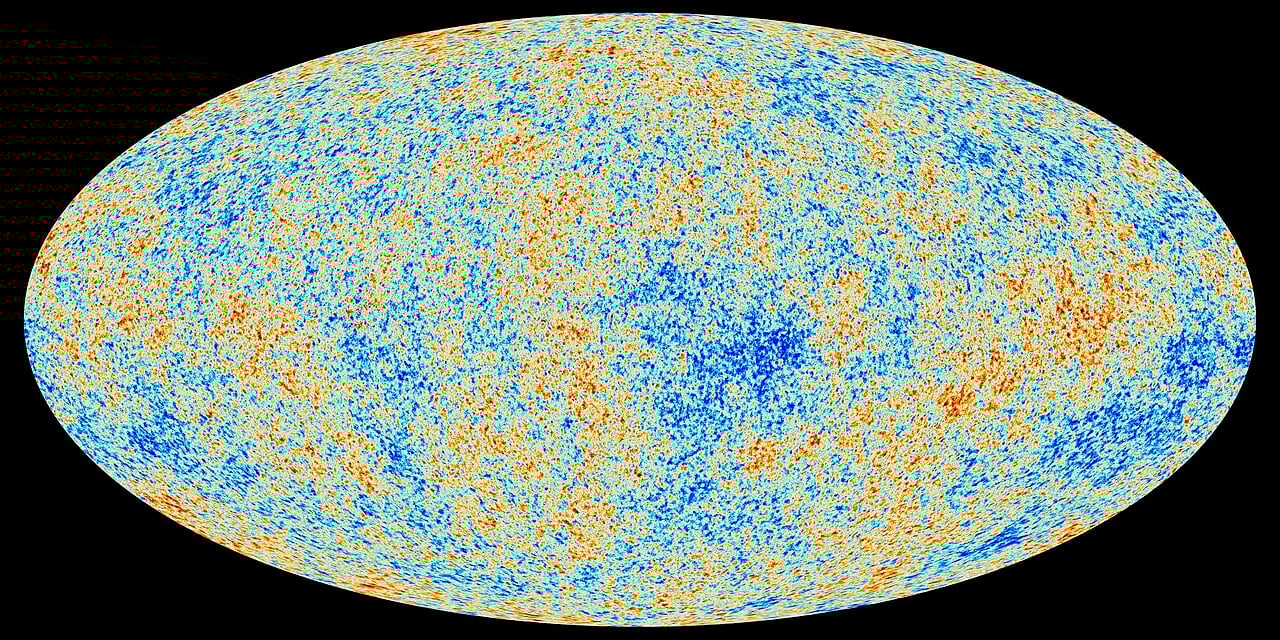 Studying the Cosmic microwave background (captured here by the Planck spacecraft) is one way to try and narrow down the value of Hubble's Constant (Credit : ESA and the Planck Collaboration)
Now a team of researchers has added a completely independent measurement to the debate and they've done it using some of the most extraordinary objects in the universe.
Gravitational waves are ripples in the fabric of spacetime, produced when massive objects like black holes collide. LIGO, Virgo and KAGRA, the global network of extraordinarily sensitive detectors have been listening for these astronomical tremors since 2015. What makes them special for cosmology is that gravitational waves carry information about the distance to their source encoded directly in the signal itself. They're what are known as "standard sirens,” like standard candles, but for ears rather than eyes.
This new study used a clever twist on that idea. Most gravitational wave events don't have a visible light counterpart to help pin down exactly which galaxy they came from. These so called "dark sirens" are harder to work with, but there are far more of them. By combining seventeen well localised gravitational wave events with deep galaxy surveys and machine learning to calculate distances statistically, the team arrived at a Hubble constant of 69.9 kilometres per second per megaparsec.
That value sits intriguingly between the two warring camps. Not quite 67, not quite 73 and with the uncertainties shrinking as more gravitational wave detections accumulate, the result is starting to carry real weight.
Here's where it gets deeper. What we call the Hubble "constant" is actually something of a misnomer, it’s really a snapshot of the expansion rate right now. In the early universe, gravity was winning and expansion was slowing down. Then, around five billion years ago, dark energy took over and flipped that into the accelerating expansion we see today. The expansion rate has a history, and it's complicated.
 Part of the KAGRA gravitational wave detector. The foreground shows the vacuum tube for one of the laser-interferometer arms (Credit : Christopher Berry)
This matters because the two main competing measurements aren't just producing different numbers they're probing different epochs. The cosmic microwave background method is essentially an early-universe measurement, extrapolated forward using our best model of cosmic evolution. The supernova method measures the local universe directly, today. If they disagree, it might not just mean one camp made an error. It could mean our model of how the universe evolved between then and now is fundamentally incomplete and that dark energy isn't as constant as we assumed, or that something unexpected happened in the early universe that we haven't accounted for. That's why an independent measurement like this one, using a completely different physical mechanism, is so valuable. It's not just another data point it's a new pair of eyes, or rather ears on the history of the cosmos.
Alas it won't settle the argument today. But every new detection, every additional ripple picked up by the detectors, tightens the constraints a little further. With the next observing run producing ever more events, astronomers are edging closer to an answer. Whether it turns out to be 42 or not remains to be seen and I for one, would simply love it if it was!
Source : Improved constraint on the Hubble constant from dark sirens with LIGO/Virgo/KAGRA O4a