Universe Today
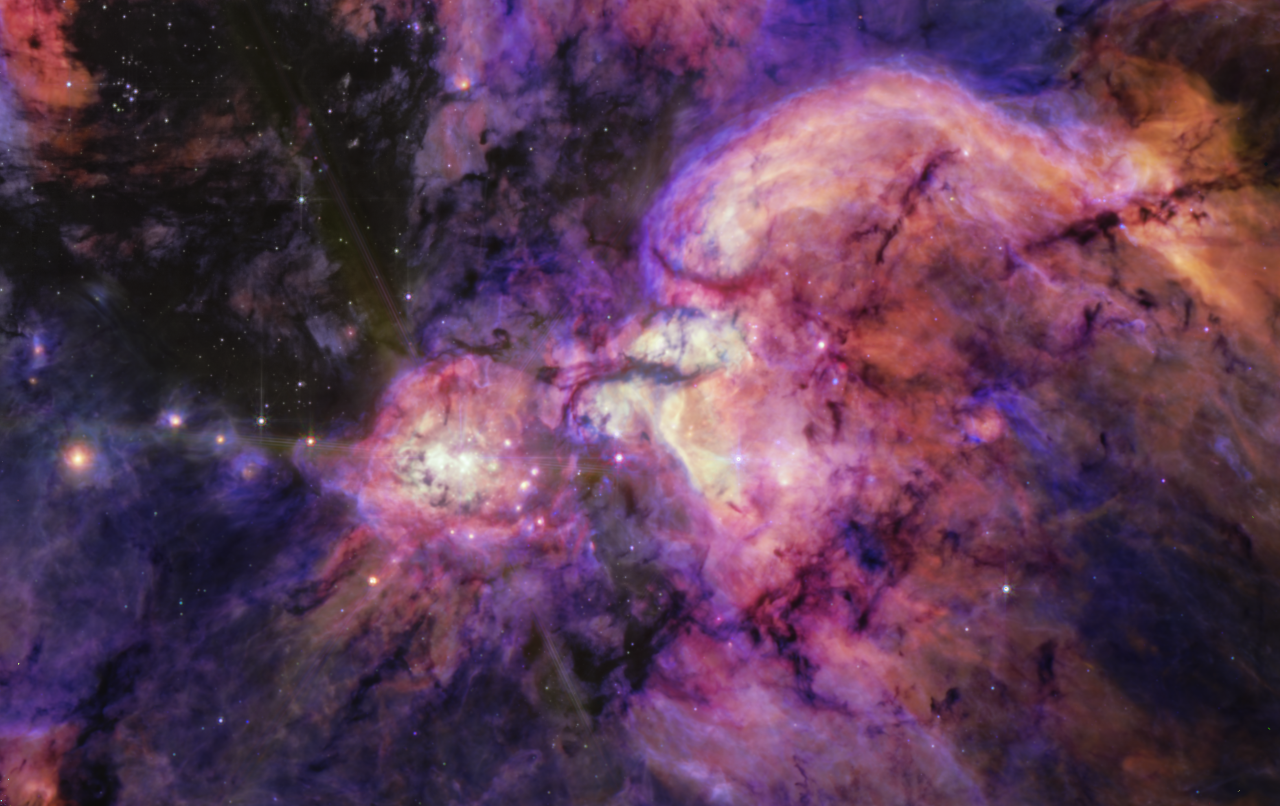
Star formation is a dramatic and complex process that erupts throughout the Universe. Yet, a lot of that action gets hidden by clouds of gas and dust. That's where observatories such as the James Webb Telescope JWST and the Atacama Large Millimeter Array (ALMA) come in handy. They use infrared light and radio waves respectively, to pierce the veil surrounding the process of starbirth.
A team led by University of Florida doctoral candidate Taehwa Yoo recently used to JWST to make observations of the giant Milky Way starbirth region Westerhout 51 (W51). It lies about 17,000 light-years away from Earth in the direction of the constellation Sagittarius. The images and data they collected revealed many fine details of the star-formation activity going on there. “With optical and ground-based infrared telescopes, we can’t see through the dust to see the young stars,” said Adam Ginsburg, Ph.D., a professor of astronomy at UF. “Now we can.”
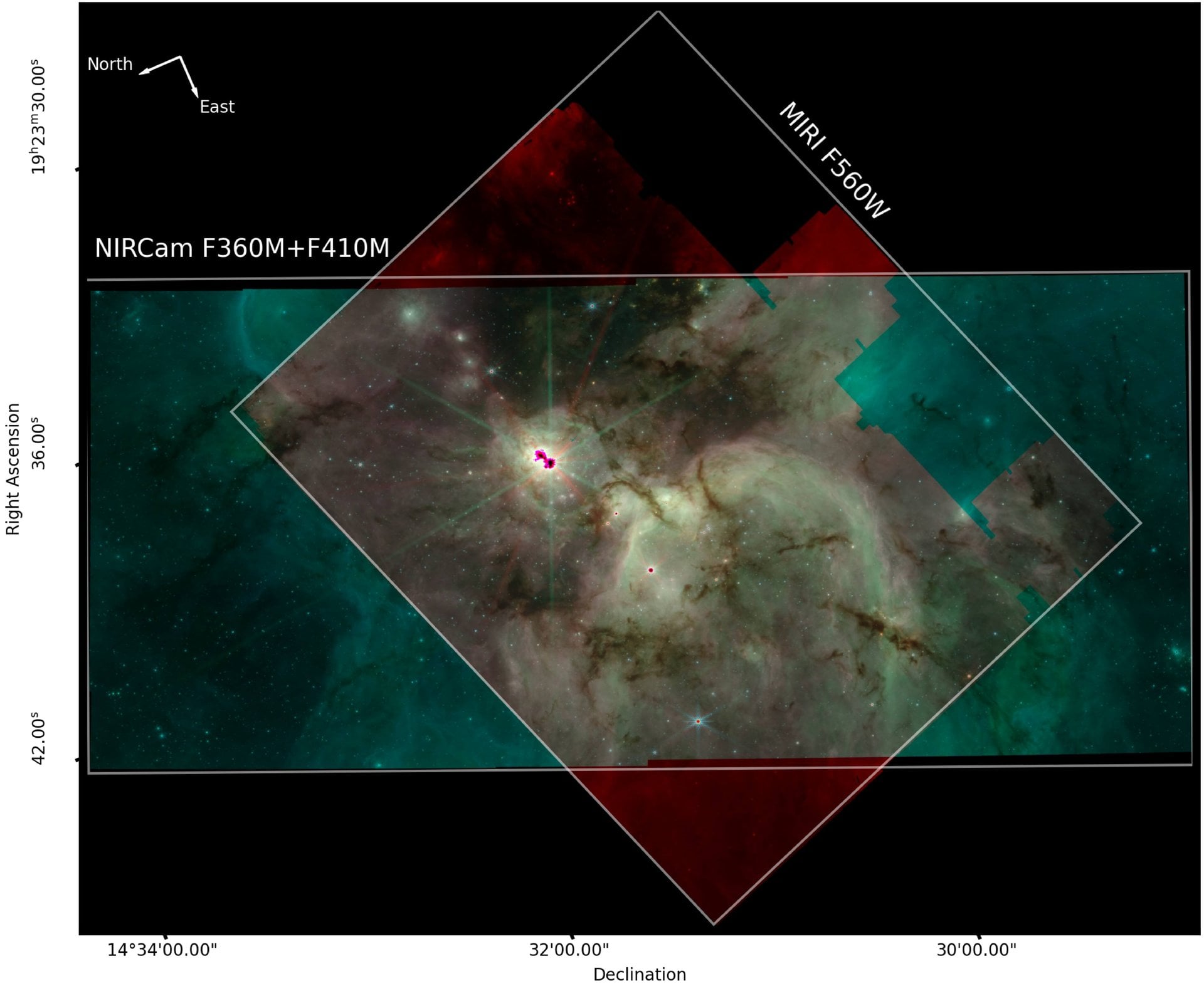 An overview of W51A region. The composite image is produced by combining NIRCam F360M (blue), F410M (green), and MIRI F560W (red) on JWST. The north and east directions in ICRS coordinates are marked as arrows at the upper left corner. Courtesy Yoo, et al.
Despite the impressive images and data, some aspects of star birth remain hidden away behind clouds too dense even for JWST to pierce. The team compared their JWST images to observations of the same region made by the ALMA, and found that only a fraction of stars are detectable by both telescopes. The observations that JWST did make, however, showed a lot of detail in the structures it could see. And that provides astronomers with new insights into the starbirth process. "Because of James Webb, we can see those hidden, young massive stars forming in this star-forming region," Yoo said. "By looking at them, we can study their formation mechanisms."
Digging Into W51's Starbirth Activity
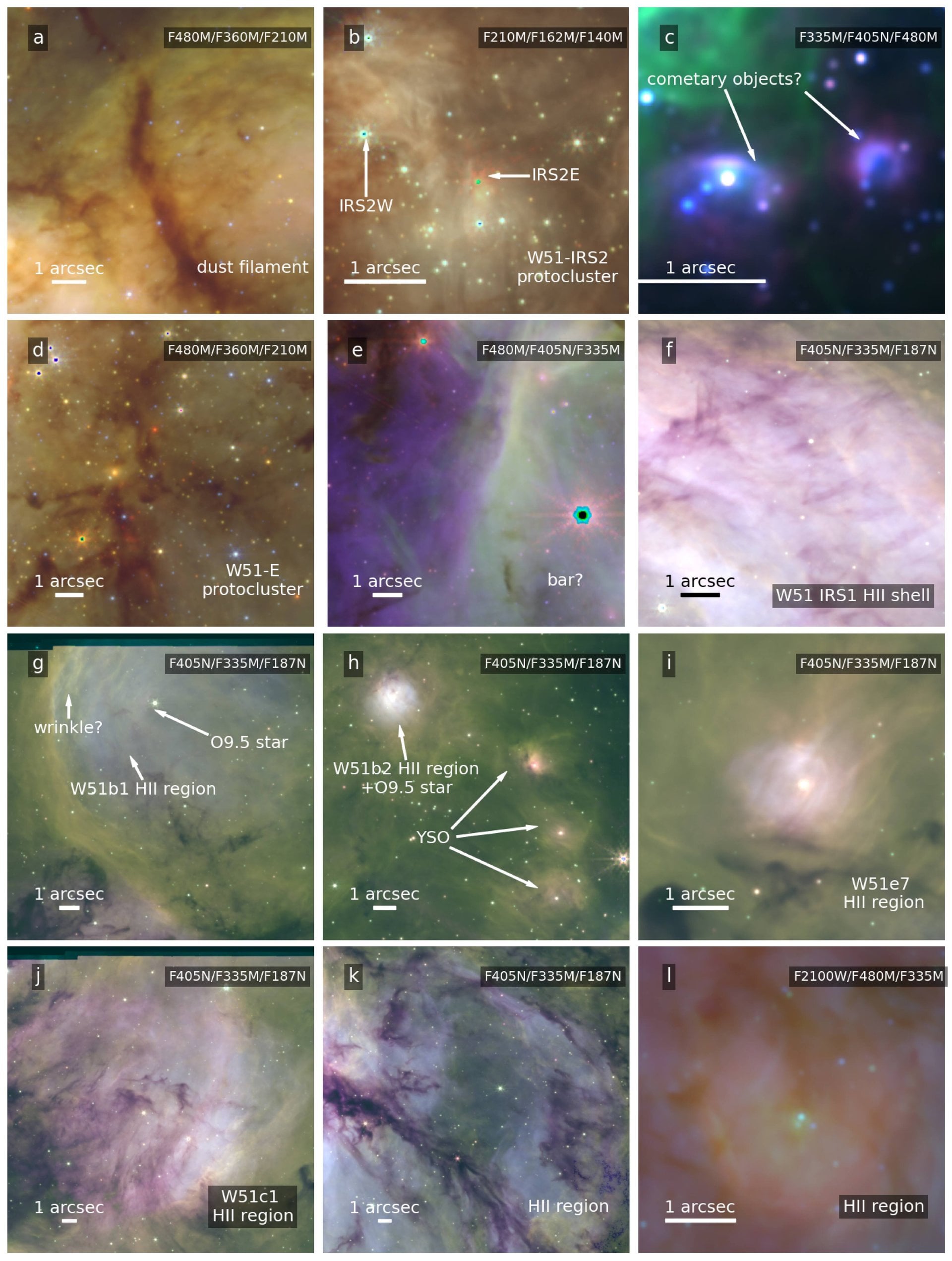 Cutout images of specific regions in W51. (a) A dust filament around W51-E. (b) W51-IRS2 protocluster. (c) Cometary objects around W51-IRS2 (these are globules of dust that look like comets, sculpted by radiation from nearby stars). (d) W51-E protocluster. (e) A bar at the edge of IRS1 H II region. (An HII region is a cloud of mostly hydrogen gas from which stars can form.) (f) W51 IRS1 H II region shell structure. (g) W51b1 H II region. (h) W51b2 H II region and YSOs. (i) W51e7 H II region. (j) W51c1 H II region. (k) and (l) Newly discovered H II regions. Courtesy Yoo, et al.
W51 is divided into several regions of enhanced star formation. As part of the observations, JWST zeroed in on the W51A region, the youngest starbirth crèche in the area. Multiple clouds of ionized gas and warm dust exist there, with some of the dust arranged in filaments. The science team also spotted a good example of a cavity around one of the newborn stars, which indicates that the star is "eating away" at its birthplace. They also studied giant gas bubbles of gas, dark dust filaments (which are likely still-hidden crèches), cometary objects, and protostellar jets streaming away from protostellar objects. Each of these are part of the starbirth process.
The team focused on the massive protoclusters called W51-E and W51-IRS2, using the Near Infrared Camera (NIRCAM) and the Mid-infrared Instrument (MIRI). Most of the stars they were able to observe are still accreting material and hadn't yet reached their full masses. Some have only formed in the past million years or so.
Yoo's group estimates there are about 10,000 solar masses of stars in W51A. Many are very young, massive stars, and not a lot is known about their earliest infancy, which is what fascinates astronomers today. In some areas, those remain hidden by too-thick clouds of gas and dust. Luckily, W51A has a lot to offer based on previous studies made by the Atacama Large Millimeter/submillimeter Array (ALMA). That radio array in Chile detected over 200 compact sources referred to as “PPOs (Pre/Protostellar Objects)” in the region. These are places where stars are actively forming or will start to form in the relatively near future. Astronomers want to know what kickstarts the process of star formation in regions like these, and what stages occur as massive young stars begin to form.
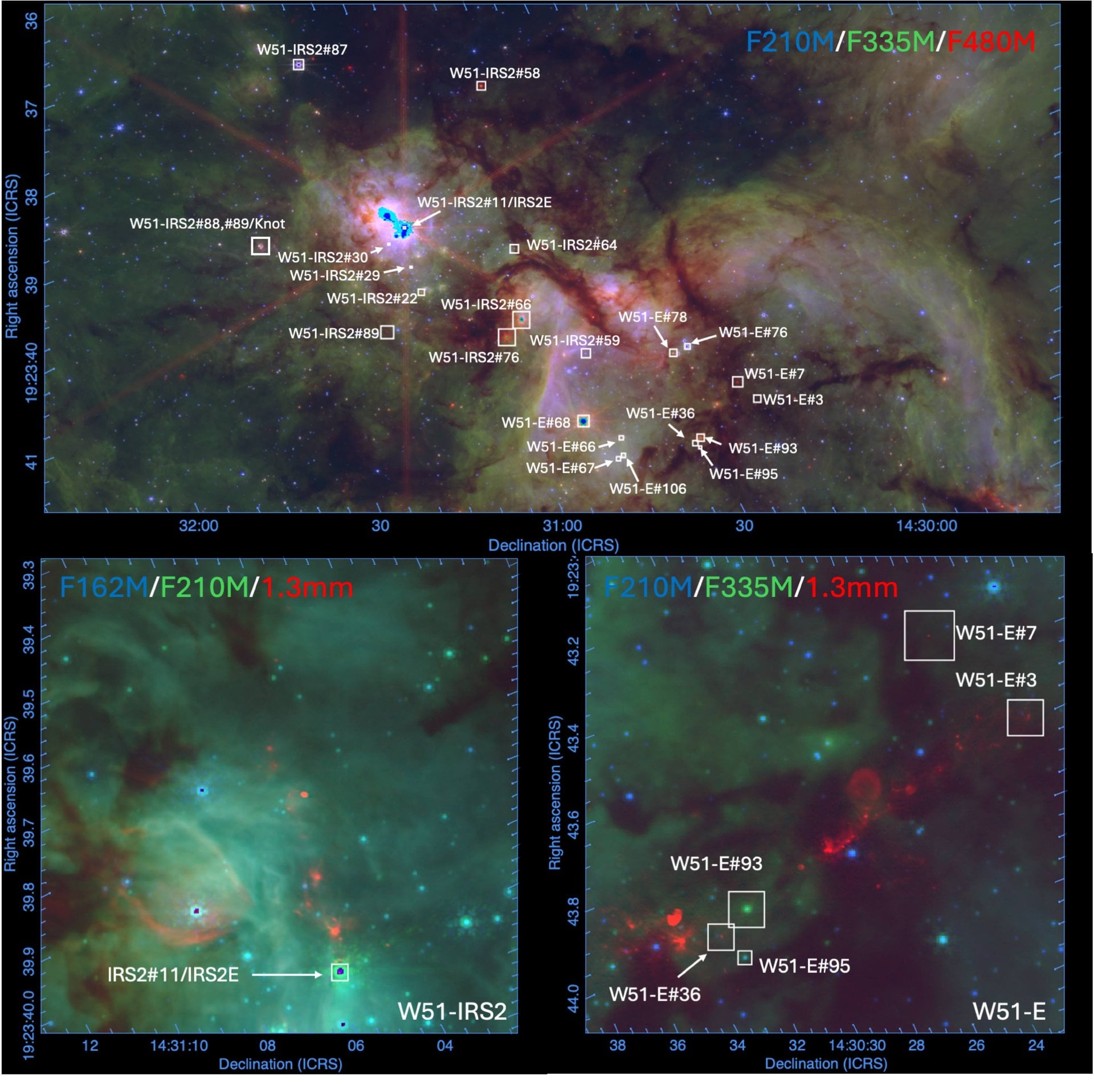 Combined observations from JWST and ALMA show the location of protocluster regions where multiple stars are forming. The locations of the matching sources are marked in the upper panel with the background image of F162M, F210M, and F480M filters on JWST. In the lower panels, W51-E and W51-IRS2 protocluster regions are zoomed in with the background image of the JWST NIRCam filters and ALMA 1.3 mm image combined. Courtesy Yoo, et al.
Starbirth Stages
In a general sense, astronomers know the overall process of starbirth: clouds of gas and dust condense and form hot cores called "young stellar objects." These are where the future star will be born. After a period of accretion, the star reaches a point where it begins fusing hydrogen to helium in its core. That's the point where the star is born. Before that, the star begins as that hot core, and also blows material away from itself via a superheated jet. High-mass stars born like this obviously affect their environment, especially in their birth crèches. They interact with neighboring clouds of gas, which affects the formation of sibling stars in the same region. The radiation from those high-mass stars can even go so far as to rip apart the clouds of gas. That chokes off the available material for new stars to form. From the JWST images and data, it's clear that each of those steps is in process in the W51A cloud.
In a recent paper in the Astrophysical Journal (noted below), Yoo and the team point out that several hot cores with rich chemistry associated with massive protostars exist in W51A. These are very likely sites of maser emissions from several varieties of molecules in the gas clouds crèches, including OH (hydroxide), CH3OH (methanol), SiO (silicon monoxide), NH3 (ammonia), and CS (carbon monosulfide). The presence of these masers acts as a tracer for dense molecular clouds where stars are expected to form (if they aren't doing so already).
In addition to the hot cores that indicate the very early stellar birth process, the team also observed at least one "knot" of emission from a protostellar object. It indicates ionized iron and hydrogen within the cloud. They think it's from a jet streaming from a hot young star that's heating up and affecting the nearby interstellar medium.
This latest look at W51 with JWST gives astronomers a much better idea of what different stages of starbirth look like, stages that are normally hidden from optical observations. The quality of the JWST data revealed more information and showed new structures in the area that astronomers can now use to more fully explain the process of starbirth. “They are not the first photos of this region, but they are the best,” said Ginsburg. “They’re so much better that they essentially are brand new photos. Every time we look at these images, we learn something new and unexpected."
For More Information
Researchers Use JWST to Reveal Hidden Details of W51 Star Formation
A JWST NIRCam/MIRI view of the W51A high-mass star-forming region