 Universe Today
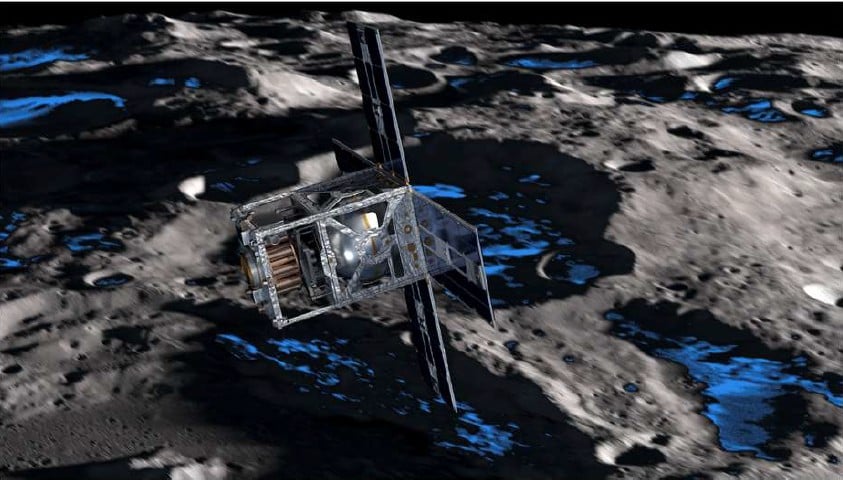
The water locked up in the Permanently Shadowed Regions (PSRs) of the Moon’s south pole is a critical resource if we are ever going to get a permanent lunar presence off the ground. But while we know the water ice there exists, we don’t really know how much. We have to move from general estimates to mineable-scale prospecting data. That is what Oasis-1, the newly proposed lunar prospecting mission from Blue Origin that was recently introduced at the 2026 Lunar and Planetary Science Conference (LPSC) is meant to do.
It’s designed as a two-SmallSat mission to be deployed from Blue Origin’s uncrewed MK1 lander. The twin spacecraft will enter a highly elliptical 10 x 50 km polar orbit, with its lowest point, known as the periapsis, skimming right over the lunar South Pole.
That proximity is necessary to collect as much detailed data as possible. Each satellite will use a suite of three instruments that are tailored for deep prospecting. First is a Hybrid Gamma-Ray and Neutron Spectrometer (GRNS). Its main purpose is to find water - neutron spectroscopy is currently the only remote sensing technique that can quantify water down to a depth of about one meter. This still isn’t much, but better than no quantifiable estimates at all. However, because neutron spectrometers aren’t optical instruments, they don’t have great resolution at high altitudes. Oasis-1’s low altitude flybys are an attempt to remove that constraint, achieving a resolution of around 15 km per pixel at the South Pole. Though that might sound great, it’s still nine times better than current global datasets.
Fraser shares his thoughts on Blue Origin from six years ago.The second instrument, a magnetometer, will map crustal magnetic anomalies at 15-30 km / pixel resolution. This instrument, which will be deployed at the end of a boom, aims to provide data that’s both of scientific value, but also a rough estimate of where valuable platinum group metals might be hiding.
Perhaps the most controversial resource available on the Moon is helium-3 - fabled for its potential use in fusion reactors that don’t yet exist. But that doesn't mean it's not worth a search, and Oasis-1 will also utilize an instrument called a multispectral pushbroom spectrometer, intended to sniff out the presence of this rare isotope at a pretty high resolution of less than 5 m / pixel.
These instruments will all take part during the active phase of the mission, which will happen over a 90-day global mapping phase followed by a 10-day controlled deorbit - essentially a slow-motion kamikaze dive into the lunar surface. During this final phase, the instruments will be working overtime to acquire ultra-low altitude to attempt to map out water deposits at hundreds of meters per pixel (rather than tens of thousands) right before impact.
Fraser talks about why the Moon’s south pole is so special.But perhaps the most interesting part of the mission is its business structure. Blue Origin is looking to license the maps detailing these materials to other commercial ventures, who need that de-risking data to improve hardware designs for lunar ISRU plants as well as increase investor confidence that their technologies might some day end up on the lunar surface. Any data that doesn’t have direct commercial relevance will also be released to the public via an agreement with the European Space Resource Innovation Centre (ESRIC). Oasis-1 itself is only the first of a three phase process. It represents the “Orbital Reconnaissance” phase of Blue Origin’s larger “Oasis Campaign”. Phase 2 will deploy mobility systems on the lunar surface to map areas in more detail, and Phase 3 will begin actual extraction operations. It dovetails nicely with Blue Origin’s ongoing ISRU resource project, known as Blue Alchemist, which focuses on manufacturing necessary components directly from lunar resources.
That tiered approach is exactly the kind of work that will be needed to push humanity out into the solar system. And it seems like Blue Origin, backed by one of the world’s richest people, just might have the resources to pull it off. Experts are expecting a launch of Oasis-1, the first step in the process, sometime in late 2027 or early 2028. Whether the dream of a former bookseller to colonize the stars really happens might just come down to whether the Blue Origin team can get a couple of satellites to work around the Moon or not.
Learn More:
J. D. Tarnas et al. - Oasis-1: Blue Origin’s First Commercial Lunar Prospecting Mission
UT - Blue Alchemist Is One Step Closer to Creating Sustainable Infrastructure on the Moon
UT - What's Next for Blue Origin After Today's Successful Flight?
UT - Lunar Outpost Shows off their New Rover that will Crawl the Moon, Searching for Resources

