Universe Today

Uranus is a planet that rolls around on its side as it orbits the Sun. That's because it's tipped over, with an axial tilt of 97.8 degrees. That weird tilt gave the James Webb Space Telescope (JWST) a chance to probe the ionosphere using the Near Infrared Spectrometer (NIRSpec) instrument. An international team of astronomers used the data to map the vertical structure of that region and detect faint auroral displays.
The team was led by PhD student Paola Tiranti of Northumbria University in England, and they mapped important characteristics of the upper ionosphere. That included the temperature and density of ions in that region, up to about 5,000 kilometers (3,108 miles) above the cloudtops of the planet. “This is the first time we’ve been able to see Uranus’s upper atmosphere in three dimensions,” said Tiranti. “With Webb’s sensitivity, we can trace how energy moves upward through the planet’s atmosphere and even see the influence of its lopsided magnetic field.”
What JWST Found
During the observations, JWST's instrument confirmed that Uranus's upper atmosphere continues to cool off. Scientists first noticed that cooling trend in infrared studies that began in the 1990s. That cooling activity seems to be affected by long-term changes in the solar wind and it's not clear if it will continue or change with solar activity. Currently, the temperature is around 426 Kelvin (150 Celsius), which is lower than previous studies.
The Uranian magnetosphere interacts with the solar wind in much the same way Earth's does when it gets hit with charged particles from the Sun: it forms aurorae. “Uranus’s magnetosphere is one of the strangest in the Solar System,” said Tiranti. “It’s tilted and offset from the planet’s rotation axis, which means its auroras sweep across the surface in complex ways. Webb has now shown us how deeply those effects reach into the atmosphere. By revealing Uranus’s vertical structure in such detail, Webb is helping us understand the energy balance of the ice giants. This is a crucial step towards characterising giant planets beyond our Solar System.”
The JWST observations were taken on January 19, 2025. The NIRSpec instrument focused on the ionosphere over the planet's magnetic poles and into the ionosphere for nearly a full Uranus day. The data reveal that the ionospheric temperatures peak in a region between 3,000-4,000 kilometers (1,864-2,485 miles) above the planet. The ion densities peak at about a thousand kilometers (621 miles). The aurorae formed in a tight set of bands near the magnetic poles.
Uranus's Odd Aspects
Uranus was discovered by William Herschel in 1781, and the orbital positions of its moons later tipped off astronomers that something was odd about this newly found planet. They moved in very high-inclination orbits that suggested the planet was tilted on its side. By the time the Voyager 2 spacecraft flew past Uranus in 1986, astronomers knew for sure that it was tilted. Voyager 2 gave them the first up-close and personal views of the planet and its moons and rings. Data about the magnetic field and the planet's rotation gave exact numbers to that tilt.
Scientists proposed several explanations for this odd tilt, and the most-accepted one is that it suffered through a huge collision early in the history of the solar system. It probably formed much closer to the Sun than it is now, and migrated out to its current position some 2.9 billion kilometers (1.8 billion miles) from the Sun. We also now know that it spins on its axis once very 17 hours, and it takes about 84 Earth years to make one orbit around the Sun. During that time, the poles will point nearly directly toward the Sun (and Earth), giving scientists a chance to study its polar regions.
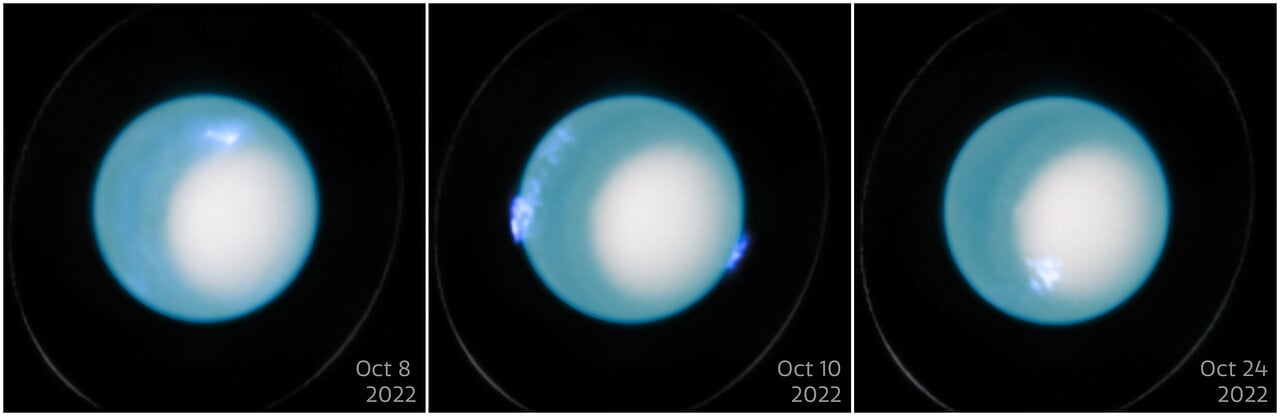 Hubble Space Telescope view of aurorae on Uranus. This view was captured in October 2022. Each panel shows dynamic auroral activity, as well as a glimpse of one of the Uranian rings. Credit: ESA/Hubble, NASA, L. Lamy, L. Sromovsky.
Will We Ever Get Back to Uranus?
Studies like this one, and a number of ground-based observations (as well as the Voyager 2 and Hubble Space Telescope observations) could clear the way for more in-depth explorations. Currently, there are no missions on their way to the planet, so planetary scientists are studying it with orbital and ground-based telescopes. At least one mission is on the conceptual drawing boards, however. It's called the Uranus Orbiter and Probe, a NASA mission concept slated for possible launch in the 2030s or beyond. It would go into orbit around Uranus and eventually launch an atmospheric probe to dig deeper into the atmosphere.
If this mission goes, it will answer a number of questions about Uranus, its makeup, magnetosphere, its past, and the formation and evolution of its many moons and ring system. Included will be a study of how the atmosphere circulates at various levels. That would also give scientists a better idea of the bulk composition of the planet, and the makeup of its core. Finally, it might help answer the questions about how the planet formed, where it first aggregated in the infant solar system, and what happened during the collision that laid Uranus on its side.
For More Information
Webb maps the mysterious upper atmosphere of Uranus https://esawebb.org/news/weic2602/
JWST Discovers the Vertical Structure of Uranus's Ionosphere https://agupubs.onlinelibrary.wiley.com/doi/10.1029/2025GL119304
Northumbria University PhD Student Maps Mysterious Upper Atmosphere of Uranus for the First Time https://downthetubes.net/northumbria-university-phd-student-maps-mysterious-upper-atmosphere-of-uranus-for-the-first-time/
Uranus Orbiter and Probe https://science.nasa.gov/wp-content/uploads/2023/10/uranus-orbiter-and-probe.pdf