 Universe Today

Open star clusters are some of the most dazzling objects in the sky. The small ones contain a few dozen stars, while the largest contain several thousand. The stars cluster together because they all formed from the same giant molecular cloud.
Astronomers don't know exactly how many open clusters (OC) there are. There are more than 5,000 confirmed clusters, and possibly as many as 100,000. They're difficult to see because so many are obscured by thick dust in the galactic plane.
OCs are identified visually, and also by their ages, metallicities, and movement. The Gaia mission, which catalogued 2 billion objects—mostly stars—added to our understanding of open clusters immensely.
Just like stars, open clusters can be in binary relationships with one another. New research in Astronomy and Astrophysics aimed to understand these binary clusters better, hoping to shed light on how many of them form, their gravitational interactions, and their physical properties. It's titled "Binary clusters in the Galactic I: systematic identification and classification using Gaia DR3," and the lead author is PhD candidate Guimei Liu from the Chinese Academy of Sciences.
"Binary clusters (BCs) provide valuable observational constraints on the formation, early evolution, and dynamical interactions of star clusters," the authors write. "Their spatial and kinematic associations offer unique insights into the hierarchical star formation process and tidal interactions within the Galactic disk."
The authors explain that BCs can offer unique insights into the star formation process and how they evolve in different environments in the Milky Way. "Their existence challenges the classical theory that star clusters form and evolve in isolation," they write. The existence of BCs suggests that star formation happens in a layered, hierarchical way, from small-scale relationships like binary pairs all the way up to galaxy-scale associations. Binary clusters are somewhere in the middle of that hierarchy.
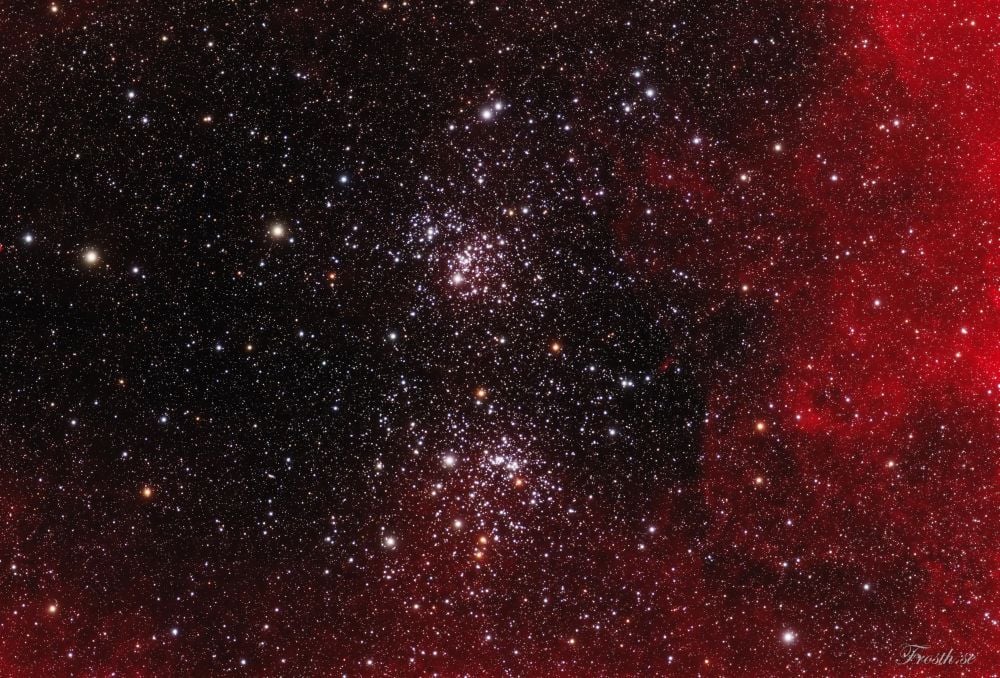 This NASA Astronomy Picture of the Day shows the Double Cluster, also called Caldwell 14, the most well-known binary cluster in the Milky Way. It contains NGC 869 and NGC 884. It's about 7,500 light years away in the Milky Way's Perseus Arm. Each of the clusters has more than 300 blue-white supergiant stars, and their output dominates this image. Image Credit: Mårten Frosth/NASA APOD
This research is based on the ESA's Gaia mission, and its third and final data release. The researchers began with almost 4,000 open clusters, high quality candidates from Gaia's astrometric and kinematic observations. After applying stringent selection criteria, the researchers identified 400 candidate binary star clusters. While some were previously known, they also found 268 new ones.
The authors point out that their existence raises important questions about their origins. "Several mechanisms have been proposed to explain the formation of interacting pairs, each leading to different observable properties," they write.
The researchers classified the BCs into three types based on observations and how they formed. One formation pathway is simultaneous formation, where the clusters form inside a star complex from the same giant molecular cloud (GMC). These are called primordial binary clusters (PBCs). Another type is tidal capture or resonant trapping binary clusters (TBCs), which form when two unrelated BCs become gravitationally bound to one another through chance encounters. The third type is different. They're called hyperbolic encounter pairs (HEPs), and they're BCs only in the visual sense. They happen to be passing by each other on hyperbolic trajectories but aren't bound together.
Out of the 400 binary clusters, 243 are PBCs, which is just over 68% of the total. "These PBCs have similar ages and motions, suggesting the member OCs formed together in the same GMC," the researchers write.
The next largest segment are the TBCs. "Another 146 pairs are TBCs, with similar motions but different ages, likely formed through a sequential mode," the authors explain.
Finally, there were only 11 HEPs in the sample of 400 BCs. "They are close in space, but have large velocity differences, indicating they were not born physically bound," the authors write.
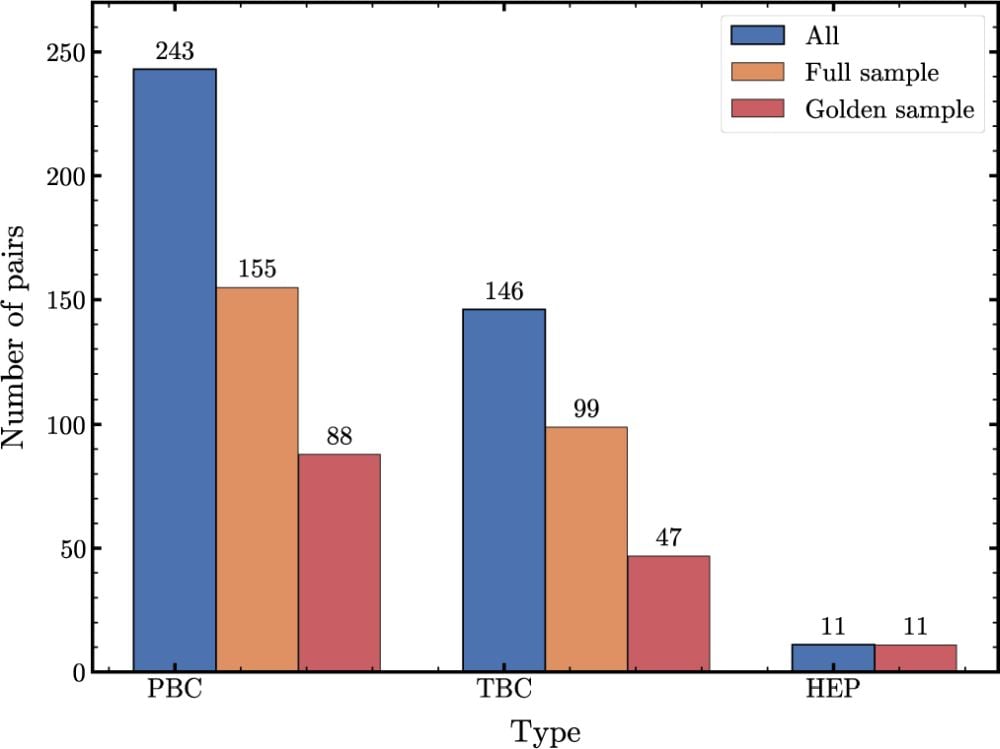 This figure shows some of the results. There are three sample categories in the work. The All categories includes all 400 BCs. The researchers divided the All sample into two other categories based on how robust the observations were for the different BCs. The Full sample includes BCs in which fewer than 10 stars in one of the clusters have good radial velocity data. The Golden Sample includes pairs in which both member star clusters have at least 10 stars with measured radial velocities. Image Credit: Liu et al. 2025. A&A. https://doi.org/10.1051/0004-6361/202556299
But there's even more detail in the classifications. 278 of the clusters are also in multi-cluster groups. "In addition, 278 star clusters are identified as members of 82 multi-cluster systems, including 27 newly reported OC groups," the authors explain. "These groups exemplify the hierarchical star formation scenario from small-scale BCs to larger-scale structures."
When they applied their sample results to the overall population of OCs in the Milky Way, they found that 16.80% of OCs are currently part of BC or group systems. They also found that almost 10% formed as PBCs. The authors say that these results agree with previous theoretical predictions and observational estimates.
The phrase "The biggest is within the smallest" is a coherent expression of our understanding of the cosmos, including how stars are born and organized. It indicates that the large things we see in the Universe are governed by the laws that govern the smallest things. The idea extends to stars. They form in gas clouds made of hydrogen atoms, and the stars themselves are like mere particles in larger structures like open clusters, galaxies, galaxy clusters, and superclusters.
Binary clusters are part of this hierarchy, and that helps drive home a point made 2,400 years ago by the Greek philosopher Anaxagoras: "There is no smallest among the small and no largest among the large, but always something still smaller and something still larger," he said.
Open clusters are part of the hierarchy of stellar groups, and this research shows that even within the population of OCs, there are yet other hierarchical groups.
"Our work provides a homogeneous and statistically robust catalog of BCs, offering a foundation dataset for future studies of hierarchical star formation, stellar feedback, and dynamical evolution within the Galactic disk," the authors conclude.

