Universe Today
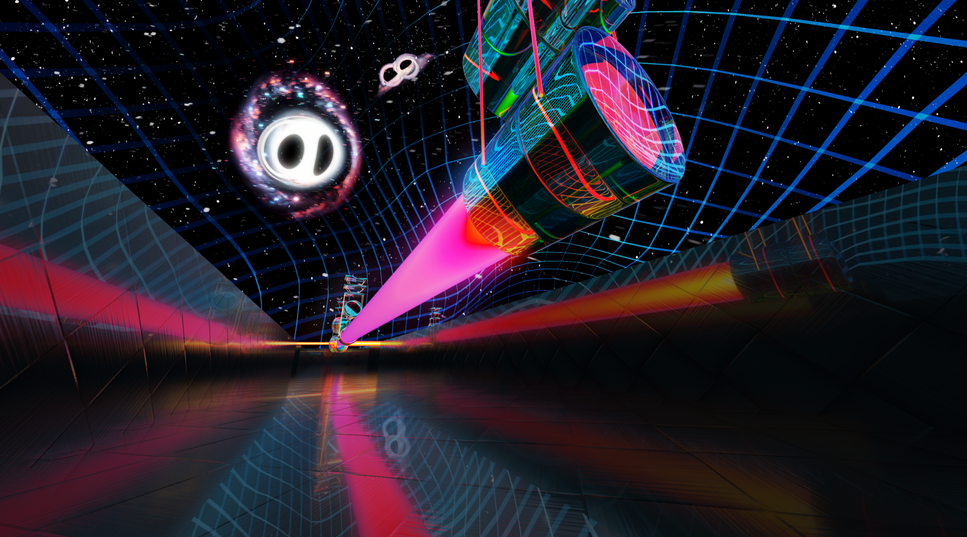
Ever since gravitational waves were first confirmed in 2017 by scientists at the Laser Interferometer Gravitational Wave Observatory (LIGO), over 390 gravitational wave events have been detected. This impressive feat, and the emergence of GW astronomy as a distinct field of study, is owed to the combined detection power of the LIGO, Virgo, and Kamioka Gravitational Wave Detector (KAGRA) detectors. However, the sensitivity of these detectors depends on many factors, and at any given moment, one of them may not be operating at full capacity.
At times like this, detector data must be processed to improve its quality. Researchers with the network have now developed a new and efficient tool for doing just that. It's called Astrophysical Calibration, and it acts upon GW events the same way autotune works in music production. In a recent study that appeared in the journal * Physical Review Letters*, the LIGO-Virgo-KAGRA (LVK) Collaboration demonstrated how this technique has been applied to two prominent and interesting signals.
Originally predicted by Einstein's Theory of General Relativity (GR), gravitational waves are ripples in spacetime caused by the merger of extremely massive objects (white dwarfs or black holes). The effect they have on a detector's arms is incredibly minute, however, measuring just 10-19 m, far smaller than the diameter of a proton. To successfully discern a signal from background noise, the detectors need to be carefully calibrated in real time using feedback control circuits and precise models of how the detectors change as the waves pass through them.
To boot, the process needs to account for the effects of the control circuits themselves and how they may influence the results. If the calibrations are not quite right, signal detection (and the interpretation of the event that caused it) will be compromised. However, if the signal is strong, comparing it with other detectors' reports (and with GR predictions) can allow the signal to be recalibrated retroactively. This is similar to how music production software like Auto-Tune can correct a singer's tone, pitch, and other audio qualities to match the intended sound.
Said Christopher Berry of the University of Glasgow’s Institute for Gravitational Research (IGR):
Gravitational waves are ripples in spacetime that stretch and squeeze space. They are tiny by the time that they reach the Earth, millions of years after the events that first created them. They are not something which we can hear, but our detectors can output the signals as waveforms that we can increase in pitch to listen to, with each signal producing its own distinctive chirp.
Those chirps encode a wealth of information we can analyze to learn about their sources—their masses, spins, distance, and location. Specifically in the case of the merger of two black holes, the astrophysical calibration technique works because the characteristic ‘chirp’ of the signal is described with extreme precision by Einstein’s theory of general relativity.
In their study, the LVK Collaboration applied the Astrophysical Calibration tool to two signals (GW240925 and GW250207) observed during their fourth observing run, detected in September 2024 and February 2025, respectively. At the time these signals were received, LIGO's Hanford detector was not properly calibrated, making it particularly difficult to interpret its data.
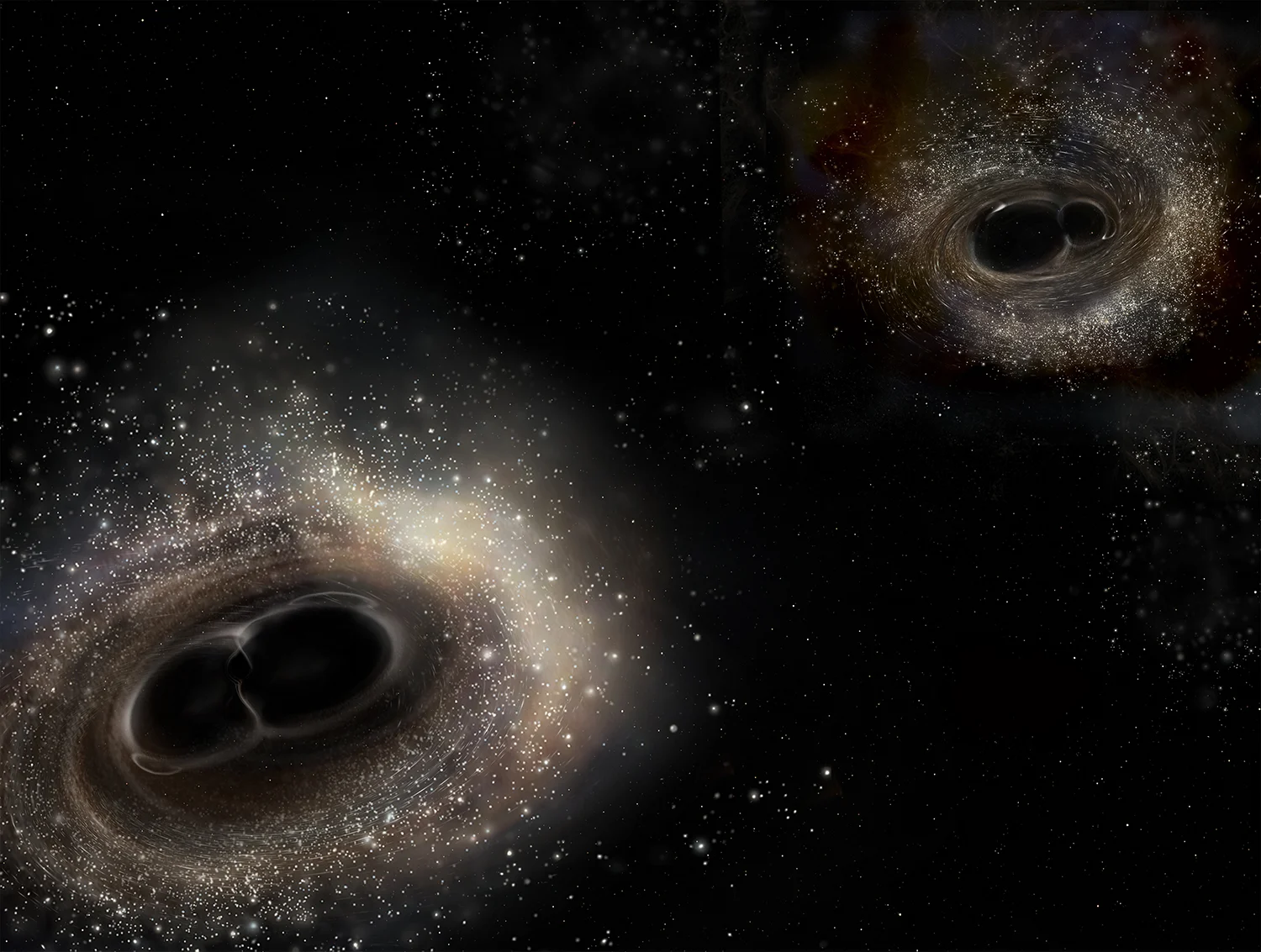 Artist's impression of merging black hole binaries. Credit: LIGO/A. Simonnet
“GW240925 happened just as we had mistakenly uploaded the wrong calibration information to our low-latency pipeline," said Alan Weinstein, Professor of Physics at Caltech. We discovered the mistake and fixed it within two hours, but the event gave us the opportunity to at last confirm the quantitative accuracy of our calibration using real astrophysical signals." By comparing the predicted signals with the observed signals and those recorded by the LIGO's Livingston detector and the Virgo detector, the researchers learned how the LIGO Hanford detector distorted its own data.
For GW250207, however, it was essential to use Astrophysical Calibration as no reliable on-site calibration measurements were available. Using corrected calibration Using the corrected calibration for the LIGO Hanford detector, LVK researchers have traced GW240925 to the merger of two black holes of 9 and 7 Solar masses, located approximately 1.142 billion light-years from Earth. Meanwhile, GW250207 was generated by two black holes of 35 and 30 Solar masses, about 652.3 million light-years distant. Said Sylvia Biscoveanu of Princeton University:
The fact that we were able to make this measurement now is remarkable — most previous works predicted it wouldn’t be possible with the current generation of detectors. These two events are among the best-localized binary black hole mergers we’ve ever detected, and such precise constraints on the sky location wouldn’t have been possible if we’d had to discard the miscalibrated data.
This demonstration offers a preview of how automated systems will assist astronomers in properly identifying GW events in the future. Combined with upgrades to the LVK network and the deployment of next-generation detectors like the Laser Interferometer Space Array (LISA), the field of gravitational wave astronomy is poised for
Further Reading: LIGO, Physical Review Letters