Universe Today
This is Part 4 of a series on topological defects. Read Parts 1, 2, and 3.
The WHAT? Yeah, the vortons. It’s not an anime monster-hunting show. It’s not some AI startup company. It’s a…it’s a thing. I think.
Listen, what I’m about to tell you is so hypothetical that it could make even a string theorist blush. We are deep in the annals of physics here. I don’t want you to trust ANY of what I’m about to say.
But that’s never stopped us before, so why stop now?
You see, cosmic string loops are supposed to be suicidal. They’re these high-tension whips of space-time that vibrate and oscillate so fast they SCREAM out gravitational waves until they fade away into nothingness. Usually, that’s the end of the story. The loop shrinks, it vanishes, and the universe is down one defect.
But that doesn’t HAVE to be the end of the story. I mean, cosmic strings are themselves super-hypothetical, so we have some options.
Imagine a cosmic string loop that isn’t just sitting there vibrating. It’s also spinning. Really, really fast. Why should they spin? Well why NOT, buddy? Who are you to say that they could never spin? And if they’re spinning, they have angular momentum (that’s kind of the definition). But as the loop emits energy, it gets smaller. But you can’t just get rid of angular momentum. Which means that as it gets smaller it spins even faster. And at a certain point, that internal spin is so strong that it starts pushing OUTWARD.
This makes a tension. The loop wants to shrink in to itself from its own tension. But the spinning wants to stretch it back out.
When those two forces find a perfect, locked-in equilibrium, the shrinking stops. The loop doesn't evaporate. It doesn't vanish. It settles into a permanent, indestructible, subatomic ring of pure field energy.
We call this a Vorton. It’s a little nugget of cosmic string-stuff, a defect, that stubbornly refuses to fade away into that long night.
Oh, and it might be the dark matter.
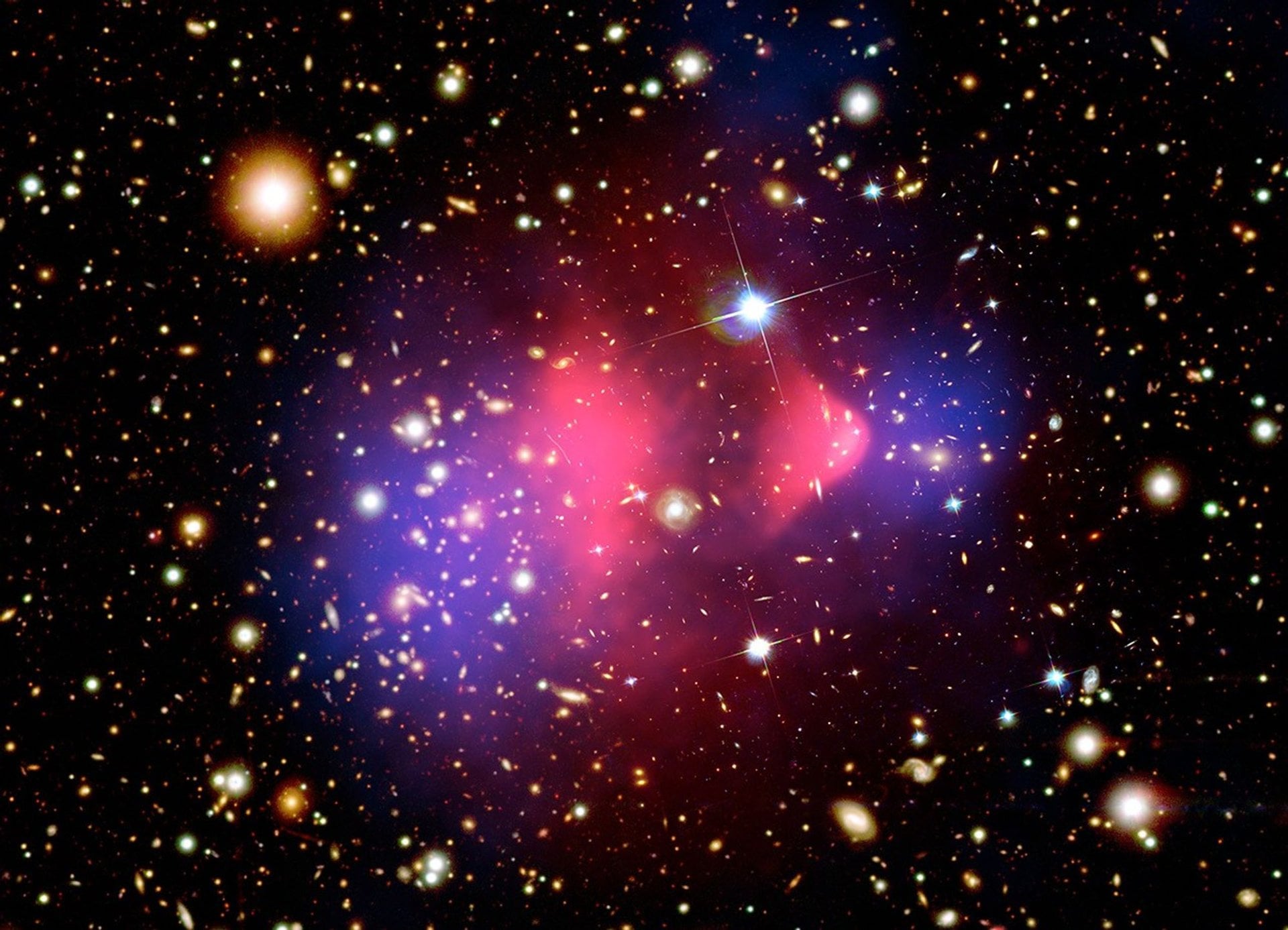
We don’t know what dark matter is, but we know what it does. It has to be a particle, or something like a particle. It has to be heavy. It has to be almost entirely invisible. And it has to have been around since the earliest moments of the big bang, so that it can participate in all that cosmic-web building that it’s so good at.
A vorton is…not a particle. But it’s small, roughly the size of a proton. It doesn’t glow or emit light – it’s a defect in spacetime, not a “thing” in the usual sense of the word “thing.” You could have a billion of them passing through you right and you’d never notice…except you would suddenly weigh more than a mountain. So I guess that counts as “noticing.” Because that’s the kicker. These things are dense. They are made of the trapped, high-energy vacuum of the early universe. And if the early universe was as messy as we think it was, then the Big Bang should have been a Vorton-producing factory. A vorton forge? I don’t know the right word – it just made a lot of vortons.
This is the story: phase transitions created lots of cosmic strings. Inflation stretched them out. Then they vibrated off each other and spawned an enormous number of loops, which shrank until they got locked in place as vortons. That would explain why we don’t see any cosmic strings anywhere. Those missing defects aren’t actually missing. They’ve just evolved into a mist of dark matter that fills every galaxy.
It means that Dark Matter might not be some extra ingredient that was added to the cosmic recipe. It might just be the residue leftover from the big bang. It’s the scuff marks on the floor from when the universe was being built. It’s the construction debris we forgot to sweep up. The universe is far from perfect. That’s part of why we exist. But do the imperfections stop with us – with the dust and stars – or do they extend down to a much deeper, more fundamental level – a level so deep that it’s frozen into the very fabric of spacetime? We don’t know if vortons exist, if they’re responsible for the dark matter, or if they even CAN exist. But that doesn’t matter. the truth is, we owe our very existence to the fact that the universe is a bit of a mess. If the Big Bang had been perfect, there would be no flaws to seed the growth of galaxies. There would be no knots in the field to provide the dark mass.
I don’t know about you, but I say it’s our flaws that make us the most beautiful.