 Universe Today
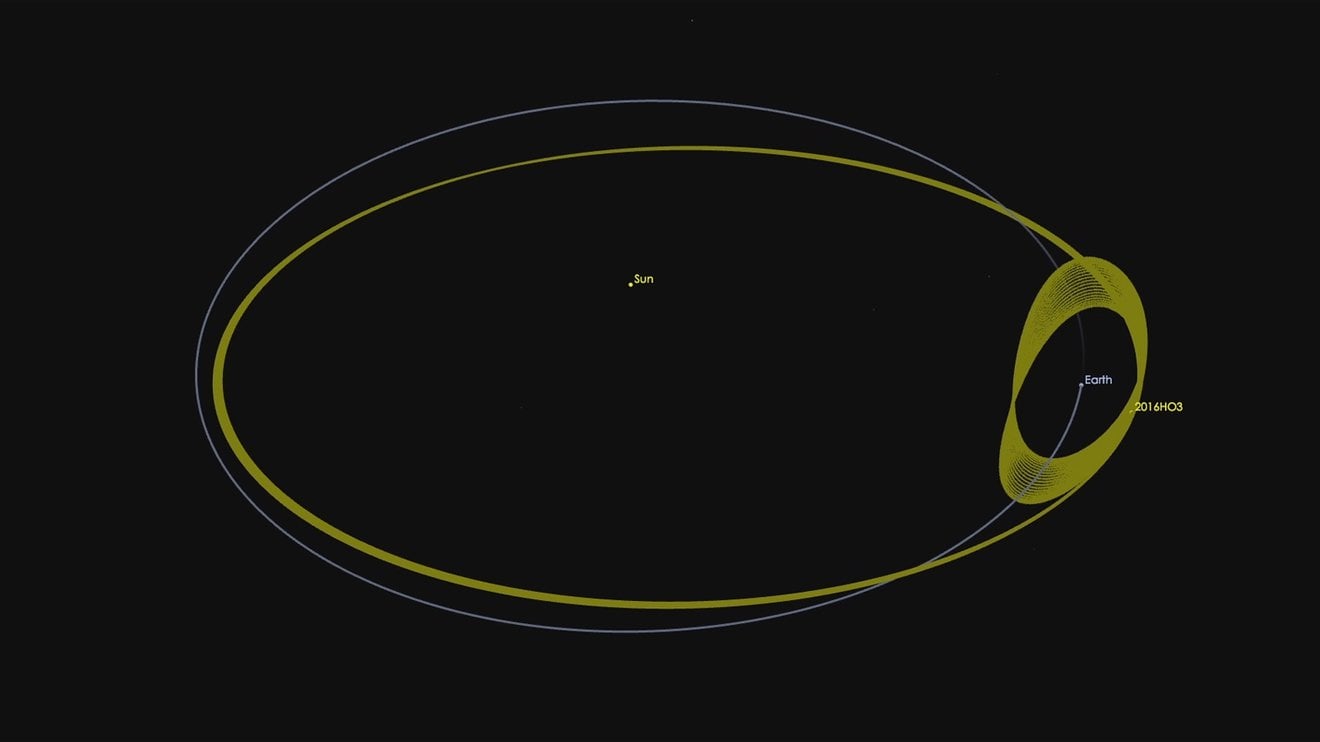
Earth has a group of cosmic stalkers. Known as “co-orbitals”, these small bits of rock have a 1:1 mean motion resonance with Earth. Basically, they take the exact same amount of time to orbit the Sun as we do. Astronomers have long believed these objects wandered in from the main asteroid belt between Mars and Jupiter, but recent spectral analysis suggests they better match the space-weathered lunar silicates that make up the Moon’s surface. As such, there has been an ongoing debate about whether these cosmic stalkers are actually visitors from the belt or blasted pieces of the Moon. A new study, published in Icarus, from researchers Elisa Alessi and Robert Jedicke provides strong hints that the belt is the more likely source - but pretty soon we’ll get a definitive answer from a spacecraft.
One of the most notable co-orbitals is (469219) Kamo’oalewa. This space rock, which is somewhere between 24 and 107 meters in diameter, is arguably the most famous co-orbital whose spectra closely resembles that of the Moon. This led some researchers to posit that it was created during the impact that created the Giordano Bruno crater - a 22-kilometer wide feature that happened sometime between 1 and 10 million years ago.
But launching a 50-meter rock into a quasi-satellite orbit requires an absolutely massive amount of energy. According to the model in the most recent paper, the likelihood that such an event should happen is only about once in 20 billion years - almost double the current life of the universe. Based on those orbital dynamics, they put a likelihood of around 21% that it is of lunar origin.
Fraser discusses the discovery of one of our most recently discovered “mini-Moons”.To prove that theory, the researchers fired up their supercomputers and simulated the trajectory of 12,000 synthetic particles launched from the lunar surface at varying speeds and angles, tracking their orbits for millions of years, to see how many stabilized into co-orbital spots, which could include several dynamic types of orbits, such as quasi-satellites, horseshoes, or “tadpole” orbits. The answer - not many. They calculated roughly 70 objects with a size larger than 10 meters that would end up in that steady state population.
The rest likely came from the asteroid belt, and when the researchers used a model called NEOMOD3 to simulate the drift of objects between the main belt and near-Earth space, they found that, under similar conditions, the main belt would supply around 1,600 co-orbitals. By that logic, the likelihood that any given co-orbital larger than 10m is lunar-derived is a relatively tiny 4.3%.
However, there are only 57 known current co-orbitals in that size range, so the sample size is likely too small to get a sense of whether those statistics are right. But, that doesn't mean we can’t find out about the most well known of them. Currently, the Tianwen-2, launched in May 2025, is making its final approach to Kamo’oalewa. There, it plans to grab 1kg of surface samples from the asteroid and return it to Earth for more detailed testing.
Discussion about where Kamo’oalewa came from. Credit - b/60 YouTube ChannelEither potential answer is exciting for science. If the sample shows that it's just a main belt asteroid redirected to a co-orbital path with the Earth, scientists will need to find a way to explain its strange spectral signature. But if that sample unequivocally shows that the surface of Kamo’oalewa is made of lunar silicates, then scientists will be forced to drastically rethink their understanding of lunar impact mechanics, crater-scaling laws, and a host of other characteristics of the Moon.
Science is driven by data, and in-situ data collected from an asteroid is some of the best we can hope for to solve this debate. Asteroid watchers everywhere will be tracking the Tianwen-2 mission progress with anticipation, and a hope that it will help resolve this long-standing debate.
Learn More:
E.M. Alessi & R. Jedicke - The steady-state population of Earth ’s co-orbitals of lunar provenance
UT - Is This Nearby Asteroid a Chunk of the Moon?

