 Universe Today
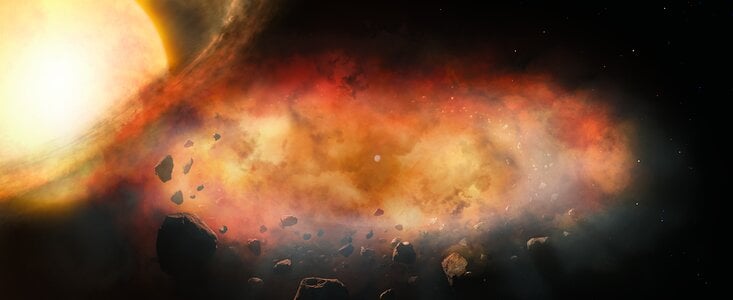
Stars change in brightness for all kinds of reasons, but all of them are interesting to astronomers at some level. So imagine their excitement when a star known as J0705+0612 (or, perhaps more politically incorrectly, ASASSN-24fw) dropped to around 2.5% of its original brightness for 8.5 months. Two new papers - one from Nadia Zakamska and her team at the Gemini Telescope South and one from Raquel Forés-Toribio at Ohio State and her co-authors - examine this star and have come to the same conclusion - it’s likely being caused by a circumsecondary disk.
Circumsecondary disks happen when a disk of gas and dust forms around a second object in a binary system, which then occults the first, dramatically dropping its brightness over a period of time. In the case of J0705+0612, that happened most recently between September 2024 and May 2025, lasting 254 days in total.
It also wasn’t the first time this was observed, but it was, seemingly, the first time that someone actually noticed. Digging back in star brightness logs at the Digital Access to a Sky Century at Harvard (DASCH) catalogues turned up two other instances of this dimming phenomenon in 1937 and again in 1981, putting them about 44 years apart, and perhaps more importantly, giving an orbital period for when the star passes behind this disk. With this data they were also able to calculate that the secondary object the occulting disk orbits is around 14 AU away from J0705+0612.
Anton Petrov discusses the star’s disappearance - and unfortunately concludes its not a Dyson sphere. Credit - Anton Petrov YouTube ChannelThe disk itself is calculated as around 0.7 AU in size. To hold onto a disk of that size, the secondary object must have a mass between a few times that of Jupiter up to that of a low-mass star. However, it's so dim that researchers are unable to find it, though that doesn’t rule it out as a star itself.
No matter what type of object it is, it appears to be relatively old. J0705+0612 itself is also relatively old - around 2 billion years - much older than expected to have a massive, gas-rich disk around it, even if it is technically orbiting another object in the system. Those types of disks typically only last for a few million years at most. Which led the researchers to believe it formed in a very interesting way - through a recent massive planetary collision.
Part of that belief comes from the spectral signature of the disk itself. It appears to be made of both “metal” (which in astronomy means any element heavier than helium) and gas. Typically debris disks are very gas-poor, so this system appears to provide a unique laboratory environment for testing the dynamics of massive collisions in mature solar systems.
Aerial view of the Gemini South telescope that did the observations for one of the papers. Credit - NOIRLabAstro YouTube ChannelThere is some confusion on that part as well. While J0705+0612, which is located about 1000 parsecs away from the Sun, does have some of the characteristics of an older star, such as a lack of lithium absorption and an “isochrone” - a snapshot of a star’s color and magnitude at a given time - that shows that it is around 2 billion years old. However, it also has some features of a much younger star, such as strong infrared excess light emission and a very strong H-alpha line emission.
There are some differences in the data between the two papers as well. The OSU team notes a strong polarization during the occultation, and the Gemini paper notes a blue shift in the gas spectra. Combining those two insights implies that there’s a magnetized wind flowing away from the circumsecondary disk, which would be a first-of-its-kind discovery.
More data is needed, though, both in order to confirm the age of the star, and determine whether some of the features of the system, such as the magnetized wind, are real. Given that the next occultation won’t happen until around the middle of 2068, it might be a while before astronomers can get the level of data needed to prove their theories. At the very least, there will hopefully be better telescopes at the ready when J0705+0612 goes into its next dimming phase.
Learn More:
NOIRLab - Massive Cloud With Metallic Winds Discovered Orbiting Mystery Object
N. L. Zakamska et al. - ASASSN-24fw: Candidate Gas-rich Circumsecondary Disk Occultation of a Main-sequence Star
R. Forés-Toribio et al. - ASASSN-24fw: An 8-month long, 4.1 mag, optically achromatic and polarized dimming event

