 Universe Today
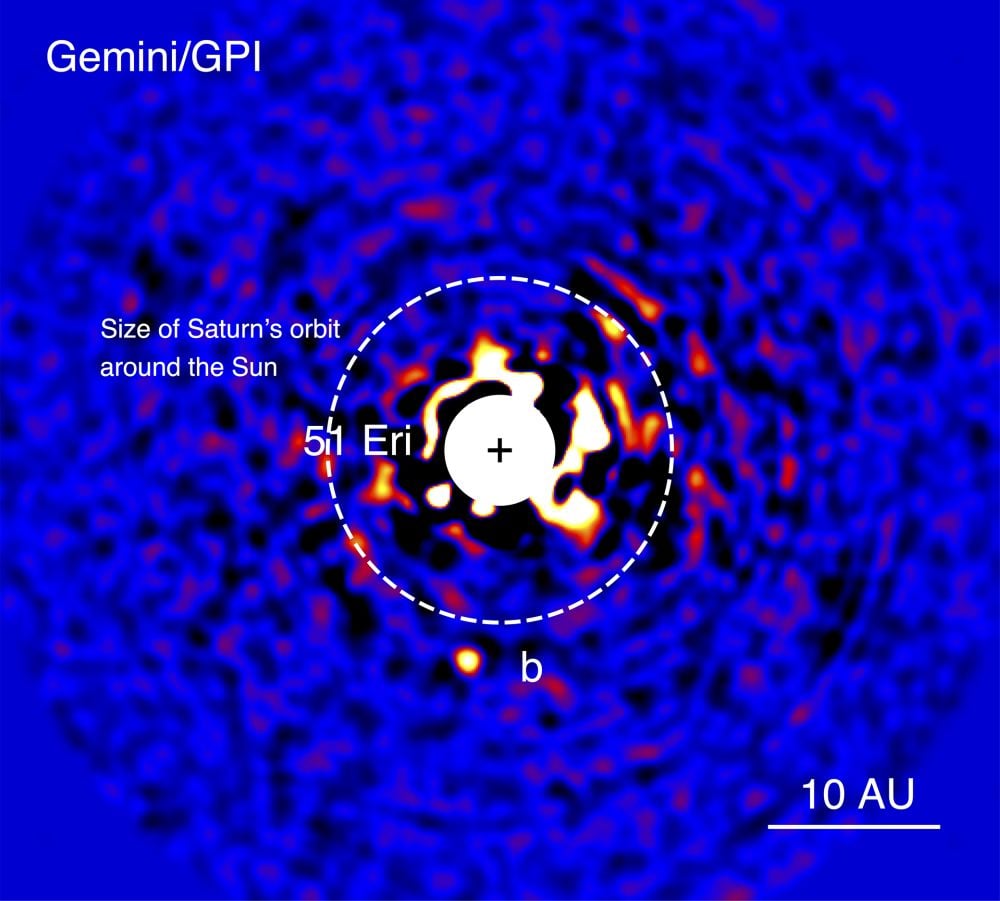
Exoplanets would be a lot easier to find if so many of them weren't so close to stars. But they are, and that's something exoplanet scientists have to contend with. Coronagraphs do great work blocking out starlight and making dim planets more visible, but they have their limitations.
The JWST has coronagraphic capabilities embedded in its NIRCam (Near-Infrared Camera) and MIRI (Mid-Infrared Instrument). These capabilities have helped the JWST study some tough subjects hidden in the glare of stars, like debris disks, and to observe extremely luminous objects like quasars.
But all telescopes have a stability limit, even the steady-eyed JWST. The stability limit is a threshold beyond which mechanical, thermal, or optical fluctuations make clear images impossible. The JWST has fine guidance sensors and a 5-layer sunshield to raise this threshold, but the limit is still there.
New research in Nature explains how astronomers developed a way to subtract more starlight from the JWST's observations and image exoplanets that are up against the telescope's limits. It's titled "Imaging exoplanets below the telescope stability limit," and the lead author is Rodrigo Ferrer-Chavez. Ferrero-Chavez is a graduate student in the Department of Physics & Astronomy at Northwestern University.
"Exoplanet imaging is the main method for detailed characterization of planets orbiting beyond 1 au (astronomical unit) but it requires suppressing the bright glare of the star to see the faint planet light," the authors write. Suppressing that glare requires a couple of things, including extremely stable telescopes.
“We try to make telescopes extremely stable, but there are extreme engineering challenges that we haven’t quite solved yet,” said study co-author Jason Wang, assistant professor of physics and astronomy at Weinberg College of Arts and Sciences at NW. “There are known causes of instability and unknown causes. Small thermal changes could cause a mirror to expand or contract by a picometer. Telescopes like JWST have cryocoolers to keep the instrument super cold. Those coolers have little motors that can cause the mirrors to vibrate. So, there are issues like those but also issues that we still don’t understand as we learn how to build these complex telescopes.”
But a stable telescope is only part of the picture. Image processing plays a huge role in modern astronomy, and the two factors, telescope stability and image processing, play into each other.
"As well as sophisticated instrumentation, effective image processing is necessary for starlight suppression, which continues to be a substantial limitation," the authors write.
There are standard algorithms that astronomers employ to overcome this limitation, including using reference images to model starlight.
“For the past 20 years, astronomers have tackled this problem by observing a different star and using its image as a reference,” said Wang said. “Then, they subtract that reference image from the original observation to remove the unwanted glare to reveal faint planets that otherwise might be hidden.”
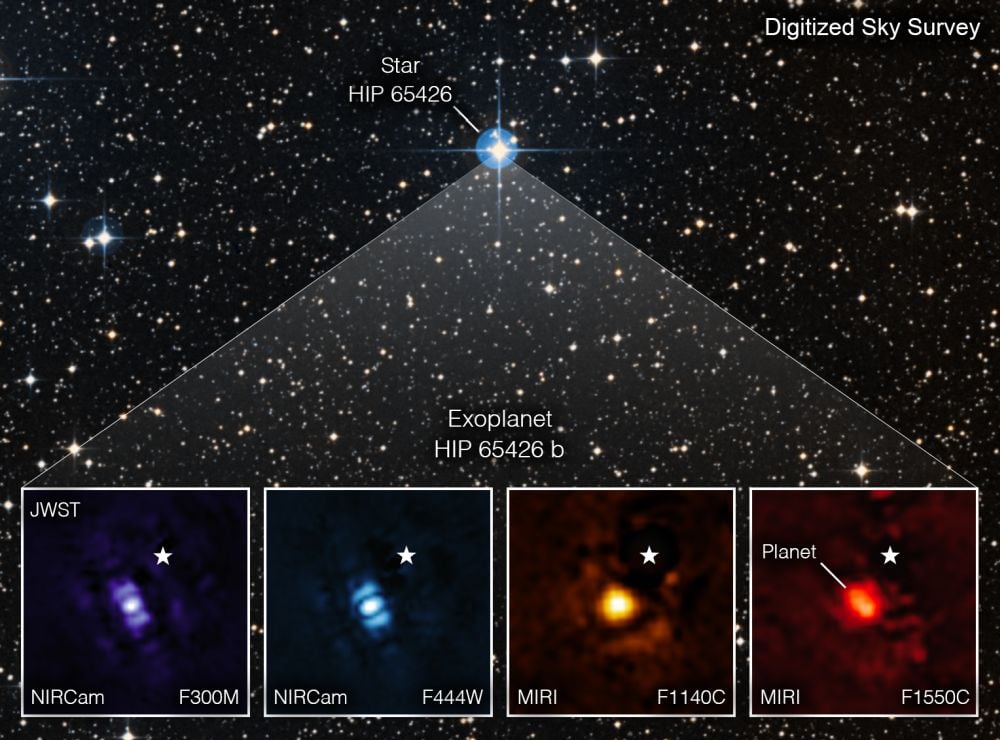 This image shows how the JWST uses coronagraphic masks in MIRI and NIRCam to remove starlight. The white star marks the location of the real star and illustrates how it's been effectively removed from the image. It's effective, but the new method will increase its effectiveness and reveal even dimmer exoplanets. Image Credit: NASA, ESA, CSA, Alyssa Pagan (STScI); Science: ERS 1386 Team, Aarynn Carter (UC Santa Cruz)
But reference images have their limits too. That method still suffers from inevitable instabilities in a telescope that arise when switching from a reference image to an actual observation. Overcoming these stubborn obstacles will mean we can directly image more exoplanets.
"Addressing this challenge will increase the number of planets amenable to direct imaging and will be a notable step towards imaging exo-Earths with future observatories," the researchers explain.
Their answer is a new method based on physics and modelling that also borrows ideas from machine-learning. It can account for the JWST's tiny, nanoscale imperfections. The method lets astronomers subtract starlight from images more effectively than ever before.
“Planets are a million times fainter than their stars,” said lead author Ferrer-Chavez. “So, to image exoplanets, we need to remove that glare. That is a very tricky problem because even the tiniest changes in the telescope can affect how that glare appears. Slight shifts or tilts — even on the scale of just a few nanometers — can change the pattern of light. Our method models how light travels through the telescope and accounts for those tiny changes, allowing us to remove the glare much more precisely.”
This comes down to PSF, point spread function. Every telescope detects light imperfectly. They all distort or bend light in some way. So instead of a point source appearing as a point, it inevitably is degraded somehow. That can hide extremely dim sources like exoplanets in the glare of their stars. Accounting for PSF is a work-a-day part of astronomy.
The new system is called FLIP, (Physics-based Learning for Imaging Planets) and it overcomes the problem of switching from reference images to real observations. FLIP "incorporates a multistep optimization strategy with a flexible physical model informed by wavefront sensing data to achieve the PSF fidelity necessary for real data," the authors write.
That's more technical detail than many will find interesting. But this type of work is behind the gorgeous images and fascinating discoveries in astronomy.
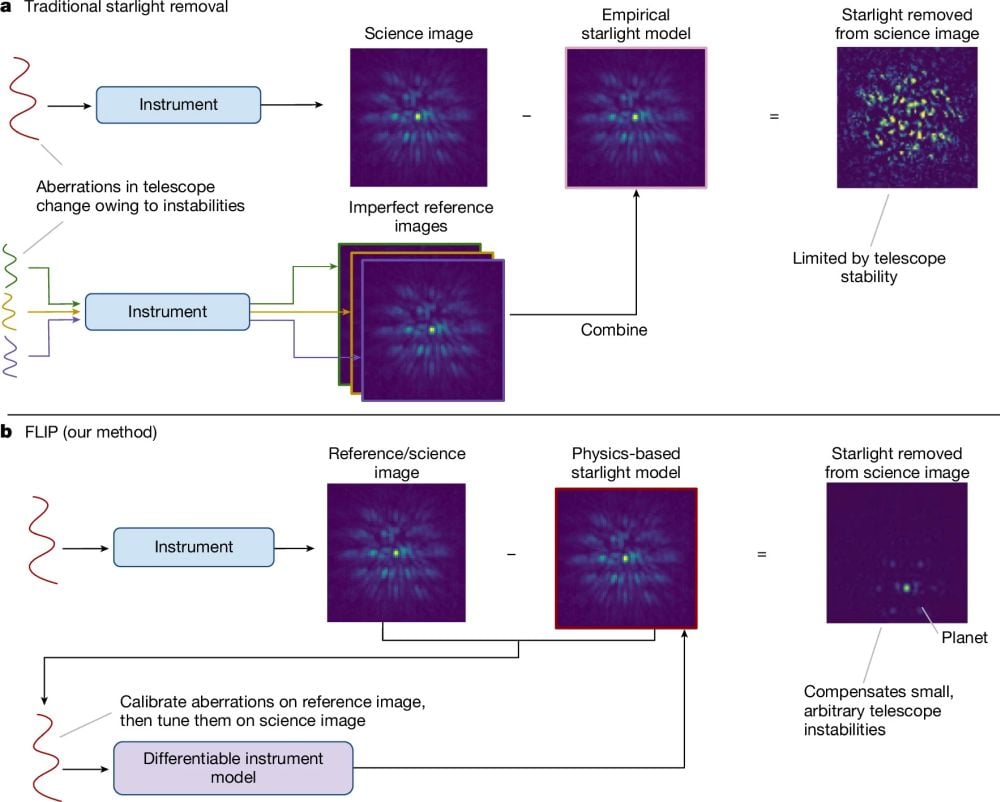 (a) shows the usual method of subtracting starlight from observations using reference images. Those image are imperfect and when combined with telescope stability, faint exoplanets remain hidden. (b) shows FLIP. Rather than reference images, it uses a differentiable instrument model and a physics based starlight model rather than an empirical starlight model. That means that starlight is more effectively removed from the end image, and a faint exoplanet becomes visible. Hooray! Image Credit: Ferrer-Chavez, R., Wang, J.J., Bouman, K.L. et al. Imaging exoplanets below the telescope stability limit. Nature 659, 58–62 (2026).
In essence, the researchers created what they're calling a "digital twin" of the JWST with FLIP. The twin reproduces how light travels through the JWST down to the smallest detail. It includes subtle shifts, distortions, and imperfections. They repeatedly adjusted FLIP until it matched the JWST's real observations, including the polluting starlight. After that, they subtracted the star's glare from the image.
And it worked.
They tested it on 51 Eridani b, an exoplanet found with ground-based telescopes. The usual image processing techniques couldn't see the exoplanet hidden in the glare when observed at the wavelength that the JWST uses to find CO2 in exoplanet atmospheres. (They chose that wavelength because that's a critical part of the JWST's job, and a sort of sweet spot in its capabilities.)
But when the researchers used FLIP, the planet came into view.
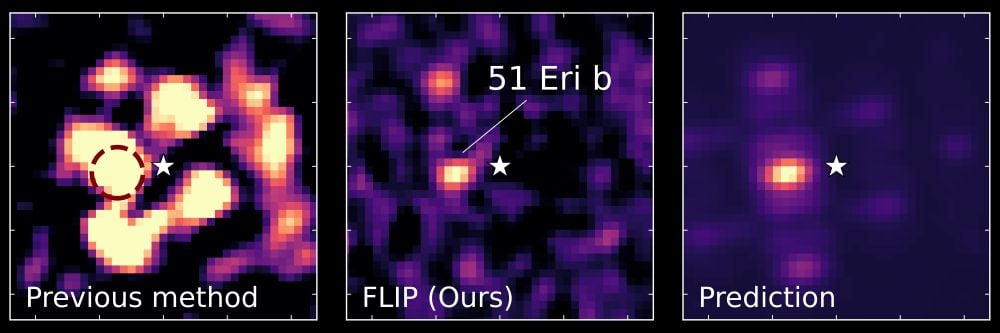 Left: JWST/NIRCam observation of star 51 Eridani A (51 Eri) in the F430M filter, using a standard processing method named KLIPto subtract the glare of the star. This method was not able to detect the planet 51 Eri b in the original analysis, whose expected location is marked with a dashed circle. Middle: The same observation, but using new method FLIP to subtract the glare of the star. Astrophysicists obtained a significant detection (>5 sigma) of 51 Eri b. Right: Simulated image of 51 Eri b, highlighting that the planet is detected at its expected location and that the planet signal has the expected morphology. The location of the star 51 Eri is marked with a star symbol. Image credit: Rodrigo Ferrer-Chavez.
"We achieve sensitivity 2–15 times superior to standard techniques, including the first detection of 51 Eridani b at 4.3 μm," the authors write. "This is the first time, to our knowledge, that such an approach has demonstrated substantially improved sensitivity on real, on-sky coronagraphic imaging."
“We showed that we can actually recover a planet that people previously couldn’t see,” Wang said. “This is real data in a real scenario. It was science left on the table because we didn’t have the right tools to analyze the data in the most optimal way.”
FLIP seems to have a bright future. Not only with the JWST, but with other space telescopes like the Habitable Worlds Observatory. Imaging exo-Earths with the HWO, for example, will require extreme stability, and FLIP might get us there. In fact, FLIP might make the HWO more easy to design and build.
"In this work, we have shown sensitivity beyond the stability limit in JWST NIRCam," the authors write. "If this can be extended to HWO contrast levels, the ultrastability requirement for the system may be partially lifted, with the error budget necessary for image post-processing being reduced, and thus the design of the observatory may become more tractable."
In short, FLIP can take some of the pressure off of the engineering challenges in building more and more powerful telescopes, and can help overcome their stability limits.
“We know of no planets around other stars that are like those in our own solar system,” Ferrer-Chavez said. “It’s not that they don’t exist. It’s that we cannot see them. Every time we improve our techniques, we discover new types of planets. By finding more planets, we can better understand how planetary systems form and evolve, and ultimately how typical our own solar system truly is.”