 Universe Today
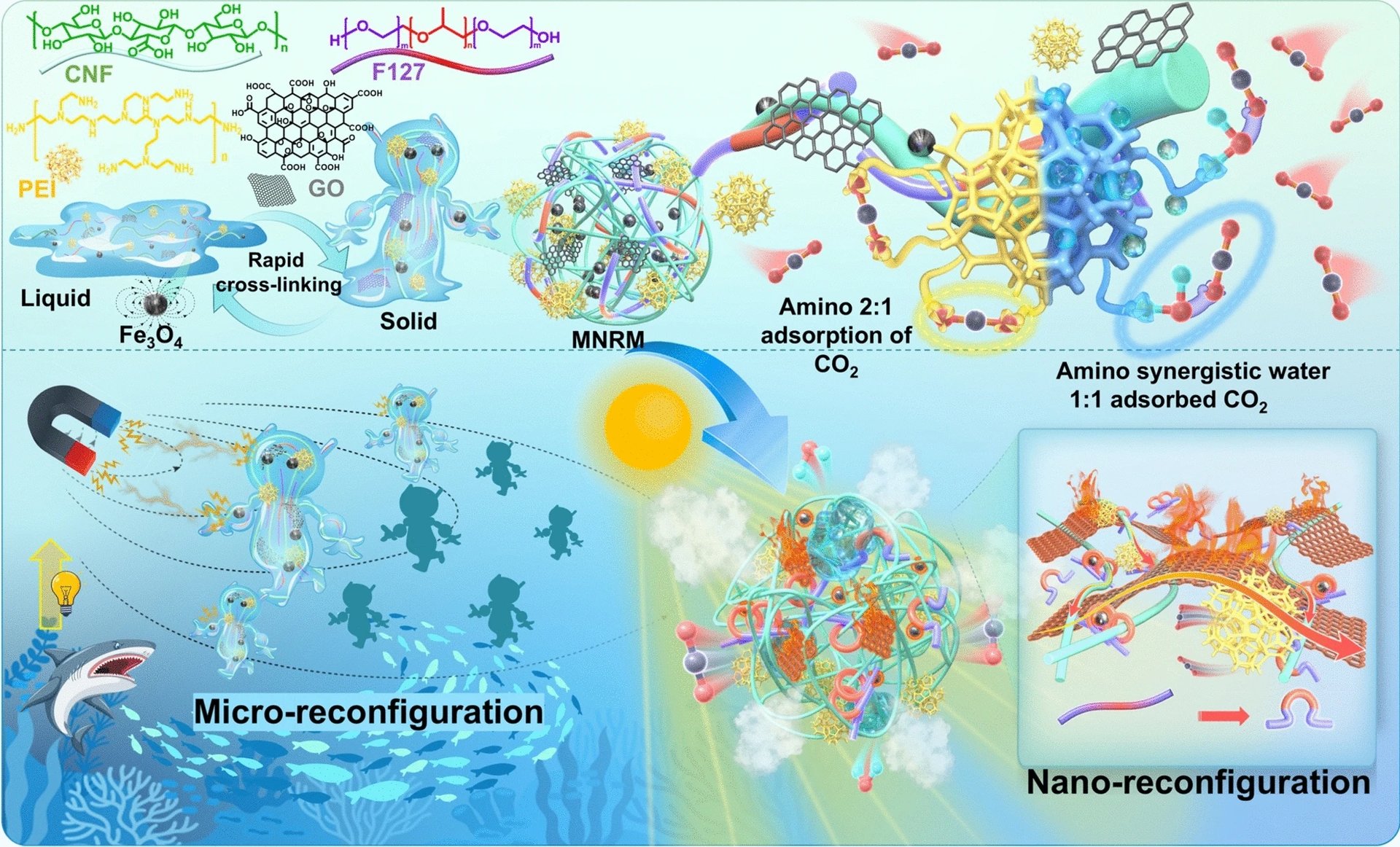
Removing, or “scrubbing”, carbon dioxide from the air of confined spaces is a critical component of any life support system on a spacecraft or submarine. However, modern day ones are energy intensive, requiring temperatures of up to 200℃ to operate. So a research lab led by Dr. Hui He at Guangxi University in China has developed what they call “micro/nano reconfigurable robots” (MNRM) to scrub CO2 from the air much more efficiently. Their work is described in a new paper in Nano-Micro Letters.
Robots in this context might be slightly confusing though. These are not traditional “robots” with mechanical limbs and servo motors to move them. They are more akin to a type of composite material that can react to its environment. It is made from four main components.
First, it uses cellulose nano-fibers as its backbone. This is the same organic structure that gives plants their shape. Embedded on that backbone is polyethyleneimine, which provides amino groups, a chemical structure especially good at grabbing onto carbon dioxide molecules. The system’s “motor” is a ferrous oxide nanoparticle that allows the “robots” to be moved by a magnet. Importantly this allows them to reconfigure to better address either the direction of sunlight, an important energy source for their “scrubbing”. A collection of graphene oxide also acts as a thermal bridge that spreads the heat from the Sun evenly over the material’s surface.
Scott Manley goes into detail about life support systems in space. Credit - Scott Manley YouTube ChannelBut the biggest innovation described in the paper is the use of a temperature-sensitive polymer, known as Pluronic F127, to act as a molecular switch. At low temperatures - or even just room temperature - the molecular chains of this material stretch, allowing them to capture CO2 efficiently. However, as temperatures increase to around 55℃, the chains “curl up” causing two important chemical changes.
First, the surface charge of the material becomes more positive, which repels the positively charged nuclei of other atoms, including CO2. It also lowers the Lowest Unoccupied Molecular Orbital (LUMO), which stops the material from locking the CO2 it has already captured into a stable bonded form, like the urea that forms with many other types of scrubbing systems. Urea requires extremely high temperatures to break down, whereas the resulting chemicals from the MNRMs - carbamic acid or bicarbonate - require much less heat, again, lowering the overall energy cost of the system.
The researchers measured the effectiveness of their scrubbing method compared to existing technologies such as zeolites and metal-organic framework (MOF) systems. They compared favorably to the efficiency of those two systems, but required about half of the heat needed to regenerate. Importantly, this amount of heat can be provided entirely by the Sun, with only 70% of standard daylight needed to enable “scrubbing”. This energy can also be provided by waste heat from electronics or other systems on-board an enclosed life-support system.
NASA video on the life support system of the space station. Credit - NASA Science YouTube ChannelA final factor was the bio-compatability of these “robots”. While they proved safe when tested on human lung cells, proving they can be used to filter air safely, they also proved anti-microbial, killing up to 99% of E. coli and S. aureus bacteria. That would prevent “bio-fouling” from bio-films that form on the scrubbing surfaces of many “wet” scrubbers.
This system has the potential to dramatically lower, or even eliminate entirely, the energy budget needed for carbon scrubber regeneration. Given the power constraints of space missions, that could offer the system a critical advantage compared to traditional methods. But it remains to be seen if it will be incorporated into the life support system of any of the space habitats currently in the design phase.
Learn More:
Shanghai Jiao Tong Unviersity Journal Center / Eureka Alert - Micro/nano‑reconfigurable robots for intelligent carbon management in confined‑space life‑support systems
W. Lu et al - Micro/Nano-Reconfigurable Robots for Intelligent Carbon Management in Confined-Space Life-Support Systems
UT - This Artificial Leaf Turns Atmospheric Carbon Dioxide Into Fuel
UT - Astronauts Could Rely on Algae as the Perfect Life Support Partner

