 Universe Today
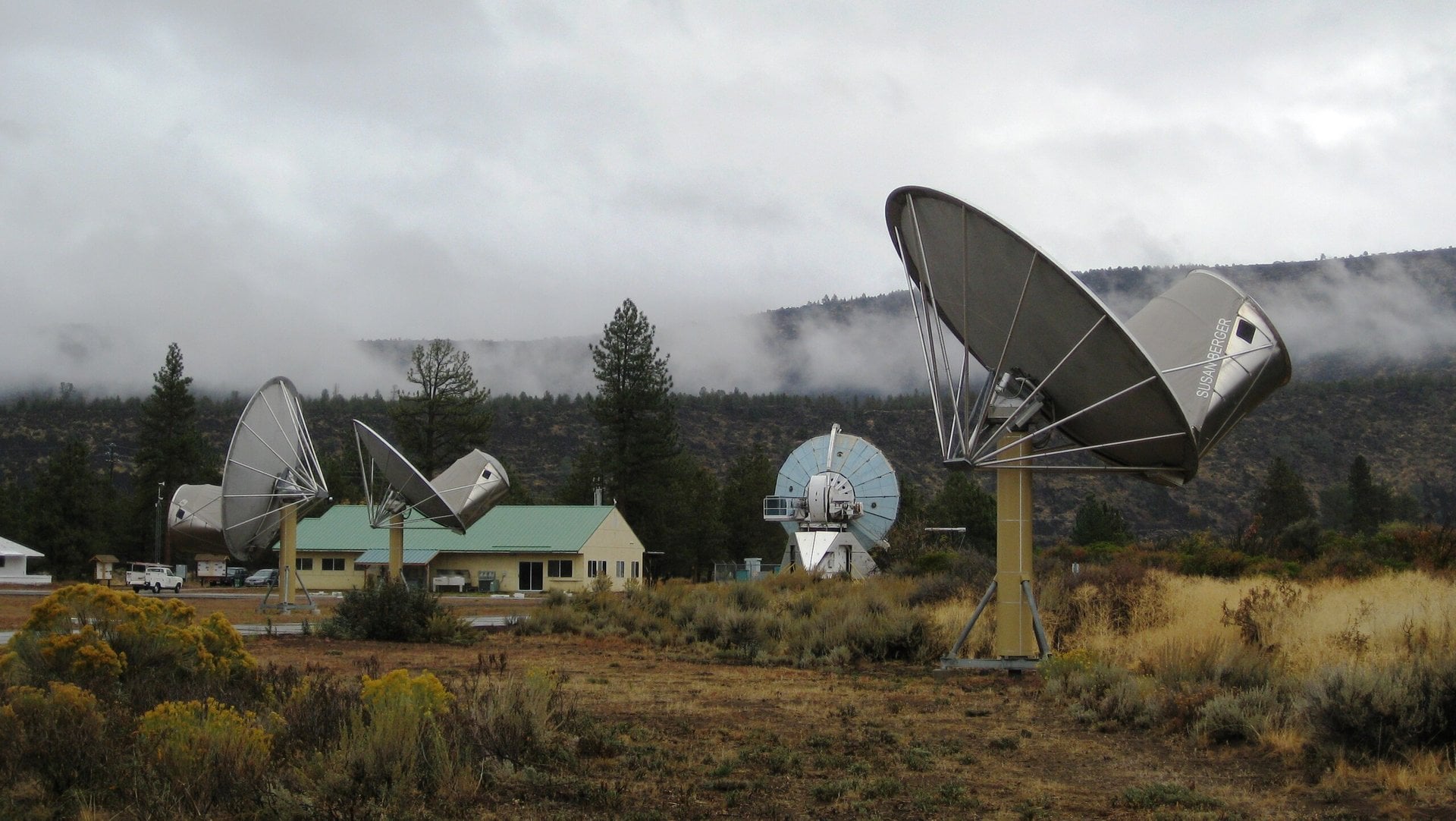
It feels like every week now we’re writing a new article about how 3I/ATLAS is not an alien technology. But it’s worth re-iterating, and perhaps taking a look at the methodology we used to prove that statement. A new paper, available in pre-print form on arXiv from Sofia Sheikh of the SETI Institute and her co-authors, details how one specific instrument - the Allen Telescope Array (ATA) - contributed to that effort.
The ATA is one of the world’s most powerful radio telescopes, and scanned interstellar comet 3I/ATLAS for a total of 7.25 hours over five distinct sessions in July 2025, shortly after the object’s discovery. Other telescopes had pegged 3I/ATLAS as a natural comet, with a coma, water outgassing, and a relatively fast rotational period of 16.8 hours. ATA’s job was to check if it was transmitting any artificial radio signals.
Luckily, the ATA itself recently received an upgrade that implemented its new “Antonio” feeds. These cryogenically cooled “feeds”, which are hardware components connected to the telescope that act as the “receiver” of the radio waves. These “Antonio” feeds are named after Franklin Antonio, the founder of Qualcomm and a major donor to the ATA’s recent upgrade project.
Documentary about the Allen Telescope Array. Credit - BerkeleySETI YouTube ChannelImproved cryogenic feeds means improved signal to noise ratio, and importantly, over a massive frequency range. During this particular observational campaign, ATA monitored the frequency space between 1-12 GHz, which includes some of the most common bands we use, such as the 2.4GHz of phone and WiFi signals.
Such an improvement in the sensitivity means the ATA team was overwhelmed with potential “signals” - over 70 million of them in fact. To narrow that down to a realistically tractable number, they applied a new filtering system called the Breakthrough Listen Interesting Signal Search (bliss) algorithm. First, they eliminated any signals in the frequency bands that are crowded with human interference, such as those used by GPS or satellites. Then they filtered for signals only matching the acceleration (red-shift) expected by 3I/ATLAS - a new feature of the bliss signal pipeline. Finally, they did a sanity check to make sure the signal actually came from the region of space where 3I/ATLAS was located at the time it was collected.
After all that filtering, they narrowed it down to 211 candidate signals, each of which was manually investigated by a human. And, in turn, each one was determined to be caused by Earth-based radio frequency interference that had slipped through the automated filtering process. As such, the ATA team ended with a “null” result - no synthetic radio-frequency techno-signature appeared to be emanating from 3I/ATLAS.
Fraser follows up on the science we know about interstellar visitor 3I/ATLASThat null result comes with a caveat, though. The authors calculated the power output at each frequency that would be the minimum required to be detected by their search algorithm. For a 1 GHz signal, they calculated it would be around 10 watts - about 5 times the power of a typical cell phone. At 9 GHz, this power jumps up to around 110 watts. But it seems pretty clear that a civilization advanced enough to intentionally send an interstellar object to another system would put in a radio transmitter that was stronger than two light bulbs put together.
ATA also wasn’t alone in its observations, though. Other telescopes around the world have been watching 3I/ATLAS since its discovery last summer. Perhaps the most relevant is the Green Bank Telescope in West Virginia. The team from that observatory recently released their own paper confirming the ATA findings, such with even higher sensitivity, ruling out any transmitter that was even 10% of the power of a modern cell phone. Observations from other observatories, such as MeerKAT in South Africa, and the Vera C. Rubin Observatory in Chile confirmed the “natural” pattern seen by every verified observation of 3I/ATLAS so far.
Despite that, I’m sure this won’t be the last article we write about further research debunking the idea of 3I/ATLAS as a technological object. As our third interstellar visitor begins to make its way out of our solar system to the depths of deep space, astronomers will continue to monitor it from every possible angle because of how interesting it is to the scientific community - whether or not it was artificial.
Learn More:
S. Z. Sheikh et al. - A Search for Radio Technosignatures from Interstellar Object 3I/ATLAS with the Allen Telescope Array
UT - What Technosignatures Would Interstellar Objects Have?

