 Universe Today
We may not know what dark matter is, but that hasn't stopped scientists from trying to understand its role in the Universe. The Lambda-Cold Dark Matter (CDM) model is the standard model that explains the cosmos the best, although it's not the only model. It makes a number of predictions about dark matter and researchers look for opportunities to test those predictions. The results either help confirm or deny the model.
Dark matter is the Universe's scaffolding, and galaxies form in dark matter haloes. One of Lambda-CDM's predictions is that some dark matter haloes never form stars or galaxies.
In a boost to the Lambda-CDM model, astronomers have found their first starless dark matter halo. It's called a RELHIC, a Reionization-Limited H I Cloud, where H I stands for neutral hydrogen. So though it contains star-forming hydrogen, no stars and no galaxy has formed within it.
New research in The Astrophysical Journal Letters presents the discovery. The research is "The First RELHIC? Cloud-9 is a Starless Gas Cloud," and the lead author is Gagandeep Anand, a staff scientist at the Space Telescope Science Institute who works with the Hubble Telescope's Advance Camera for Surveys.
Reionization Limited refers to the object's roots in the very early Universe. RELHIC's are relics of the Universe's Epoch of Reionization. They're gas clouds that never collapsed to form stars and, eventually, galaxies. This one is named Cloud 9 because it was the ninth gas cloud found near Messier 94, a nearby spiral galaxy. It was first detected in a survey done by China's Five-hundred-meter Aperture Spherical Telescope (FAST). However, those observations couldn't determine what type of object it was; it could have been a dwarf galaxy. Only follow-up observations with the Hubble's ACS determined that it's a RELHIC. Those observations failed to detect any stars.
"Here we present deep Hubble Space Telescope/Advanced Camera for Surveys imaging designed to search for a luminous stellar counterpart," the authors write. "The nondetection of a luminous component reinforces the interpretation that this system is a reionization-limited H i cloud."
“Before we used Hubble, you could argue that this is a faint dwarf galaxy that we could not see with ground-based telescopes. They just didn’t go deep enough in sensitivity to uncover stars,” explained lead author Anand in a press release. “But with Hubble’s Advanced Camera for Surveys, we’re able to nail down that there’s nothing there.”
“This is a tale of a failed galaxy,” said the programme’s principal investigator, Alejandro Benitez-Llambay of the Milano-Bicocca University in Milan, Italy. “In science, we usually learn more from the failures than from the successes. In this case, seeing no stars is what proves the theory right. It tells us that we have found in the local Universe a primordial building block of a galaxy that hasn’t formed.”

The obvious question is, why didn't it form stars? It contains massive amounts of star-forming hydrogen, about one million solar masses worth, so why didn't that happen?
Researchers think that galaxies only form in haloes that reach a critical mass. "After reionization," the authors explain, "this threshold is set by the balance between gravity, gas cooling, and photoheating by the cosmic ultraviolet background (UVB)." Gravity and cool gas encourage star and galaxy formation, while heated gas inhibits it. Scientists think that in our current epoch, the critical dark matter mass or threshold is 109.7 solar masses, or about 5 billion solar masses.
UVB wasn't a factor before the EoR because the Universe was opaque and light couldn't travel, so in the ancient Universe, the critical mass (Mcrit) threshold was different. Galaxies already had stars before UVB heated up the Universe's gas.
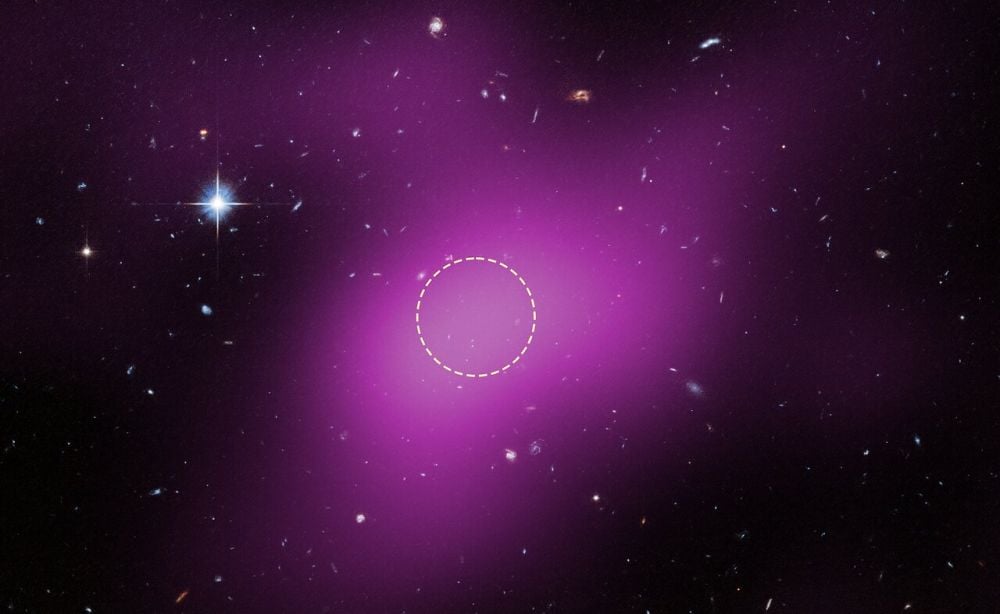
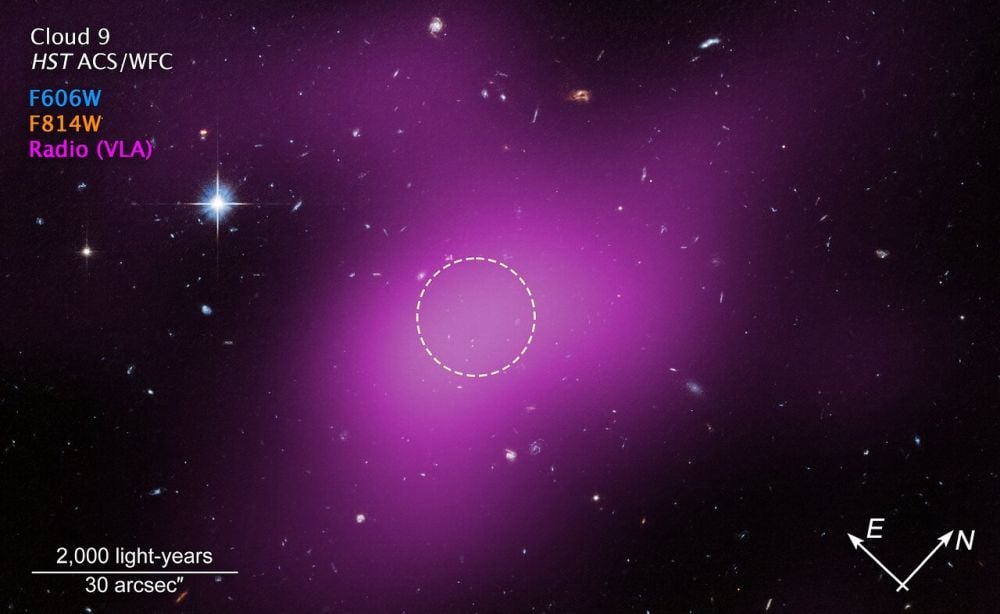 This image shows the location of Cloud-9, which is 14 million light-years from Earth. The diffuse magenta is radio data from the ground-based Very Large Array (VLA) showing the presence of the cloud. The dashed circle marks the peak of radio emission,which is where researchers focused their search for stars. Follow-up observations by the NASA/ESA Hubble Space Telescope’s Advanced Camera for Surveys found no stars within the cloud, proving that it couldn't be a dwarf galaxy. The point sources inside the cloud are actually background galaxies. Image Credit: NASA, ESA. G. Anand (STScI), and A. Benitez-Llambay (Univ. of Milan-Bicocca); Image processing: J. DePasquale (STScI)
"Halos just below Mcrit occupy an intermediate regime: they are not massive enough to form stars today, but are massive enough to retain some of their gas," the authors explain. The most massive of those ones retained enough baryons in their central regions for hydrogen recombination to occur. That's when free electrons and hydrogen ions recombine to form neutral hydrogen, eliminating the Universe's opacity and allowing light to travel.
Simulations show that in these cases, REHLICS should retain a compact spherical core of neutral hydrogen, even though they lack stars that form from that hydrogen. In essence, these are literal relics of the Universe's early days because they're preserved structures from the early Universe. They existed before the EoR, but their evolution into star forming galaxies is basically frozen in time. The photoheating from reionization heated the gas and prevented them from acquiring more gas necessary for star and galaxy formation. Haloes above the Mcrit had sufficient mass to continue to accrete more gas, while REHLICs didn't.
It's possible that this REHLIC could eventually form a galaxy. If it somehow acquired enough gas, it would collapse and form stars like any other galaxy. But astrophysicists aren't sure how that could happen. It's close to M94 and appears to be associated physically with it, so perhaps in the future gas from M94 could somehow find its way into Cloud 9.
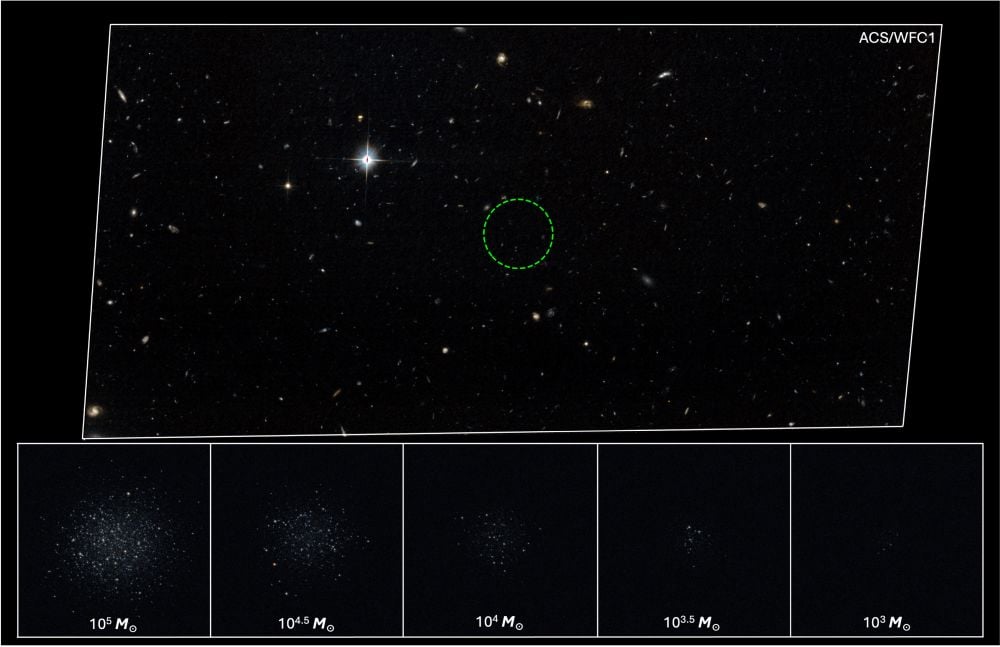 To determine if Cloud 9 was actually a dwarf galaxy, the researchers simulated dwarf galaxies covering a range of stellar masses (bottom row). None of them matched the Hubble ACS observations, helping them conclude that Cloud 9 is a cloud of gas, not a dwarf galaxy. Image Credit: Anand et al. 2025. ApJL
As the first discovered REHLIC, it's an important discovery in the field of dark matter.
“This cloud is a window into the dark Universe,” explained team member Andrew Fox of AURA/STScI for the European Space Agency. “We know from theory that most of the mass in the Universe is expected to be dark matter, but it’s difficult to detect this dark material because it doesn’t emit light. Cloud-9 gives us a rare look at a dark-matter-dominated cloud.”
The discovery is also more support for the Lambda-CDM model.
"This provides strong support for a cornerstone prediction of the Lambda cold dark matter model, namely the existence of gas-filled starless dark matter halos on subgalactic mass scales, and constrains the present-day threshold halo mass for galaxy formation," the authors write.

