Universe Today
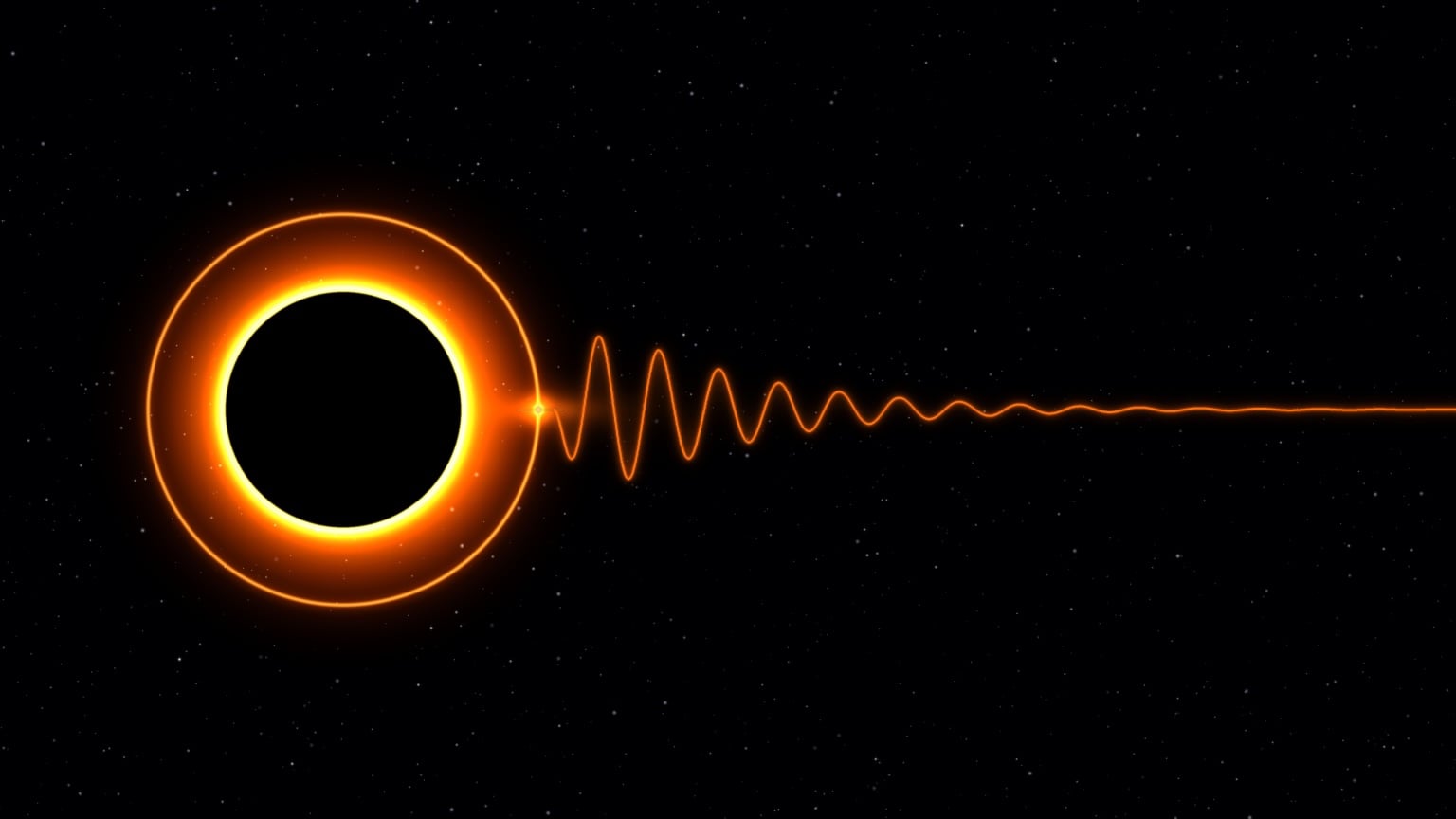
In theory, the structure of a black hole is amazingly simple. It depends on only three things: mass, rotation, and electric charge. All you've got to do is compress objects down tightly enough for the black hole to form. Radioactive waste, old tax returns, a massive cloud of helium, you name it. Compress it into a black hole, and all the information and atomic structure become irrelevant. A black hole is just that simple. At least according to the no-hair theorem. Now a new study finds that if real black holes violate the no-hair theorem, it will be seen in the gravitational waves of their mergers.
The no-hair theorem gets its name from John Wheeler, who contrasted it to the mathematical hairy ball theorem about how to cover a sphere with particular features. Since a black hole's event horizon has no unique features, Wheeler argued, then "black holes have no hair." But the no-hair theorem hasn't been proven in general. We know that any steady-state black hole is hairless according to general relativity, but things get fuzzy when talking about merging black holes. Hence, this new research.
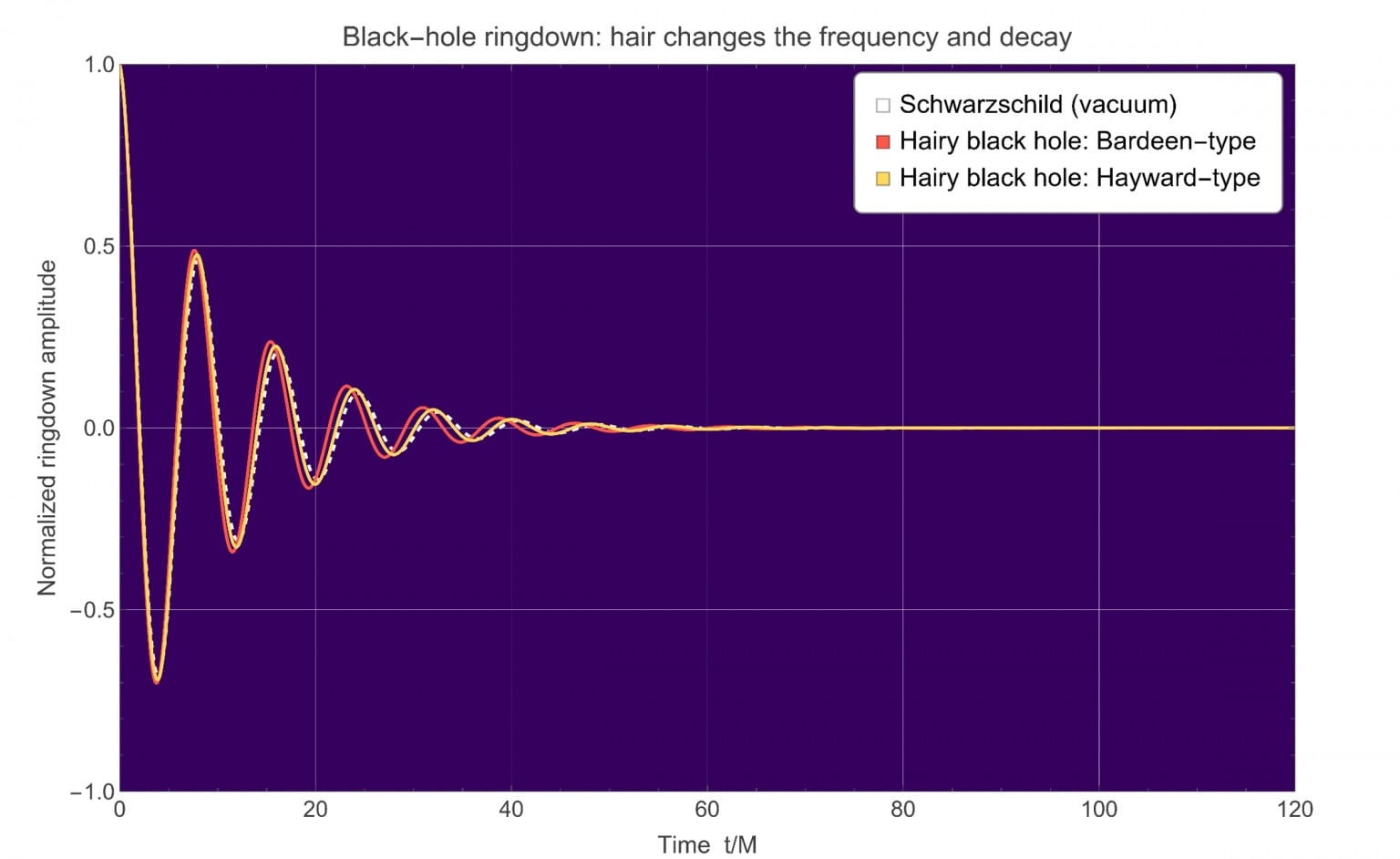 A comparison of different black hole models shows that their ringdown frequencies differ. Credit: Ariadna Uxue Palomino Ylla, Nagoya University
Since classical black holes are hairless, the authors compare the standard model to a few variant models. One of these is known as a Hayward black hole. This model was first proposed by Sean Hayward as a way to remove singularities from the black hole equations. It follows general relativity but assumes that somehow matter reaches a non-singular quantum state. And since Hayward black holes don't have a strict singularity, they also don't have a strict event horizon. The no-hair theorem doesn't apply to them.
Another model the authors consider is known as the Bardeen black hole. James Bardeen is most well-known for his work on the laws of black hole thermodynamics. If black holes radiate as Stephen Hawking predicts, then they obey the laws of thermodynamics. A Bardeen black hole is one with an electromagnetic structure to its radiation and thus has hair.
The team computed what would happen if a pair of Hayward black holes merged and if a pair of Bardeen black holes merged, then compared them to the mergers of standard black holes. They found that each model has a unique signature to their ringdowns. Both the ringdown frequency and rate of decay are different for each model. They also demonstrated how the ringdown can be used to probe the structure of spacetime in the horizon regions of the black hole. Are they truly vacuums as GR predicts, or do quantum fluctuations come into play?
Current gravitational wave observatories aren't sensitive enough to detect these differences, but they could be revealed as we develop new tools. It's clear that black hole mergers have a great deal more to tell us than the mass, rotation, and charges of the merging black holes.
Reference: Palomino Ylla, Ariadna Uxue, et al. "Ringdown waves from hairy black holes." Journal of Cosmology and Astroparticle Physics 2026.09 (2026): 046.