 Universe Today
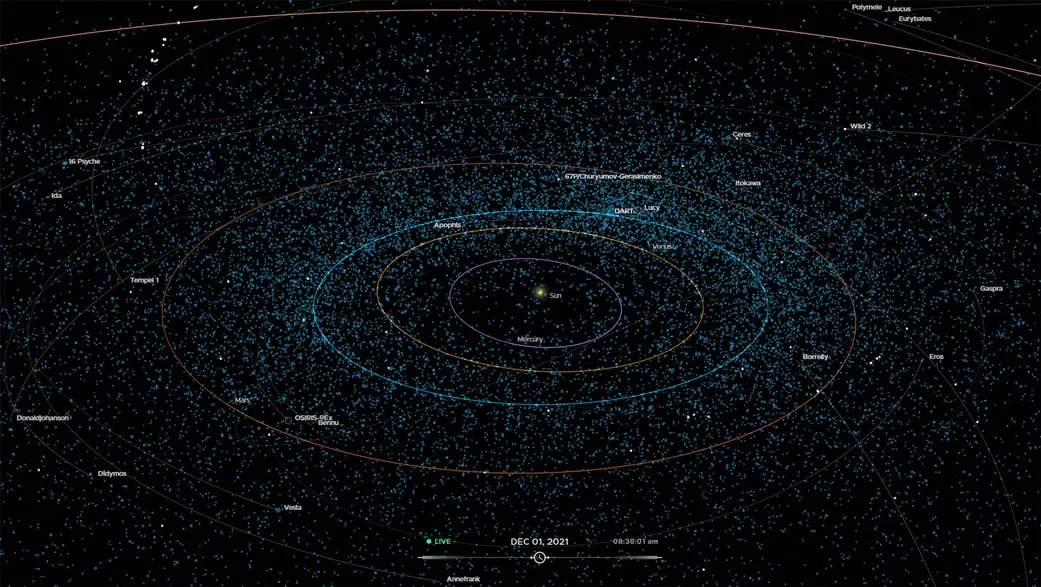
There are tens of thousands of Near-Earth Objects (NEOs) that represent some of the most easily accessible resources in the solar system. If we can get to them at least. Planning trajectories to rendezvous with these miniature worlds is notoriously difficult, and requires a massive amount of computational power to calculate. But a new paper from astrodynamicist Alessandro Beolchi of Khalifa University of Science and Technology and his co-authors offers a much less computationally intensive way to find these trajectories, and has the added bonus of finding the much less energy-intensive paths to boot.
When plotting orbital trajectories, NASA engineers used a technique called the “Patched-Conics” method. This system relies heavily on the Two-body Problem, a mathematical model that essentially just looks at the Sun and the spacecraft, ignoring the gravitational influence of all other bodies in the solar system. It also assumes that the velocity changes of the spacecraft will be provided in short, powerful bursts by chemical rockets. For most of the history of space exploration, that has been enough. And while those models haven’t always provided the most efficient route to get from Point A to Point B, it sure got the spacecraft there quickly.
But times are changing, and efficiency is becoming increasingly important when planning these routes. We don’t exclusively use chemical rockets anymore. Nor is it necessary to simply ignore all of the other gravitational influences - especially the Earth. So the researcher’s model takes a more nuanced approach to their astrodynamical models and finds some significant improvements in doing so.
Fraser discusses the possibility of mining asteroids.First, they blended together two different models of the physics of spaceflight. While close to the Earth, they use a model known as Circular Restricted Three-Body Problem (CR3BP). This model has the advantage of introducing the tug-of-war between Earth and the Sun, specifically the Lagrange points of orbital stability that are introduced by that tug-of-war. Spacecraft can effectively “park” in these spots in interplanetary space, allowing it to await a passing asteroid when it zooms by.
Each of these Lagrange points also has an “invariant manifold” - essentially an invisible highway that would allow a spacecraft to coast away from Earth with almost no fuel expenditure. Eventually, once they get far enough away from Earth, the paper switches models to the more traditional Two-Body problem of the Sun and the spacecraft, eliminating the gravitational influence of our home planet entirely. The inbound trip (i.e. from the asteroid or comet back to the Earth) is calculated completely separately from the outbound trip, with some basic stitching together at the NEO itself.
This is computationally much more effective. But there’s another change the new models make. Modern deep-space propulsion technologies, such as Solar Electric Propulsion (SEP), don’t have the same short-duration, high-force impact of chemical rockets. Their propulsive technique is more like the tortoise than the hare - they might only have the equivalent face of a piece of paper resting on your hand, but applied continuously over months or even years that can result in a big change in velocity.
Fraser discusses the utility of Lagrange points.The researchers modified the code that factored in velocity changes as almost instantaneous (i.e. how they would be with chemical rockets) to make it more accepting of slow burn technologies like SEP. Once they had the finalized model, they started running simulations on actual asteroids - 80 of them to be exact. Each had relatively flat, low-eccentricity orbits, but the results from the simulations were staggering - over 2 million distinct, viable round-trip trajectories.
Two specific case studies stood out to the researchers. Asteroid 1991 VG was temporarily a “mini moon” of Earth, and the researchers found a distinct “alternate gate” transfer where a robotic probe could leave Earth along an orbital path to the L1 Lagrange point, visit the asteroid, and then return home along via L2 on the opposite side of the planet. Another case study was Apophis, which has a notoriously eccentric and inclined orbit. According to the researchers, the algorithm handled developing a trajectory for this nearby object beautifully.
Comparing the overall results of their modeled trajectories to NASA’s standard trajectories in the Near-Earth Object Human Space Flight Accessible Targets Study (NHATS) database, there were clear benefits using the new methodology. The “delta-v” was similar between the two systems, but the new methodology dramatically lowered the launch escape energy required. In other words, it made the missions much cheaper. Even better, the return trajectories back to Earth were much slower, allowing the spacecraft to hit the Earth’s atmosphere at safer speeds, and therefore requiring less heat shielding.
As we start to explore more and more nearby mini-worlds, these astrodynamical models might play an increasing role in determining the missions architecture when we do so. If it means a lower cost and higher survival rate, that sounds like a win-win situation for this new, updated way of doing things.
Learn More:
A. Beolchi et al. - Low-Energy Round-Trip Trajectories to Near-Earth Objects using Low Thrust
UT - Could Plasma Jet Thrusters Kickstart Interplanetary Travel?
UT - If We Want to Visit More Asteroids, We Need to Let the Spacecraft Think for Themselves

