 Universe Today
Asteroids don’t come with a warning label that they might one day hit Earth. While we don’t know of any currently on course to do so, we are finding thousands of new ones each year, and there’s always a potential that one could. We proved a viable technique for dealing with that eventuality - the DART mission successfully moved a small asteroid using a “kinetic impactor” - basically a big rod designed to push the asteroid off its trajectory. But DART had one big flaw - it was traveling in the same direction as the asteroid, and approached it from behind, eventually hitting it with an impactor launched while in orbit around it. That technique might work if we have enough warning, but would require years of orbital mechanical maneuvering to pull off. An alternative, proposed by researchers at Beihang University, is to use a new type of solar sail to deflect a potentially hazardous asteroid by hitting it head on.
Deflecting an asteroid using an impactor comes down to one simple factor - energy. The more energy transferred from the impactor to the asteroid, the more the asteroid will move. And the great thing about energy is that it increases with the square of velocity. In other words, the faster you hit something, the more energy you impart to it.
DART smashed into Dimorphos, its target asteroid at about 6 km/s - a respectable speed, but limited by the fact that it was coming from the same direction. According to the new paper, an impactor using a solar sail can come at an approaching asteroid from the opposite direction - akin to a wrong-way highway driver - and smash into its target at around 100 km/s - imparting something like 230 times the force per kilogram of impactor mass than the DART test did.
Fraser talks about how we could potentially stop a killer asteroid.The problem is getting the spacecraft moving in the opposite direction. Almost everything orbits the Sun in a counter-clockwise direction, including the Earth. As such, when something launches from the Earth, it’s already moving that way. Reversing that direction, and entering a clockwise (retrograde) orbit requires a lot of energy, to put it mildly. Chemical rockets aren’t capable of it - the tyranny of Tsiolkovsky’s rocket equation makes it impossible for them to carry enough fuel to complete that maneuver. But solar sails potentially can.
Solar sails work by harnessing solar radiation pressure - the tiny amount of force that a photon imparts when it runs into something. In essence, they sail on sunlight rather than requiring fuel like a traditional chemical or ion rocket. Back in the 1990s, Italian engineer Giancarlo Vulpetti realized you could use this technology to get a solar sail into what he called a H-reversal trajectory - essentially a way to make the sail start orbiting backwards.
This technique first uses the sail as a brake, slowing the craft’s angular momentum. After it drops to zero, the Sun’s gravity does its work, pulling the craft toward our star in a deep dive. But in Vulpetti’s trajectory, the sail kicks back on during the craft’s closest approach (perihelion), and slingshots back outward into a retrograde orbit. Sounds like a brilliant solution to get an impactor moving in the right direction to impart a massive amount of energy to an asteroid. There’s only one problem - solar sails are notoriously clumsy.
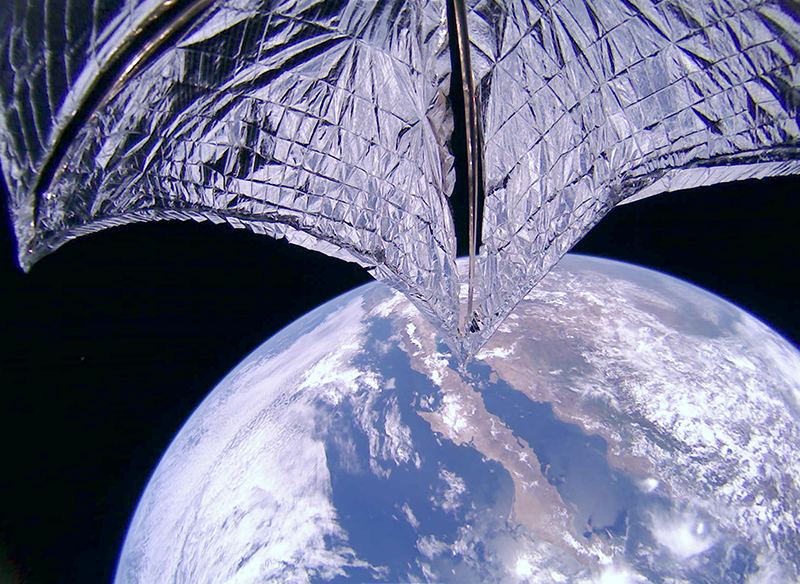
Fraser talks about the results of the DART test.We’ve successfully tested a few in space - JAXA’s IKAROS mission and The Planetary Society’s LightSail 2 are examples of traditional solar sails, which essentially act like giant mirrors. In their case, the light that bounces off of them leaves at the same angle it arrives. The thrust is always perpendicular to the sail’s surface. That situation isn’t ideal for a H-reversal trajectory, as it means you have to tilt the sail at an extreme angle to the Sun, which thereby presents a much smaller target for the sunlight to hit, dramatically reducing the sail efficiency.
Enter the diffractive solar sail. Instead of traditional reflective film, the material these sails are made out of uses microstructured optical gratings to diffract the light sideways, without the sail itself turning. That means the sail can keep its whole face towards the Sun, even at perihelion, but force all of that thrust into sideways motion. This dramatically simplifies attitude control and still enables the significant push needed to pull off this tricky orbital maneuver.
The researchers simulated several different types of solar sail configurations for this H-reversal trajectory, and found that reflection-type diffractive sails are the clear winner. In their simulations, only that type didn’t either fall into the Sun or get launched onto a trajectory where it was pushed out of the solar system entirely. But finding the right type of sail was just the first step - their second simulation showcased an example of what might happen with another famous asteroid - Apophis.
Fraser talks about how great solar sails are.Apophis is a 340m wide asteroid that will famously come within 38,000km of Earth on April 13th, 2029. While that in itself does not warrant a deflection, the researchers decided to see what they could do with this well-studied asteroid. They simulated a diffractive-reflective sail in two different configurations - one where it was set with a permanent diffraction angle, and one where it could switch between a moderate angle for its dive towards the Sun and then dial it up near perihelion to around 90 degrees.
Both versions were able to deliver a 100 km/s impactor directly to Apophis in around 200-300 days from launch time. That shaves nearly a year off the mission time of a standard reflective solar sail - a time differential that could be the difference between a deflection and an impact.
Hopefully, we will never actually need to use this technology to deflect a potentially hazardous asteroid. But realistically, we will face one someday. And knowing that this technique could deliver hundreds of times more energy than the more mundane co-orbital impacts we’ve proven work so far is heartening - at least we know there’s another tool in our toolbelt to deal with these hazards, even if we miraculously never have to use it.
Learn More:
J. Zhang et al - Diffractive Sail H-Reversal Trajectory: Theoretical Feasibility, Design Strategies, and Applications
UT - Planetary Society Deploys LightSail 2's Solar Sail. What Does The Future Hold For Solar Sails?
UT - NASA's DART Mission Also Changed Didymos' Orbit Around Sun
UT - Deflecting Asteroids Isn't Simple According to New Data from DART

