 Universe Today
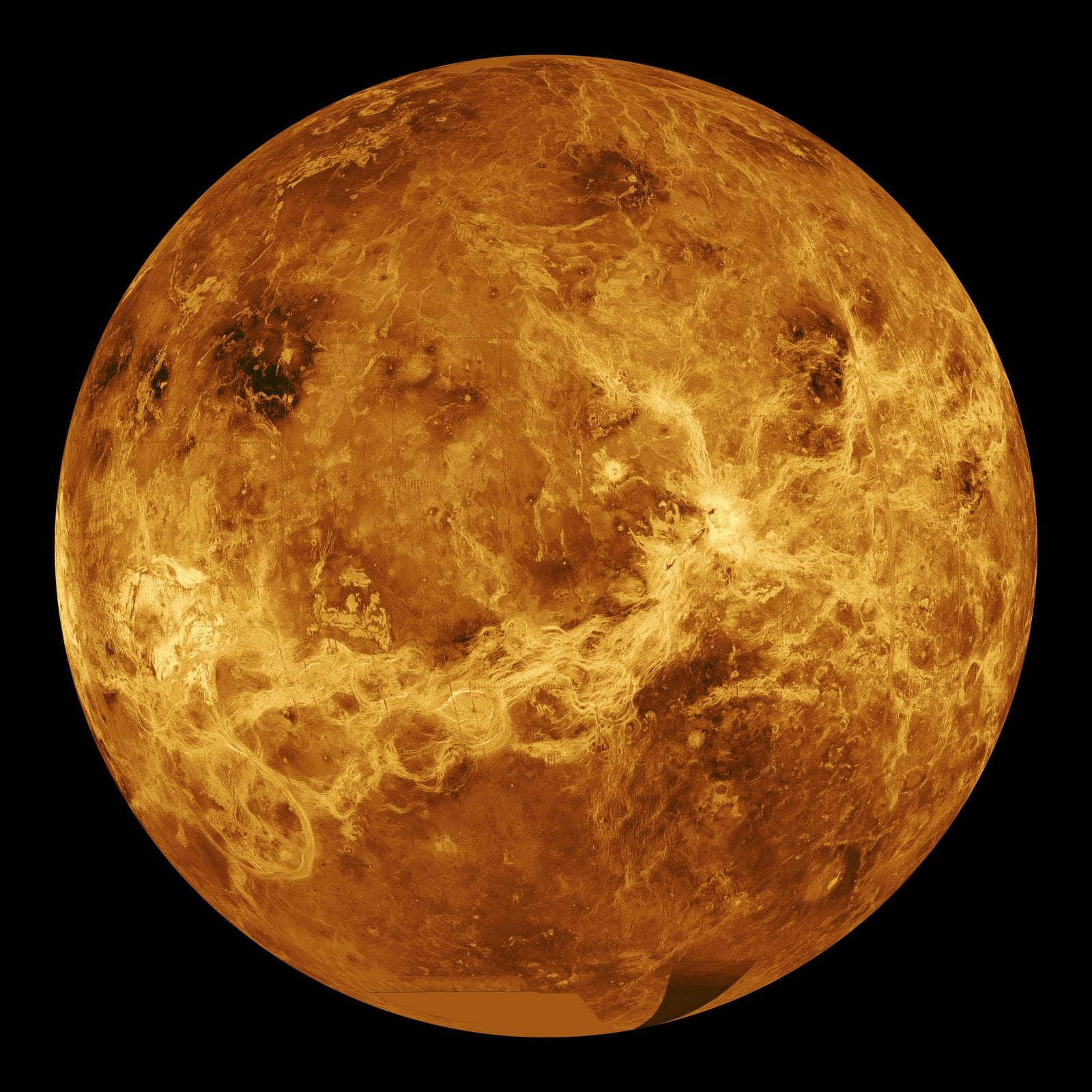
Venus is increasingly becoming a touch point for our studies of the exoplanets, as missions like the James Webb Space Telescope (JWST)and the upcoming Habitable Worlds Observatory (HWO) begin to characterize rocky exoplanets around other stars. Understanding the difference between the evolutions of Venus and Earth, which ended up with such different results, is a key to understanding whether we might be looking at an Earth-analogue or a hellish landscape like Venus. A new paper by Rodolfo Garcia of the University of Washington and his colleagues, which is available in pre-print form on arXiv, simulates Venus’ 4.5 billion year evolution as part of the solar system to try to understand some of those differences.
To run this simulation they used an open source software called VPLanet, which allows them to vary plenty of initial conditions for the planet’s formation and also the physical parameters of the changing world. Mr. Garcia and his co-authors commonly use this software to study planetary evolution as part of their work at the Virtual Planet Laboratory (VPL), so they’re familiar with how the models work, including for exoplanets.
In this particular case, they ran 234,000 4.5 billion year long simulations operating under one main assumption - that Venus has always been in a “stagnant lid” tectonic regime, which means its crust never broke into moving plates like Earth. The model itself couples the planet’s interior, lithosphere (i.e. its crust), and atmosphere, and the authors selected three constraints that mimicked the environment of modern-day Venus.
Fraser made a whole video about Venusian plate tectonics and the important role they play.First, the atmospheric carbon dioxide levels must be around 92 bars of partial pressure. Second, the atmospheric water levels must be around 3 millibars of partial pressure. And third, the magnetic moment of the planet must be less than 100,000 times smaller than Earth’s - a proxy for not having any active core dynamo at all. Of the 234,00 simulations they ran, only 808, or 0.35%, of the simulation successfully reproduced these results.
Those successful simulations can be broken down into four different evolutionary pathways. By far the most common is the “conventional” scenario. In this case, the mantle and core cool smoothly over time, which is what usually is predicted to happen by previous models. Around 72% of the successful simulation runs fall into this category.
A second successful pathway, which represented about 18% of the models that worked, shows a Venus that is magnetically dying. In these scenarios, the planet loses a massive amount of water from the mantle, which causes “dehydration stiffening”. This, in turn, reduces the mantle’s viscosity, thickening the stagnant lid of the tectonic plate. This choked off the planet’s internal heat flow, dropping the amount of molten rock in the core to less than 1%.
Fraser discusses why Venus is such an interesting planet to explore.10% of the scenarios feature an inner core that never quite grew up. In these models, the solid inner core that runs a planet’s active dynamo never exceeded 80% of the total core size - and in some cases a solid core failed to form at all. The last scenario included a rare case where the planet underwent wild, oscillating swings in its internal temperature and properties during the first 500 million years before settling down into its current state.
According to the paper, some parameters of the planet played critical roles in whether the simulation was successful at mimicking Venus’ current environment or not. The most critical included its initial mantle water abundance, the mantle’s viscosity, its dehydration stiffening strength, the eruption efficiency of its volcanos, and the core’s melting point.
Those scenarios and parameters all might simply sound like different paths to get to hell, but perhaps the most interesting part of the study are its predictions. According to the paper, in all of the successful models, Venus managed to hold on to a significant amount of water deep in its interior - at least as much as an entire ocean on Earth. They predict that Venus is still geologically active, just at a lower level than predicted by some other models.
Fraser discusses the future of Venus exploration.One prediction that could soon be proven is the idea that Venus had a magnetic field early in its life. In 88% of the successful simulations, it did, and remnants of that field could be locked in the surface rocks of the planet. A probe sent to scan the surface might be able to pick up that signal and determine whether or not Venus once did have an active core.
Luckily, three missions are gearing up to explore our sister planet. Later this decade and early next, Venus will be visited by three missions - DAVINCI and VERITAS, both headed by NASA, and EnVision, which is managed by ESA. They plan to peer through the thick clouds, map the surface of the planet, and sample the atmosphere to measure isotopic ratios. Assuming they work as planned, they should be able to start confirming some of the predictions made in this paper, which will then give us a better sense of how our planet’s nearest neighbor’s history differed so much from our own.
Learn More:
R. Garcia et al. - Investigation of Venus' thermal history, crustal evolution, and core dynamics with a coupled interior-lithosphere-atmosphere model
UT - Venus' Variable Evolution

