Universe Today
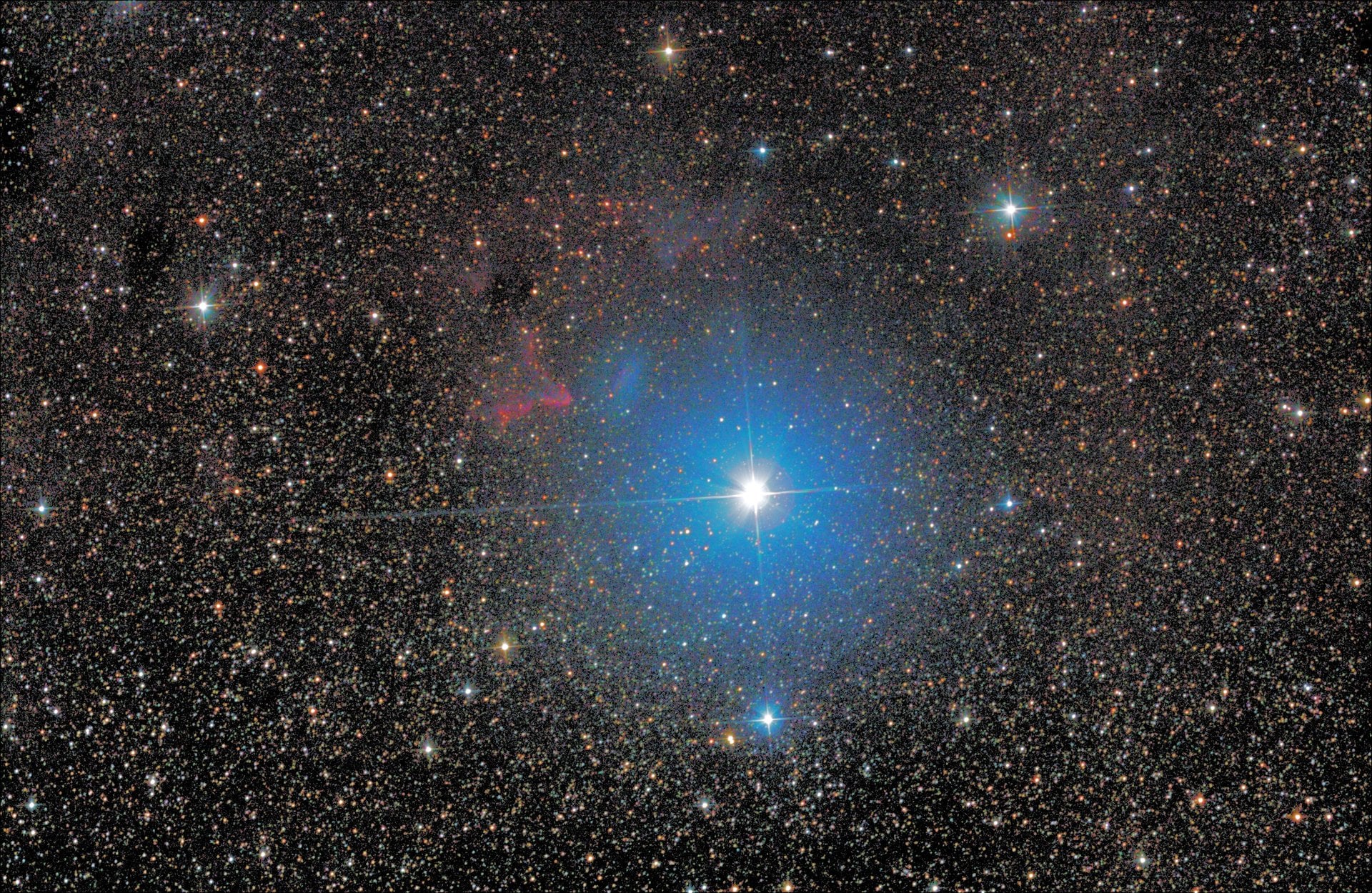
Some stars are famous for what they do, Gamma Cas on the other hand is famous for what nobody could explain. Step outside on a clear night and look north. The 'W' of Cassiopeia is one of the most recognisable shapes in the sky, and Gamma Cas sits right at its centre, it’s bright, prominent, and hiding a secret that has confounded astronomers for half a century.
The strangeness began in 1866, when Italian astronomer Angelo Secchi noticed something odd in the light of Gamma Cas. Its hydrogen signature was glowing brightly where it should have been dark, a feature so unusual that it gave birth to an entirely new class of stars, called Be stars. Decades of study eventually revealed that rapidly spinning Be stars throw off a disc of material, which produces that distinctive glow.
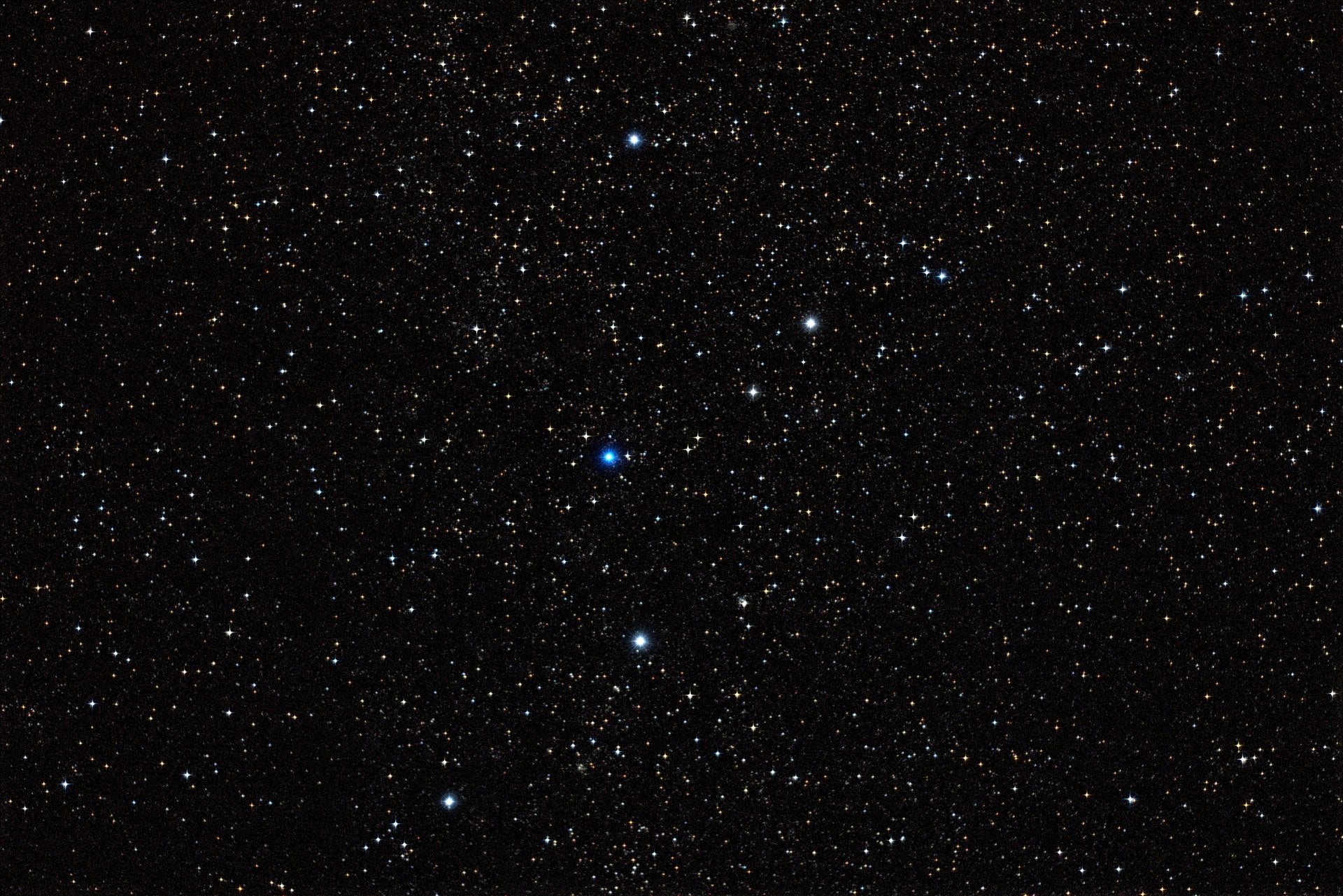 Cassiopeia in the night sky. Gamma Cassiopeia is at centre (Credit : pithecanthropus4152)
But in the mid 1970s, the mystery deepened as Gamma Cas was found to be pumping out high energy X-rays, a lot of them. The plasma producing them was a staggering 150 million degrees, and its X-ray brightness was around forty times more than you'd expect from a star of its type. The astronomical community had until now, no satisfying answer.
Two competing theories survived the decades of debate. Were the X-rays generated by magnetic interactions between the star and its surrounding disc? Or was something else, perhaps an invisible companion that was consuming material from Gamma Cas and releasing energy as it did so?
Resolving that question needed an instrument precise enough to tease apart the subtlest details in the X-ray spectrum. That instrument is XRISM (the X-Ray Imaging and Spectroscopy Mission) and its extraordinarily sensitive spectrometer, Resolve, has now delivered the verdict.
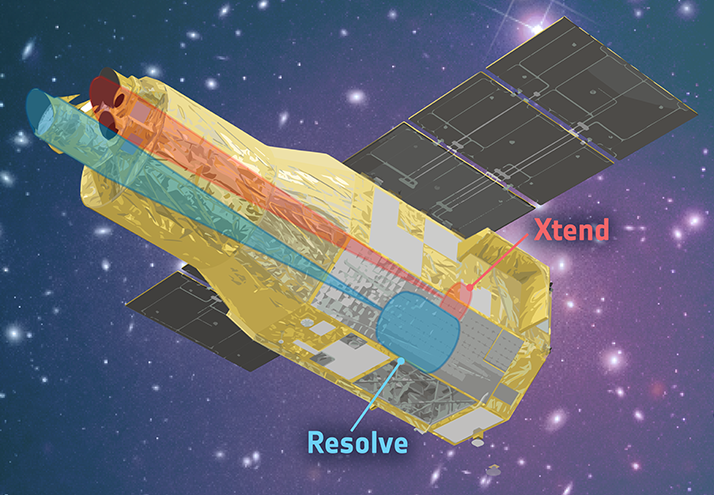 Artist impression of the X-Ray Imaging and Spectroscopy Mission with the Resolve spectrometer highlighted (Credit : ESA)
The X-ray signatures, it turns out, follow the orbital motion of Gamma Cas's companion, a white dwarf, an object with the mass of the Sun compressed to the size of the Earth, orbiting unseen and steadily feeding on material from its host. As matter spirals down onto the white dwarf, it heats to extreme temperatures and blazes in X-rays. Mystery solved.
"There has been an intense effort to solve the mystery of Gamma Cas across many research groups for many decades and now, thanks to the high-precision observations of XRISM, we have finally done it." - Yaël Nazé, lead researcher of the University of Liège.
The result doesn't just close a fifty year old case, rather annoyingly it opens a new one. Binary systems like this with a massive Be star paired with a white dwarf quietly feeding on its companion were expected to be common. They're not. They turn up far less often than predicted, and almost exclusively among high mass stars. Understanding why requires new models of how pairs of stars interact and evolve over their lifetimes.