 Universe Today
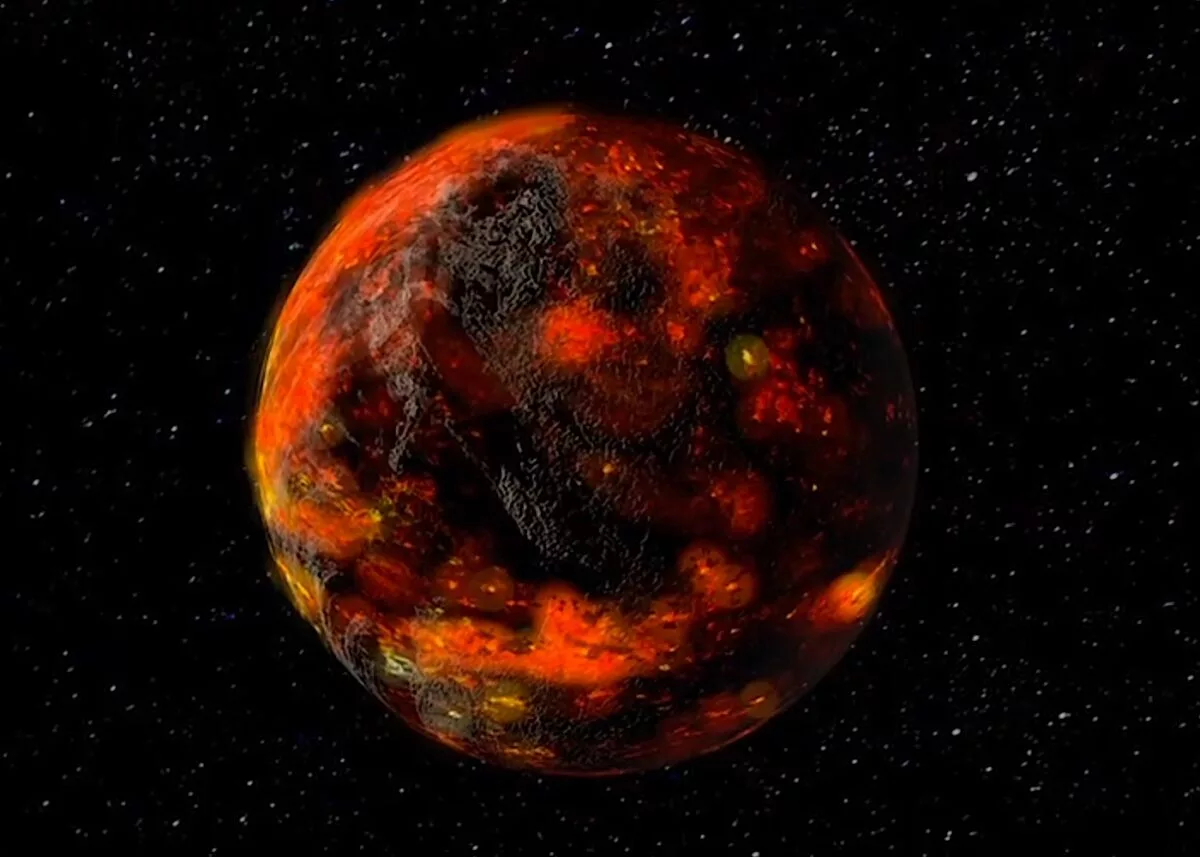
4.5 billion years ago was an interesting time for the Earth. The atmosphere was thick and what we would now think of as toxic. The Moon, which was freshly formed, looks much more massive than it does today and faintly glows with the residual heat from its own creation. And the floor was literally lava. Everywhere. If there were any children alive at the time, they would have no chance of winning that game. But for a long time, scientists had thought this molten phase of the Earth didn’t last long. But according to a new paper, available in preprint on arXiv by researchers at the Kapteyn Astronomical Institute, it might have lasted for upwards of half a billion years.
Why so long? Wouldn’t the magma that made up the Earth’s surface eventually cool down to a point where it became solid? In the long run yes, but that process can be drawn out by two competing factors - the tidal forces introduced by the newly formed Moon and the greenhouse effect of Earth’s own primordial atmosphere.
Today we know the Moon causes the ocean tides, but when it was newly formed (and much closer than it is now), it had an even more dramatic impact on the physical structure of the Earth. Since gravitational forces scale with distances, this close-by Moon kneaded the Earth’s interior like dough. This created “tidal heating” that generated massive internal heat, powering the magma oceans from within.
Fraser discusses how the Earth/Moon dynamic can create magma oceans.On the other side, Earth can radiate that heat out into space, eventually allowing itself to cool and gain a solid surface. But not if its ability to radiate that heat away was blocked by an atmosphere. The magma itself outgassed just such an atmosphere, creating a massive greenhouse effect that dwarfs anything similar happening today.
To model this dynamic between the interior heating caused by the Moon and the greenhouse effect caused by the atmosphere, the authors used a planetary evolution framework called PROTEUS. Using this framework, they found that there were several periods of this phase of the Earth when the planet was in Global Radiative Equilibrium - in other words, it was releasing heat into space at almost the exact same rate as it was being heated by the tidal forces from the Moon. During these periods, the magma wouldn’t solidify - instead the Earth’s solidification would simply stall. And according to the paper, these stalling periods could last anywhere from 2 million to 320 million years.
That wide variability is caused by one particular aspect of the Earth’s chemistry - its oxygen fugacity - in other words, how oxidizing or reducing its mantle was. If it were oxidizing, it would have held on to water until the very late stages when the magma oceans began to crystallize. When it finally did degas as steam, it would have created a massive greenhouse blanket, causing the surface to stay molten for much longer than other scenarios.
Video describing the beginning of the Earth/Moon dynamic. Credit - Spark YouTube ChannelIf, on the other hand, the mantle was reducing (i.e. dominated by hydrogen and methane), the planet would have degassed its greenhouse gases early, causing much less of a greenhouse effect. In this case, the only way the surface would have stayed molten for longer periods was if the lunar tides were much stronger than originally predicted.
Such a magma world isn’t just a nightmare for children playing The Floor is Lava - it also sounds pretty terrible for giving birth to life itself. However, according to the paper, such an extended magma ocean phase might have been exactly what life needed to get started later. The conditions during this long-term magma ocean phase, particularly for surface oxygen fugacities near the iron-wüstite buffer, resulted in an atmospheric methane to carbon dioxide ratio of around 0.1. That number might seem very specific, but it is the key to the photochemical production of hydrogen cyanide.
Nowadays, that chemical is deadly to most forms of life. But back when life first began, astrobiologists considered it a critical precursor molecule for the creation of RNA and proteins - in other words the literal building blocks of life. So Earth’s magma ocean phase, sustained by our much closer Moon, might have given Earth the time it needed to build up a surplus of prebiotic chemicals that would result in the spark of life later in the planet’s history.
We don’t know that for sure, but it is an intriguing hypothesis, and there is some logical chemistry to back it up. Whether that means Earth itself is an outlier in terms of its early conditions (big, close by moon, outgassing lava floor) remains to be seen. But the better we understand the conditions on the early Earth that eventually led to life, the more likely we are to recognize it when we finally find it somewhere else in the galaxy.
Learn More:
M.R. van Dijk, H. Nicholls, & T. Lichtenberg - Onset of habitable conditions on the Hadean Earth set by feedback between tides and greenhouse forcing
UT - A New Type of Exoplanet Has a Magma Ocean That's Lasted 5 Billion Years
UT - Deep Magma Oceans Could Help Make Super-Earths Habitable
UT - Early Earth's Oceans of Magma Accelerated the Moon's Departure

