 Universe Today
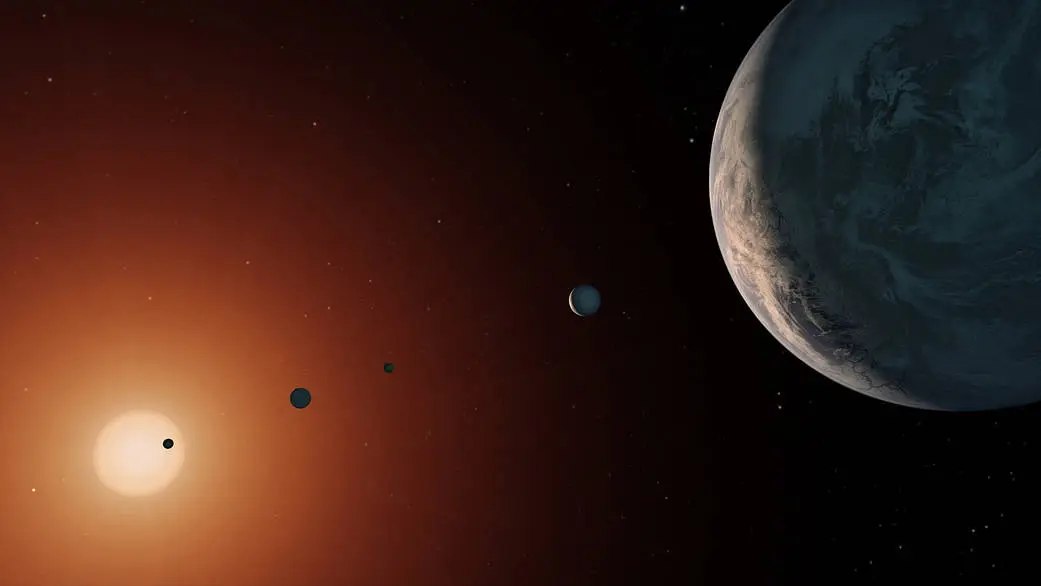
The TRAPPIST-1 system, located about 41 light years from Earth, has been a focal point of much exoplanetary discussion - mainly because it has 7 confirmed planets orbiting a dim M-dwarf star. Two of those planets - TRAPPIST-1e and -1f - are thought to be in the star’s habitable zone. However, the habitable zone of M-dwarfs is so close to the star itself the planets are likely tidally locked to it, meaning they have a permanent day and night side, with a “twilight terminator” in between. Armed with that knowledge, scientists have been attempting to model the climate on these two exoplanets, and a new paper from Jacob Haqq-Misra of Blue Marble Space uses a new type of climate model to accurately do so with much less computational power.
Typically when modeling the climates of exoplanets, scientists use three dimensional General Circulation Models (GCMs). These highly complex models explicitly calculate features like radiative transfer, atmospheric dynamics, and other physical processes. But all those calculations mean they are computationally very expensive, making them difficult to use when exploring lots of potential variables, such as the amount of carbon dioxide or stellar energy a planet might be receiving.
There are alternatives, though. Scientists also use simpler models called Energy Balance Models (EBMs). These much simpler models, which typically only run in one dimension (compared to the three in GCMs) don’t try to model every single drop of rain or wind gust. Instead they look at the energy that comes into the planet from the radiation of the host star, and that leaves the planet via radiation back out into space. Balancing these two values gives a general indication of how much warming or cooling a planet will undergo, and with much less computational intensity needed.
Fraser discusses the TRAPPIST-1 system in detail.Dr. Haqq-Misra chose a particular EBM for his work - the Habitable Energy balance model for eXoplaneT ObseRvations (HEXTOR). However, he had to modify it for a tidally locked planet by switching its coordinate axis from latitude to longitude, to model the continual energy transfer from the “day” side of the planet to the “night”, as compared to the traditional transfer of energy from the equator up to the poles on a non-tidally locked planet.
To increase the accuracy of his model, Dr. Haqq-Misra calibrated it using a look-up table of surface temperatures generated by the more computationally intensive GCMs as part of the TRAPPIST-1 Habitable Atmosphere Intercomparison (THAI) project, a community-driven project that established a standard set of exoplanet simulations that helped bind some properties of this interesting set of planets. With this calibration dataset and its longitudinal modification, HEXTOR was able to successfully recreate the global mean temperature of 240.8K for TRAPPIST-1e, essentially matching the result from the more complex THAI GCM models.
With that proof of concept, Dr. Haqq-Misra took full advantage of the simplified model, running 6,300 simulations adjusting the amount of insolation (incoming starlight) and the pressure of the carbon dioxide in the planet’s atmosphere. He found the most likely scenario for TRAPPIST-1e is a “cool” dayside, which would transition to a “warm dayside” or ice-free state only if the CO2 partial pressure is at or above approximately 0.1 bar. TRAPPIST-1f, on the other hand, is likely a “snowball” planet, with even its day side being completely covered in ice. It would require a CO2 pressure of above 1 bar to be completely ice-free on its dayside - essentially becoming a massive greenhouse.
Fraser discusses the hopes for an atmosphere on TRAPPIST-1eBut really, the HEXTOR model was never meant to provide an end result. Its real intention is to find which one of the 6,300 simulations it ran would be the most interesting to follow up with more expensive GCMs. This combination of a “scout” and follow up heavy hitting models can guide the likes of the James Webb Space Telescope as it continues to explore this interesting solar system, and possibly finds an atmosphere that could support life as we know it.
Learn More:
J. Haqq-Misra - Exploring TRAPPIST-1 Climate States with an Energy Balance Model
UT - The Solution To Finding An Atmosphere On TRAPPIST-1 e

