 Universe Today
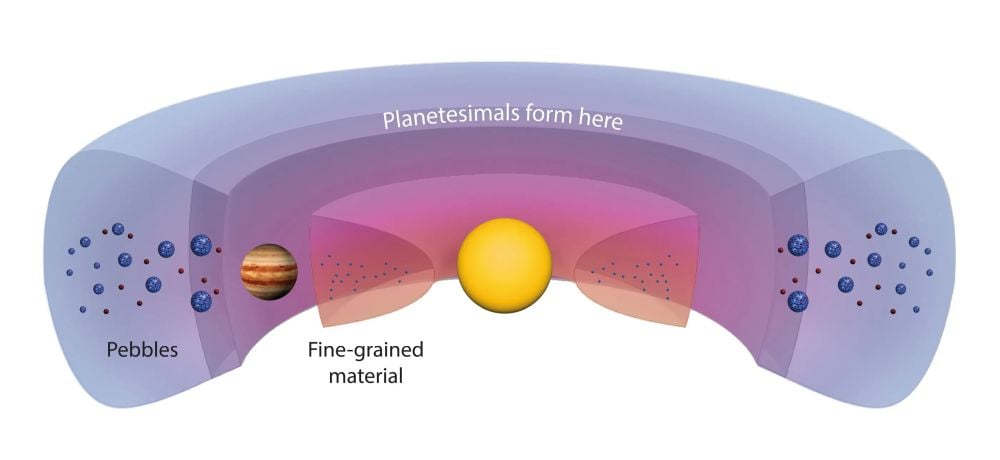
After the Sun formed around 4.6 billion years ago, the protoplanetary disk took shape around it. This rotating disk of gas and dust was the birthplace of all the other Solar System objects. The course of events in the disk determined where everything formed, from the massive gas giants like Jupiter all the way down to the smallest asteroids.
A protoplanetary disk is a complex system. While dust is a critical part of the disk and leads to the creation of bodies like planetesimals and rocky planets, it's gas that makes up most of the mass, about 99%. The gas is under different amounts of pressure in different regions of the disk, and this gas pressure influences where objects form. It can create what scientists call pressure bumps and dust traps.
New research looks at how early planetesimals formed in the disk between 2 and 4 million years after the Sun formed. While the planetesimals themselves are long gone, carbonaceous chondrites are not. These chunks of rock are pieces of planetesimals that were broken apart by collisions. Some of them have fallen to Earth as meteorites, and the research uses them and computer simulations to understand where planetesimals formed in the early days of the Solar System.
The research is "Carbonaceous Chondrites Provide Evidence for Late-stage Planetesimal Formation in a Pressure Bump," and it's published in The Astrophysical Journal. The lead author is Nerea Gurrutxaga, a PhD student at the Max Planck Institute for Solar System Research.
"Carbonaceous chondrites are samples from planetesimals that formed 2–4 million years after solar system formation began," the authors explain in their research. "They consist of distinct dust components formed at different times and locations in the accretion disk, and whose abundances in carbonaceous chondrites vary over planetesimal formation time."
But exactly what's behind these different formation times and locations is not clear. Carbonaceous chondrites (CCs) are the most primitive, and also the most diverse, of the chondrites. There are six groups of CCs distinguished by composition and age. Some CCs are made almost entirely of material that crumbles easily, while others resist crumbling. The more stable material formed early in the Solar System under the influence of heat and was then dispersed throughout the disk.
The robutst material also includes Ca-Al-rich inclusions (CAIs). These are important in this issue because they're the oldest dated solids in the Solar System. They're used to understand the Solar System's timeline because they were the first solids to condense out of the disk after the Sun formed.
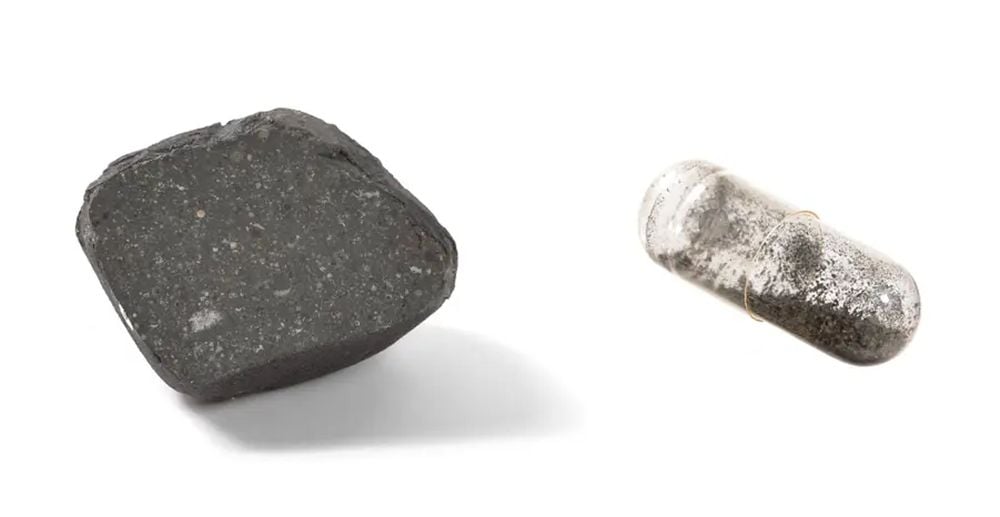 These are two different carbonaceous chondrites. The one on the left is the tougher type, and the calcium-aluminum inclusions are visible in it. The one on the right is the crumblier type. Image Credit: MPS / T. Klawunn
In this work, the researchers used simulations to focus on a region just beyond Jupiter in the 2-4 million year time frame after the Sun formed. The researchers say that understanding what happened at that point shaped planetesimal formation later in time.
"For the first time, we have succeeded in accurately reproducing the results of laboratory studies of meteorites using computer simulations of the early Solar System. The meteorites serve, so to speak, as a touchstone for theories of planetary formation," said MPS Director and cosmochemist Thorsten Kleine in a press release.
Dust is at the heart of this issue. The dust in the disk wasn't homogenous; there were different dust components in the disk, including the carbon in the carbonaceous chondrites. The dust components exist in different parts of the disk, and they moved around in the disk according to different forces, especially due to gas pressure and what are called planet-induced pressure bumps.
"Using a two-dimensional Monte Carlo simulation of dust evolution, we show that differences in dust filtering and delivery rates of distinct dust components to a planet-induced pressure bump in the disk reproduce the observed compositions and formation ages of the carbonaceous chondrites," the researchers write.
The planet they're referring to is Jupiter. When it formed, it carved out a massive gap in the disk as it accreted material. Just beyond Jupiter's orbit, a pressure bump formed, which is a ring-shaped region where gas pressure is higher. This is where the relationship between gas pressure in the disk and dust in the disk dictates whdwhere rocky bodies formed.
In the part of the disk on the inner Solar System side of this bump, the gas pressure increases as dust approaches the bump. On the outside of the bump, gas pressure decreases. But gas pressure doesn't change all at once; it changes in gradients. Just inside the bump, the gas pressure gradient is steep, making the gas orbit faster. Just outside the bump, the gas pressure drops on an outward gradient. The end result is that drifting dust stalls; the pressure prevents it from moving further inward and it gets trapped.
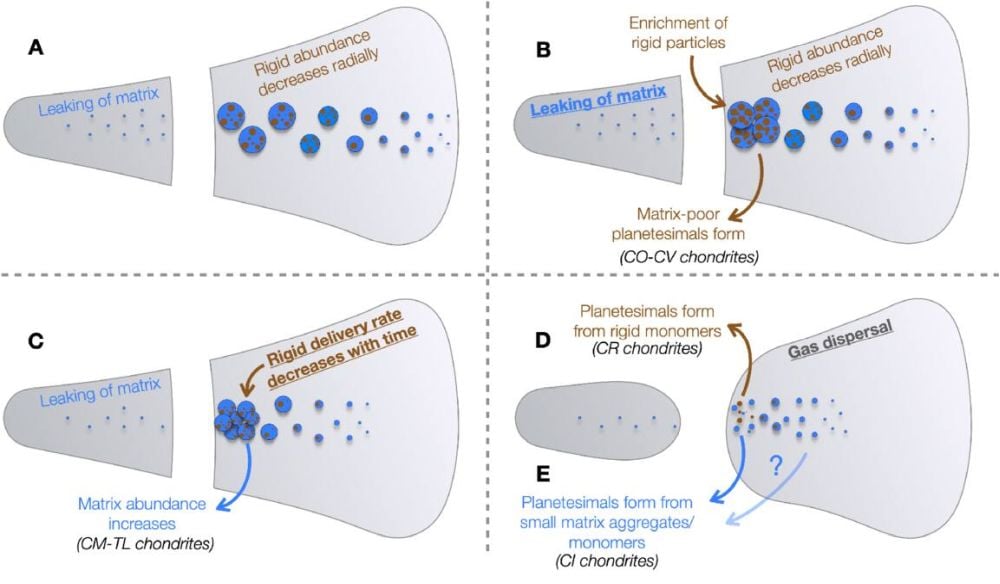 This schematic illustrates how carbonaceous chondrites formed at different times. Matrix is the fragile material, while inclusions and chondrules are the more rigid material. Both can stick together to join pebbles. "(A) Initially, about 2 Myr after CAI's form, a gap is opened by a Jupiter-like planet," the authors write. "(B) Mostly fragile material passes through the gap, enriching the pressure bump with rigid particles. Planetesimal formation begins once the pebble-to-gas ratio becomes sufficiently high. (C) Then, the delivery of rigid particles to the pressure bump declines over time due to the faster radial drift (and thereby faster depletion in the outer disk) of the largest rigid monomers. (D) Afterward, photoevaporation reduces the gas surface density by orders of magnitude, and submillimeter-sized rigid particles reach pebble Stokes numbers. (E) Finally, as the gas density continues to decrease, particle sizes are further reduced to micrometer sizes. At this late stage, planetesimal formation may extend across the disk as the gap expands during photoevaporation." Image Credit: Gurrutxaga et al. 2026. ApJ. DOI 10.3847/1538-4357/ae6104
This is how a dust trap was created, and over time, different mixes of dust were filtered into the trap. The trap is more effective on the larger and more stable particles than on the finer-grained, crumblier ones. Over time, both types of particles were trapped in different proportions. Over the first half-a-million years, crumbly material decreases, then over the next million years, it increases. That generated two populations of CCs, with the earlier one consisting almost entire of robust material, and the later one of crumbly material.
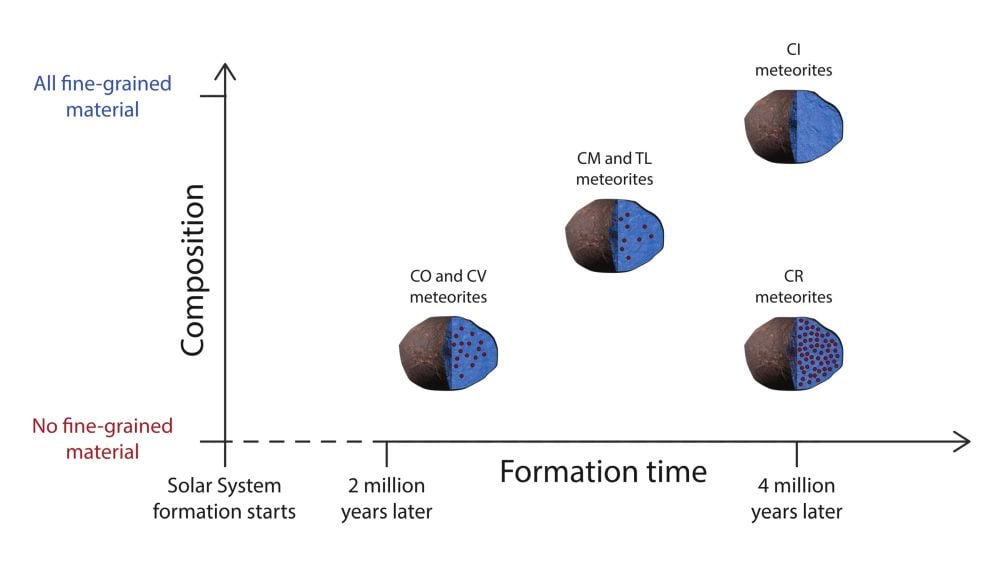 Different groups of carbonaceous chondrites (here CO, CV, CM, TL, CI, and CR) can be traced back to different generations of planetesimals that formed over the course of about two million years. They differ in their proportions of fine-grained material (shown here in blue) and calcium-aluminum inclusions (in brown). Image Credit: MPS / hormesdesign.de
The authors say that the implications are clear when it comes to the carbonaceous chondrites.
"This implies that carbonaceous chondrites likely formed in a single, long-lived dust trap, most likely outside of Jupiter’s orbit," they write.
There are two overall types of meteorites: differentiated and undifferentiated. Chondrites are undifferentiated, meaning they're pristine and have never been melted. But differentiated ones have. They're fragments of planetesimals that were once large enough to differentiate. That means they were massive enough to generate internal heat that melted the body. Heavier elements sank to the middle, while lighter elements remained nearer the surface. That's what differentiated means.
"Because differentiated meteorites, which sample an earlier generation of planetesimals, exhibit similar isotopic variability as the chondrites, they likely have also formed in dust traps, implying these structures were the dominant site for planetesimal formation in the solar system," the authors write.
This is another example of Jupiter's powerful effect on the Solar System. By creating this pressure bump and dust trap, it dictated where and how the Solar System's earliest rocky bodies formed.

