 Universe Today
As our powerful telescopes have penetrated time's veil, astronomers have confronted a number of puzzling observations of the ancient Universe. Universe Today readers are familiar with the supermassive black holes the JWST has found, and how they're challenging our understanding of black hole growth.
But there are other puzzles, too.
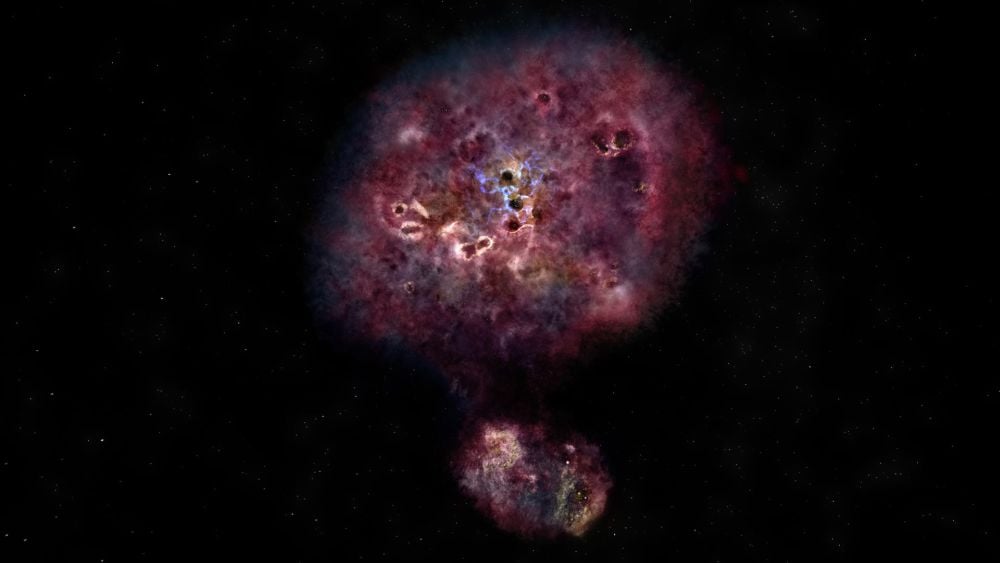
One of the most perplexing ones concerns some of the most massive galaxies in the early Universe, and why they stopped creating new stars so soon after they formed. Astronomers call these galaxies massive quiescents (MQs). Understanding their premature quenching will help build a more accurate understanding of the Universe and its myriad interacting processes.
According to observations, some early massive galaxies that formed 3 or 4 billion years after the Big Bang ceased star production only about 1 billion years after they formed. This is strange, and seems even stranger when compared to the Milky, which is more than 13 billion years old and is still producing stars, albeit slowly. What happens to MQs that strangles their star formation?
Researchers at the Institute of Astronomy, Geophysics, and Atmospheric Sciences at the University of São Paulo, along with collaborators from Denmark, the Netherlands, and the UK, think they have determined the reason for this premature quenching.
Their work is published in Astronomy and Astrophysics and is titled "The connection between dusty star-forming galaxies and the first massive quenched galaxies." The lead author is Pablo Araya-Araya, a post-Doc in the Department of Space Research and Technology, Astrophysics and Atmospheric Physics, at the Technical University of Denmark.
MQs were considered rare, though different studies have found different amounts. But since the JWST was launched, it's found even more of them, heightening the tension between observations and theory. Powerful simulations like IllustrisTNG underpredict the number of MQs by an order of magnitude, highlighting the fact that our models are not complete. Rather than having their hopes dashed, scientists embrace results like this, because it shows them where there's work to be done.
"High-redshift (z ≳ 2) massive quiescent galaxies (MQs) provide an opportunity to probe the key physical processes driving the fuelling and quenching of star formation in the early Universe," the authors write. Understanding the processes behind this could rely on studying another type of high-redshift galaxy. "Observational evidence suggests a possible evolutionary link between MQs and dusty star-forming galaxies (DSFGs, or sub-millimetre galaxies), another extreme high-redshift population."
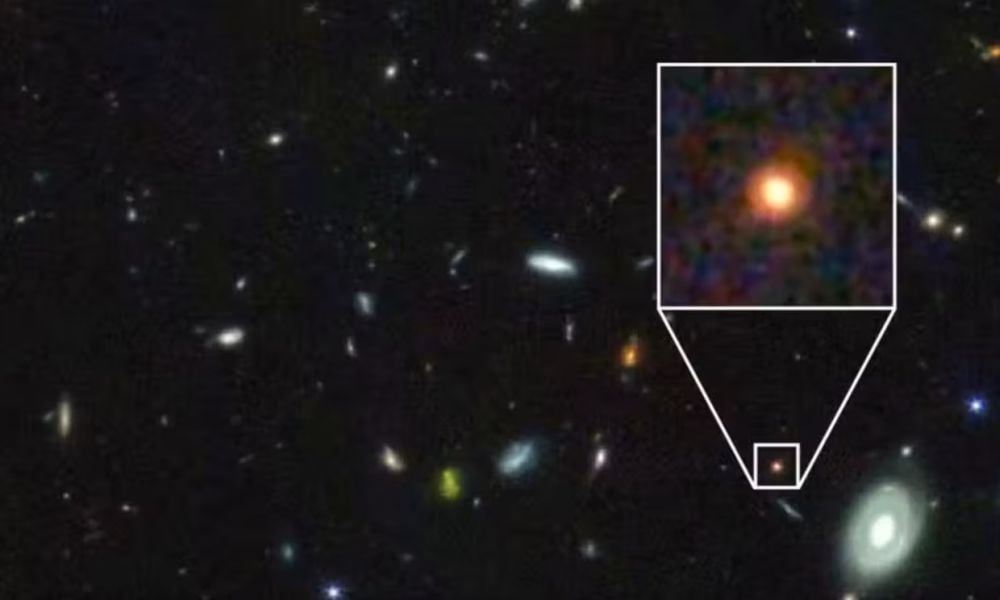 This is GS-9209, discovered by the JWST. It's a massive quenched galaxy that ceased star formation only about 1.25 billion years after the Big Bang. Image Credit: NASA/ESA/CSA JWST
"We focused on two seemingly distinct populations: dusty star-forming galaxies [DSFGs] and massive quiescent galaxies [MQs]," said Laerte Sodré Júnior in a press release. He is a retired full professor and doctoral advisor to the lead author of the study, Pablo Araya-Araya. "They formed and stopped producing stars rapidly within the first few billion years of the history of the universe."
DSFGs are the opposite of MQs. ALMA has discovered thousands of DSFGs and studied them as best it can. They're prolific star-formers, and they can produce up to 500 solar masses of stars per year, compared to the Milky Way's one solar mass per year. Though DSFGs are cloaked in thick dust that blocks optical light, they're extremely luminous in the infrared and sub-millimeter, which can penetrate all that dust.
Researchers have developed models that try to explain both the MQs and the DSFGs, but there's a trending problem in those models. "This trend–where models that reproduce MQs at high redshift tend to underpredict DSFGs, and vice versa–reveals a persistent tension in galaxy formation models," the researchers explain. "It suggests that the physical mechanisms required for efficient dust-obscured starbursts may be at odds with those needed for rapid quenching and MQ formation."
To find out what's going on and resolve the tension, the researchers ran a new model of galaxy formation on the Millennium simulation "For this work we used this new model to investigate the progenitors of MQs at z > 2 and the physical mechanisms that lead to their quenching," the researchers write.
This new model produced a better match between the observed numbers of both MQs and DSFGs, which lends strength to its results. The results show that most MQs—between 86% and 96%—first went through a phase as DSFGs. "Therefore, in our model, the progenitors of the vast majority of MQs are DSFGs," the authors write. They researchers also found that the most massive MQs were the brightest during their DSFG phase.
Major galaxy mergers that boost both supernova and AGN feedback, as well as star formation, are responsible, according to the researchers. "An early major merger dictates the evolutionary paths followed by the general DSFG population and high-redshift MQ progenitors," the authors write. These mergers not only create starbursts, they're the main driver of the growth of supermassive black holes and the resulting active galactic nuclei.
"The merger of the two galaxies concentrated large amounts of gas in the core, simultaneously triggering an extreme burst of star formation and intense feeding of the supermassive black hole," Sodré summarized. "In that process, the cold gas is rapidly consumed while the energy released by the active nucleus heats the surrounding halo gas and prevents it from cooling and being reincorporated into the galaxy, blocking the supply of raw material for new stars and halting star formation in less than one billion years," explained Sodré.
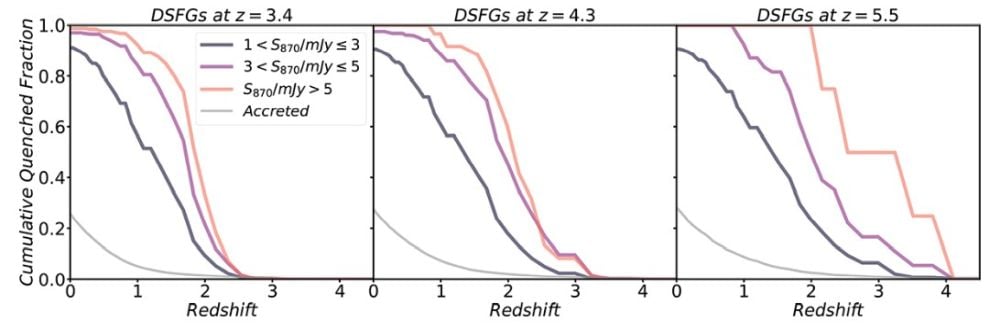 This figure shows DSFGs at three different redshifts. It shows the "Cumulative fraction of dusty star-forming galaxies (DSFGs) selected at z = 3.4, 4.3, and 5.5 (from left to right) that become massive and quiescent as a function of redshift," the authors explain. Each colored line is a different sub-millimetre flux density, while "The grey line indicates the fraction of DSFGs that were accreted by a more massive galaxy," write the authors. Overall, it shows that the brighter DSFGs become quenched more rapidly than fainter ones. Image Credit: Araya-Araya et al. 2026. A&A. https://doi.org/10.1051/0004-6361/202557426
"In this context, merger events can simultaneously boost both supernova (SN) and AGN feedback," the authors write, and this is the key finding. The mergers generate a starburst which shows up as infrared and sub-millimetre DSFGs. But then the SN and AGN feedback quench star formation.
"We find that the rapid quenching of high-redshift MQs is driven by early mergers that result in overmassive SMBHs relative to the stellar mass of MQ progenitors. Consequently, less AGN feedback energy is required to quench star formation in these systems," the researchers explain.
Most galaxies don't follow this path. They grow slowly, in more measured ways. Their gas is consumed more slowly and their extinction comes later. For them, major mergers occur later in their evolution, and the effects aren't as pronounced.
Their are still discrepancies between this model and observations. In some aspects, it doesn't match observations. For one thing, it can't reproduce the number of MQs the JWST found in its most recent observations. "We're observing far more galaxies with submillimeter emissions than we predicted," said Sodré.
But scientific results don't have to be perfect to be productive. These results will feed into more observations and modelling in the future, and over time, our understanding of galaxy evolution will also evolve.

