Universe Today
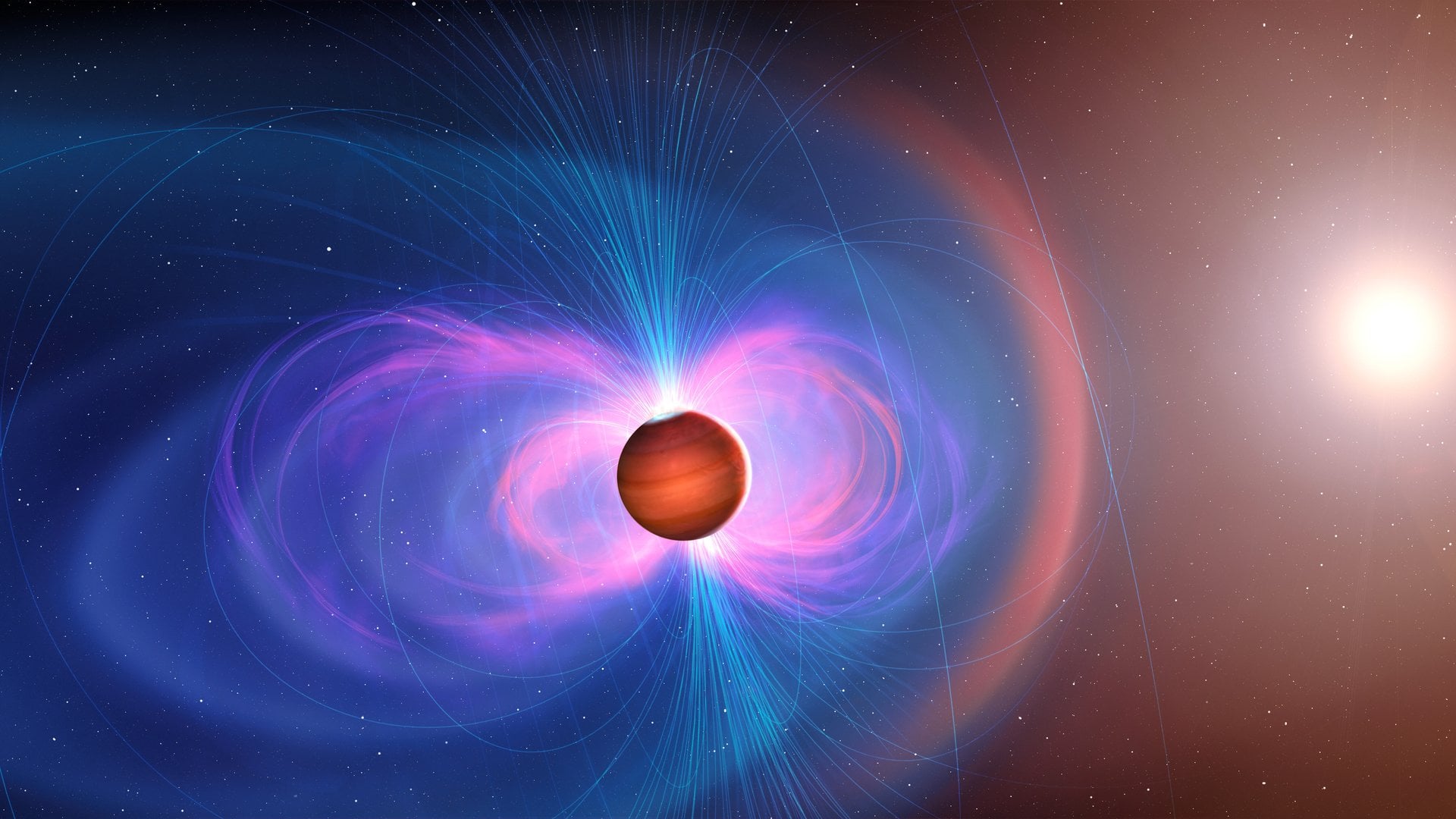
Astronomers studying wind speeds on distant exoplanets have discovered weather systems driven by magnetic fields, rather than the largely hydrodynamic weather patterns observed on Earth. This discovery is among the best evidence yet for the existence of magnetic fields on exoplanets.
“This breakthrough opens a completely new window on exoplanet research. It’s the first time we can compare the magnetic environments of other worlds — a key step toward ultimately understanding which planets can stay alive, keep their water, and perhaps even, one day, host life as we know it,” said Julia Seidel, Laboratoire Lagrange, Observatoire de la Côte d’Azur, who led the study.
The exoplanets in question were Ultra-hot Jupiters, massive gas giants orbiting close to their stars. They are tidally locked, so the same side of the planet always faces the star. The extreme temperature difference between the night and day sides helps drive extreme winds, far beyond anything seen in our solar system. On Jupiter, the fastest wind speeds reach 900 miles (1,500 kilometers). Among the seven Ultra-hot Jupiters observed as part of the study, the wind speeds ranged from 4,400 miles (7200 kilometers) to a whopping 15,500 miles (25,000 kilometers).
But the strange thing is that these speeds, fast as they are, are actually slower than expected if temperature was the sole factor affecting them.
Using observations from the Gemini North telescope in Hawaii and the Very Large Telescope in Chile, the team noticed that planets with higher temperatures had slower wind speeds: exactly the opposite from what hydrodynamic models would suggest. Something is slowing the winds down.
“This is totally counterintuitive because, all things being equal, hot planets have more energy to accelerate the winds! Something must happen that slows down the wind speeds for hotter objects,” explained study co-author Vivien Parmentier, Laboratoire Lagrange, in a press release.
Astronomers believe that something is a planet-wide magnetic field.
The data gathered allowed the team to determine the approximate strength of the magnetic fields on each planet, and they found that they are roughly comparable to similar-sized planets in our solar system, with fields four times as strong as Saturn and about half as strong as Jupiter.
This is the first time anyone has successfully measured the strength of a planetary magnetic field outside our solar system.
Neither of the telescopes used in the study has the ability to directly observe exoplanets. Instead, they use the radial velocity method, in which they detect slight wobbles in the spectrum of light coming from a star, indicating the presence of planets in the star’s orbit. This works because planets tug gravitationally on their star, inducing a motion that can be observed in the incoming light spectrum. Using this method, large planets close to their star are easier to find.
For these Ultra-hot Jupiters, the team was able to dissect the light spectrum to look for the presence of a specific chemical signature, in this case vaporized iron atoms present in the planets’ atmospheres. In the spectral data, this takes the form of an expected pattern: the iron lines. From there, the team were able to measure the pattern’s doppler shift, giving them the planetary wind speed measurements that made the discovery possible.
It’s an extraordinary bit of interstellar detective work, and sets the stage for further analysis of exoplanetary weather patterns and magnetic fields.
The study was published in Nature Astronomy on June 2, 2026.