 Universe Today
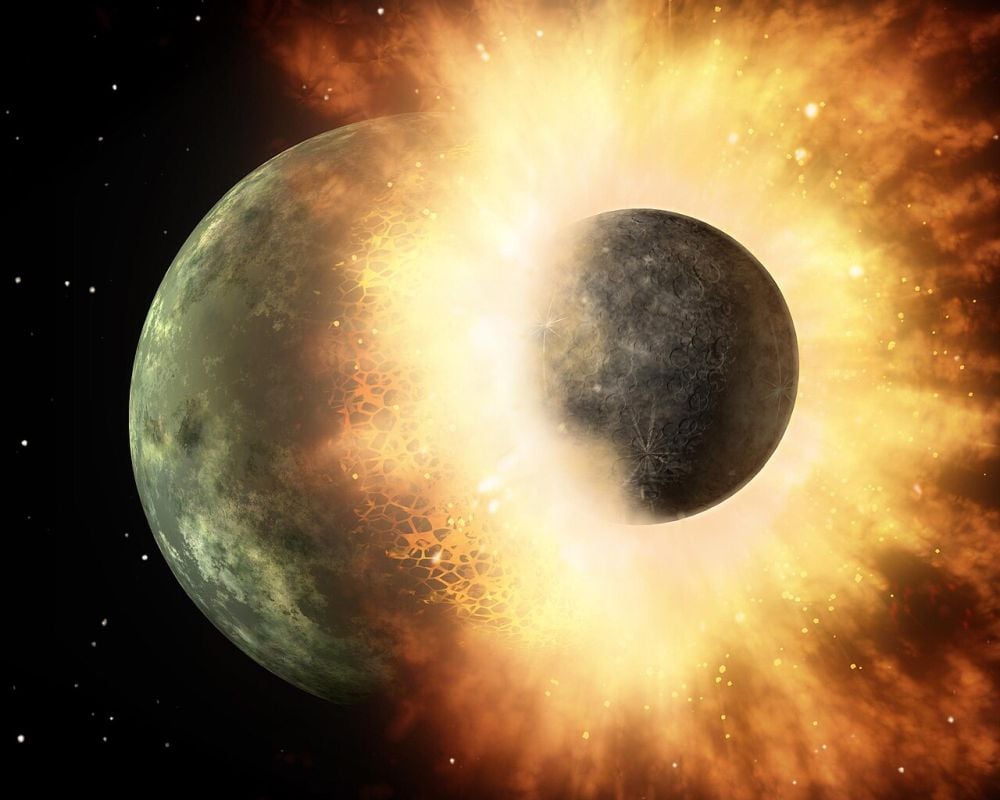
Earth's formation was a messy process. It all happened about 4.5 billion years ago, in our young chaotic Solar System. Rocky planetesimals were whizzing around in the Solar System back then, and Earth formed as more of these objects collided and merged with it.
Some of these collisions were giant impacts that generated immense heat. These were common in the later stages of Earth's formation, after the protoplanetary disk had largely dissipated and atmospheric accretion was complete. Planetary scientists have wondered how young planets like Earth could've held onto their atmospheres near the end of their accretion period. The massive heat from giant impacts should've driven primordial He/H atmospheres away. But new research suggests that simple picture doesn't capture some important details, and that giant impacts could've actually helped young rocky planets retain their atmospheres.
The work is titled "Retention of primordial atmospheres through giant impacts," and it's published in Nature Astronomy. The authors are Darius Modirrousta-Galian and Jun Korenaga. Modirrousta-Galian is a former Yale postdoc who is now at Shanghai Jiao Tong University, and Korenaga is a professor of Earth and planetary sciences in Yale’s Faculty of Arts and Sciences.
This research focuses on what happens near the end of a rocky planet's accretion process, after the protoplanetary disk has largely dissipated. This is when other planetesimals had also grown large through their own accretion processes, and when they collided with a planet like Earth, they released an enormous amount of energy.
“Giant impacts are a key part of how rocky planets grow,” said co-author Korenaga. “Planets the size of Earth or larger are expected to form through collisions between smaller planetary bodies. These collisions add mass and release enormous amounts of heat, which can drive atmospheric escape. Their effect on a planet’s atmosphere depends on how those two changes work together.”
Modirrousta-Galian and Korenaga have been working on how planetary interiors and atmospheres evolve together and have published several papers on the topic. Their previous research laid the foundation for this work.
Their work shows that increased heat near a planet's surface isn't the only result of impacts. Some of that heat is driven deep into the planet. The impact can also "increase atmospheric gravitational binding," according to the researchers.
There are two components of a giant impact: heat and mass.
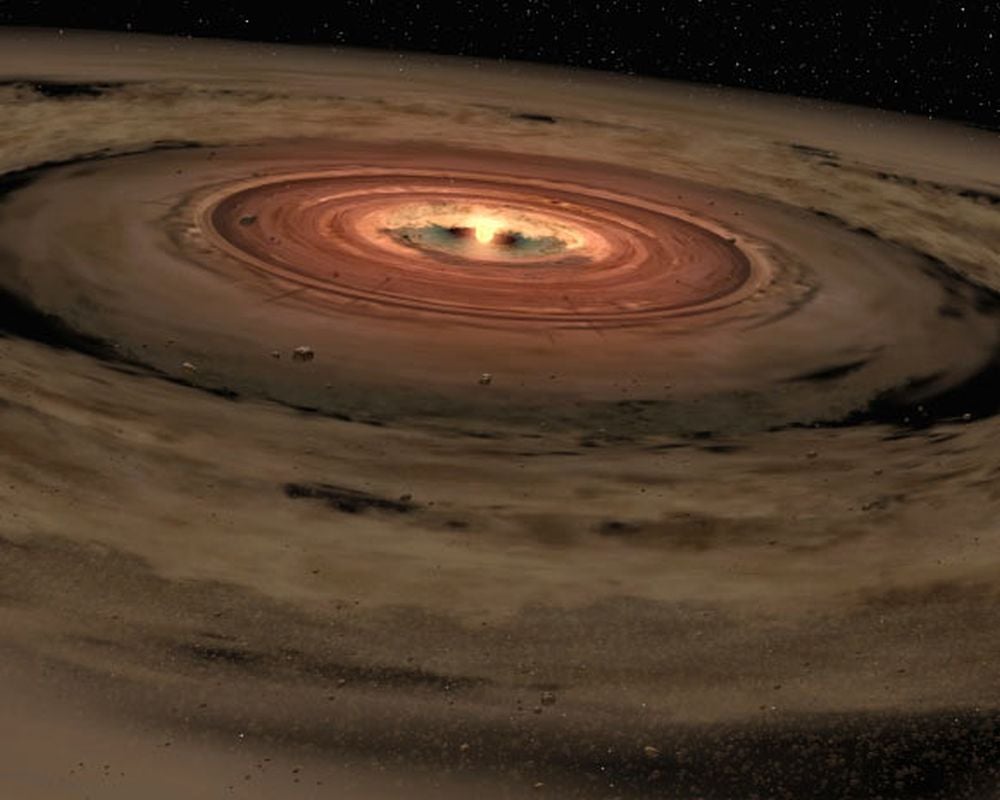 This illustration shows planetesimals in a disk around a young star. Rocky planets grow by accretion of planetesimals, and as time goes on, the planetesimals become more massive. When these massive planetesimals impact young planets, they not only generate heat, they add mass. Image Credit: NASA / JPL-Caltech.
When a planetesimal smashes into a rocky planet, the heat can be divided into two separate components. Some of it is driven more deeply into the planet where it won't drive away the atmosphere. Some of it will be mantle heat that does contribute to driving the primordial atmosphere away. But the mass gained by the accretion of the planetesimal isn't divided. All of that mass gives the planet more power to hold onto its atmosphere.
"Whereas the entire accreted mass contributes to the increase in gravitational binding energy, only part of the impact energy raises mantle temperature," the authors explain. "Mantle melting consumes energy as latent heat, while the impactor’s metallic core transfers little energy to the mantle and remains superheated at depth."
"Giant impacts therefore increase gravitational binding energy more than mantle thermal energy, shifting planets towards atmospheric retention," the researchers explain.
This understanding can help explain the exoplanet population.
Astronomers used to think that our Solar System was an archetype of how other solar systems would look. There would be rocky planets in the inner Solar System, gas giants further out, and ice giants beyond them. But exoplanet discoveries have cast doubt on that. The most common types of detected exoplanets aren't even represented in our Solar System: super-Earths and sub-Neptunes.
Astronomers think that super-Earths and sub-Neptunes could represent two types of planets that started out as rocky cores but ended up with much different atmospheres. Super-Earths have lost their atmospheres, while sub-Neptunes have retained more of their primordial atmospheres. A sub-Neptune only needs to retain a few percent of its H/He atmosphere to have an extended puffy atmosphere that can increase its radius by a large amount.
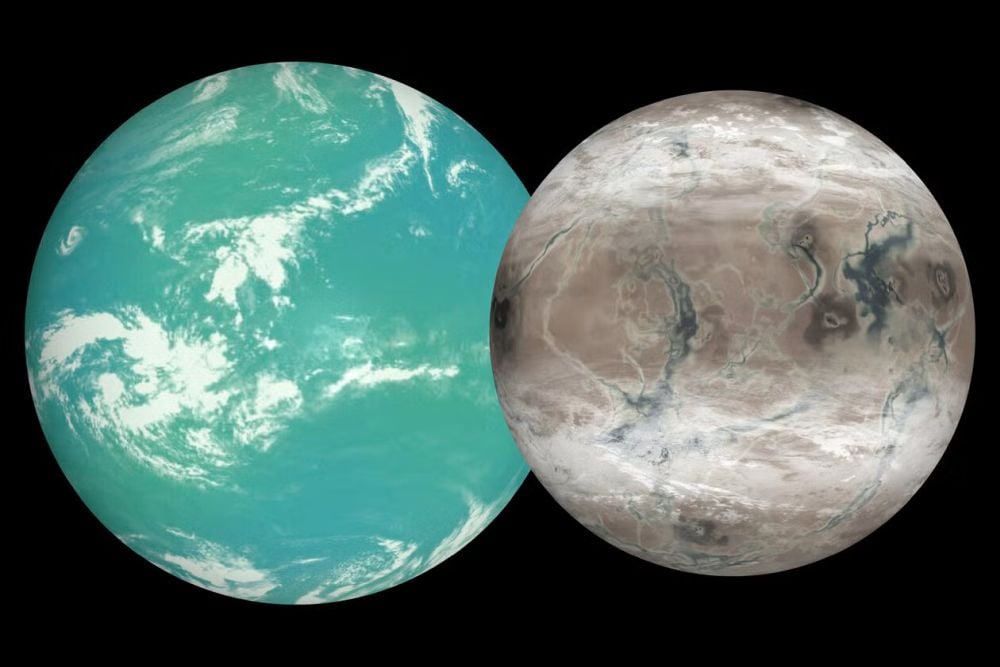 These are artist's impressions of the super-Earth Kepler-452b (right) and the sub-Neptune Kepler-22b (left). They're very different from each other, and both types of exoplanet are abundant in exoplanet discoveries. Giant impacts could explain their abundance. Image Credit: NASA.
“Why nature produces both types in such abundance is a fundamental puzzle in exoplanetary science,” said Modirrousta-Galian. “We set out to find an explanation.”
This research shows that sub-Neptunes could have grown larger through more massive impacts, and those impacts not only added mass but allowed them to retain larger atmospheres. Super-Earth's weren't subjected to those same massive impacts, and so did not gain enough mass to retain their atmospheres the same way that sub-Neptunes did. They lost theirs due to stellar radiation.
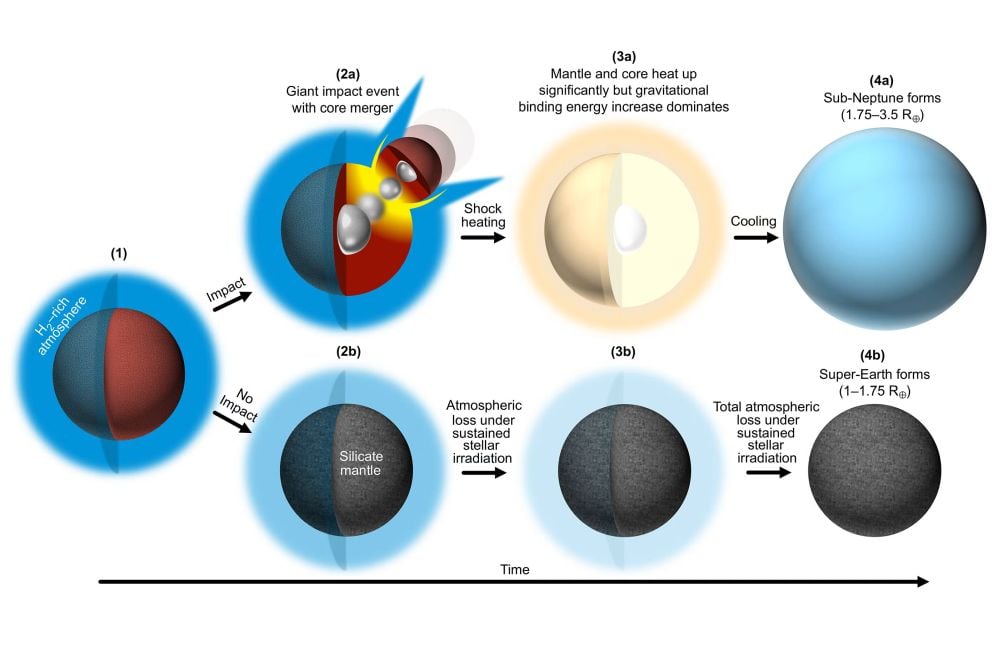 This schematic shows different outcomes for rocky planets. In one scenario, massive impacts onto a rocky create a more massive planet that can retain more of its primordial atmosphere: a sub-Neptune. In the other scenario, there are no massive impacts, no increase in rocky mass, and the planet retains less of its atmosphere. Image Credit: Darius Modirrousta-Galian
"Larger, atmosphere-bearing planets emerge preferentially through collisional growth," the researchers explain. "By contrast, smaller planets without such impacts tend to lose their primordial atmospheres under sustained stellar irradiation. At the population level, these results suggest that sub-Neptunes have, on average, more massive rocky interiors than super-Earths."
These results appear to overturn the long-held idea that giant impacts spelled doom for planetary atmospheres, and in turn, for the prospects of habitability. Primordial H/He atmospheres themselves didnt create habitability. But some research shows that they're essential for the development of a world that is eventually habitable, through interactions with a young rocky planet's magma ocean. These interactions may have been a significant source of Earth's water and could be on other rocky worlds, too.
“This overturns the decades-old canonical view that giant impacts almost always lead to complete atmospheric loss, demonstrating instead that these collisions can play a crucial role in the formation of sub-Neptunes,” Korenaga said.

