 Universe Today
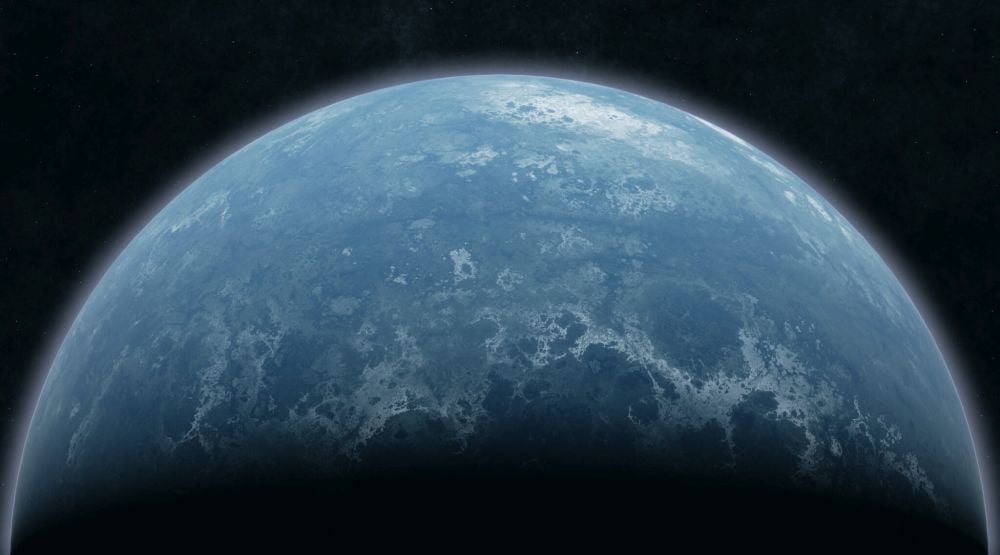
In the search for life elsewhere in the galaxy, astronomers sift through exoplanet discoveries looking for ones that could be habitable. That means rocky planets with atmospheres in habitable zones. But one thing stymies these efforts. Can we examine atmospheres and differentiate between an exoplanet that's habitable and one that's actually inhabited?
That's difficult, partly because exoplanets are so far away, and also because we only have Earth to guide us. It's the only habitable and inhabited world we know of. But new research shows how we can work with those facts to try to detect inhabited worlds.
The work is "A Whole-planet Model of the Earth without Life for Terrestrial Exoplanet Studies," and it's published in The Planetary Science Journal. The lead author is Samantha Gilbert-Janizek, who was a postdoctoral astronomy student at the University of Washington when conducting this work.
"As the only known habitable (and inhabited) planet in the Universe, Earth informs our search for life elsewhere," the authors write. "Future telescopes like the Habitable Worlds Observatory (HWO) will soon look for life on rocky worlds around Sun-like stars, so it is critical that we understand how to distinguish habitable planets from inhabited planets."
Observatories like the Habitable Worlds Observatory (HWO) will inject new energy into the search for life. They will shift exoplanet science from identifying worlds that could be habitable, to identifying worlds with atmospheres showing signs of life. But as the researchers point out, we still don't know how to tell inhabited worlds, if there are any, from those that are merely habitable.
"Earth is currently the only known inhabited planet in the Universe, and geological evidence suggests that it was habitable with liquid-water oceans for most of its 4.54 Gyr history," the authors write. "Owing to its long-term habitability, Earth serves as the template that guides our search for biospheres elsewhere."
The researchers tackled this issue by building a sort of virtual Earth, but one without life.
"As a first step toward answering these questions, we present a coupled interior-atmosphere evolution model of the Earth without life from 50 Myr to 5 Gyr that reproduces 19 key observations of the preindustrial Earth after 4.5 Gyr within estimated measurement uncertainties," the researchers explain. Those 19 observations included atmospheric CO2 and H2O, surface temperature and albedo, ocean mass, and even factors like upper-mantle temperature and upper-mantle heat flow. These non-biological factors all shape a planet's atmosphere and have to be accounted for.
"Though exoplanet interiors themselves will likely never be directly observable, the effects of interior evolution are apparent in the composition of the atmosphere and the albedo of the surface environment, both of which HWO will observe on Earth-like planets around Sun-like stars via reflected-light spectroscopy," the authors explain.
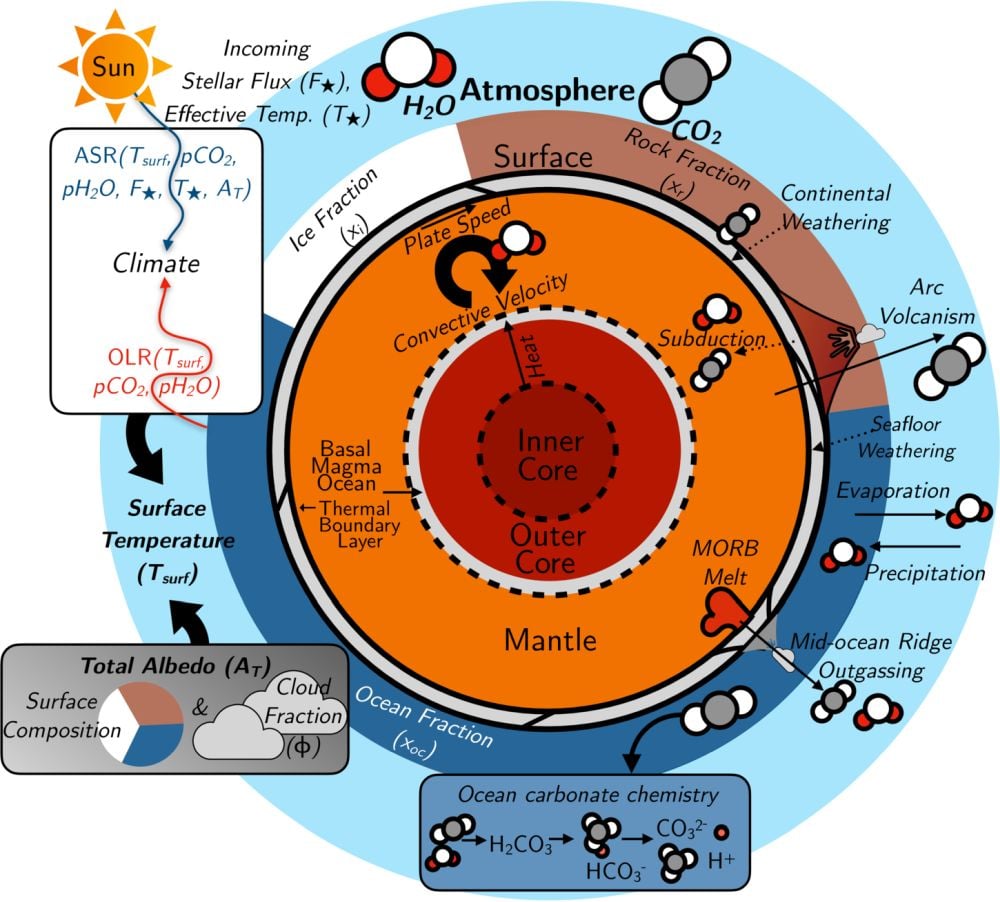 This schematic shows some of the key processes included in the abiotic Earth model. Remotely observable quantities (surface temperature, albedo, and atmospheric H2O and CO2) are in bold. Image Credit: Samantha Gilbert-Janizek et al 2026 Planet. Sci. J. 7 216
The researchers also produced reflected light spectra of the model Earth that covers the likely wavelength range of the HWO. They used a code to compute a "synthetic HWO reflected-light spectra (0.2–2.0 μm) for the true Earth and the abiotic Earth’s atmospheric state after 4.5 Gyr," the authors write. These included line absorptions for CO2, H2O, O2, O3, and CH4.
This virtual Earth without life can serve as a benchmark to compare with detailed atmosphere observations of habitable worlds.
“This model can help us see how habitable but non-living planets might mimic living planets,” lead author Gilbert-Janizek said. "When we interpret observations of an exoplanet’s atmosphere, this tool will help us determine the probability that what we observe indicates life on the surface.”
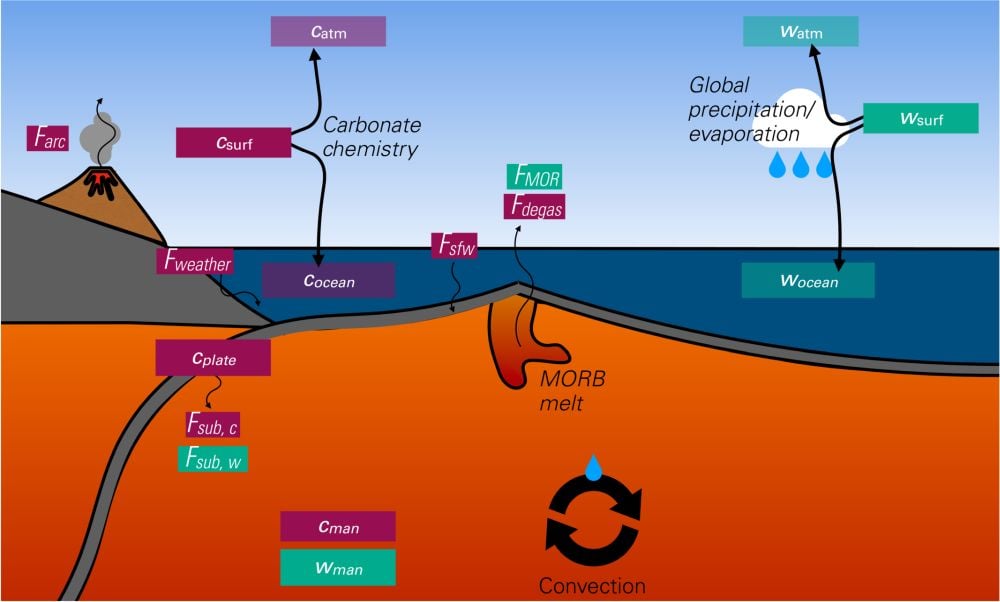 This schematic shows the atmospheric sources and sinks that define the new volatile cycling processes in the model. Fluxes related to CO2 are color-coded magenta, and fluxes related to H2O are color-coded teal. The schematic doesn't include ocean chemistry. Image Credit: Samantha Gilbert-Janizek et al 2026 Planet. Sci. J. 7 216
Gilbert-Janizek didn't start from scratch. Senior author Rory Barnes, a UW associate professor of astronomy, had already built a model that included the core, mantle, crust and stellar radiation. This work added the surface and the atmosphere to build a more comprehensive model.
The authors hope that this model can serve as a kind of plug-and-play model that can be adjusted to fit with any particular exoplanet being studied. They can input factors like albedo and atmospheric CO2 and test what happens. If the model then recreates the observations of the planet, it suggests that the exoplanet in question is uninhabited.
Naturally, an undertaking of this size and complexity requires some assumptions. The model initializes after Earth's magma ocean solidified, and that dictated the atmosphere's initial composition. The authors say they chose an initial set of conditions "that apply after the bulk of the mantle has solidified."
They also assumed that plate tectonics were active during all of Earth's history beginning in the middle Hadean, which is widely believed to be true and in line with evidence. There are alternative hypotheses saying that this wasn't the case. One says that plate tectonics only began when it shifted from a stagnant-lid to modern plate tectonics during the Archaean, but the researchers avoided that.
Other assumptions were made regarding atmospheric pressure, the strength of Earth's geodynamo, and even atmospheric escape of hydrogen. But these types of assumptions are a normal part of science and are explained up front.
But the virtual Earth model successfully reproduces the properties of the Pre-Industrial Earth, and that's the most important thing. It also predicts that a planet can maintain habitable conditions for a long time without requiring the presence of life. This is relevant because false positives are one of the HWO's challenges.
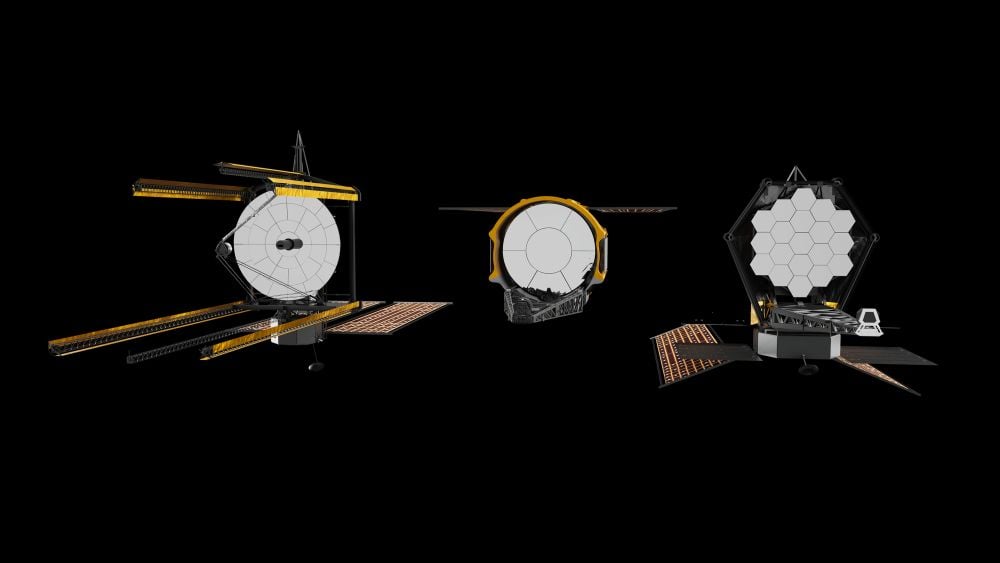 These are three Engineering Architecture Concepts (EACs) for the Habitable Worlds Observatory. Each one features a different mirror design. EAC-1 is a 6m, segmented, off-axis telescope. EAC-2 is the same but uses a round keystone mirror and surrounding segments. EAC-3 is an 8m on-axis telescope with round segments. Not shown is the extendable, protective barrel that each design has, which will protect the mirror from micrometeorites. Image Credit: NASA Goddard/Conceptual Image Labs
“Dr. Gilbert-Janizek’s work represents an exciting step toward understanding where life can exist in the universe,” Barnes said. “After more than a decade of work by many scientists, Dr. Gilbert-Janizek has finally completed a model of the Earth that simultaneously reproduces properties of Earth’s core, mantle, surface and atmosphere. That calibration gives us confidence that future simulations of exoplanets will be accurate.”
The question "Are we alone in the Universe" can be asked in one breath but not answered in one. It has to be broken down to much smaller questions asked and answered across many generations. Even "Are we alone in the Milky Way" is far too large and encompassing a question. "Are we alone" has to be asked exoplanet by exoplanet, and that requires tools of the sort developed by Dr. Gilbert-Janizek and her colleagues.
Our first 6,000 exoplanet discoveries were bulk discoveries. But the search is becoming more targeted toward Earth-like planets, meaning tools like this one are becoming more and more necessary. The upcoming HWO, if it gets built, places this point in even finer focus.
“Realizing the ambitious goals of a telescope like the Habitable Worlds Observatory requires decades of work across many generations of scientists,” Gilbert-Janizek said. “I’m so grateful to join this lineage and one day pass the torch to the next generation so that we can continue chipping away at this question of whether or not we are alone in the universe.”

