Universe Today
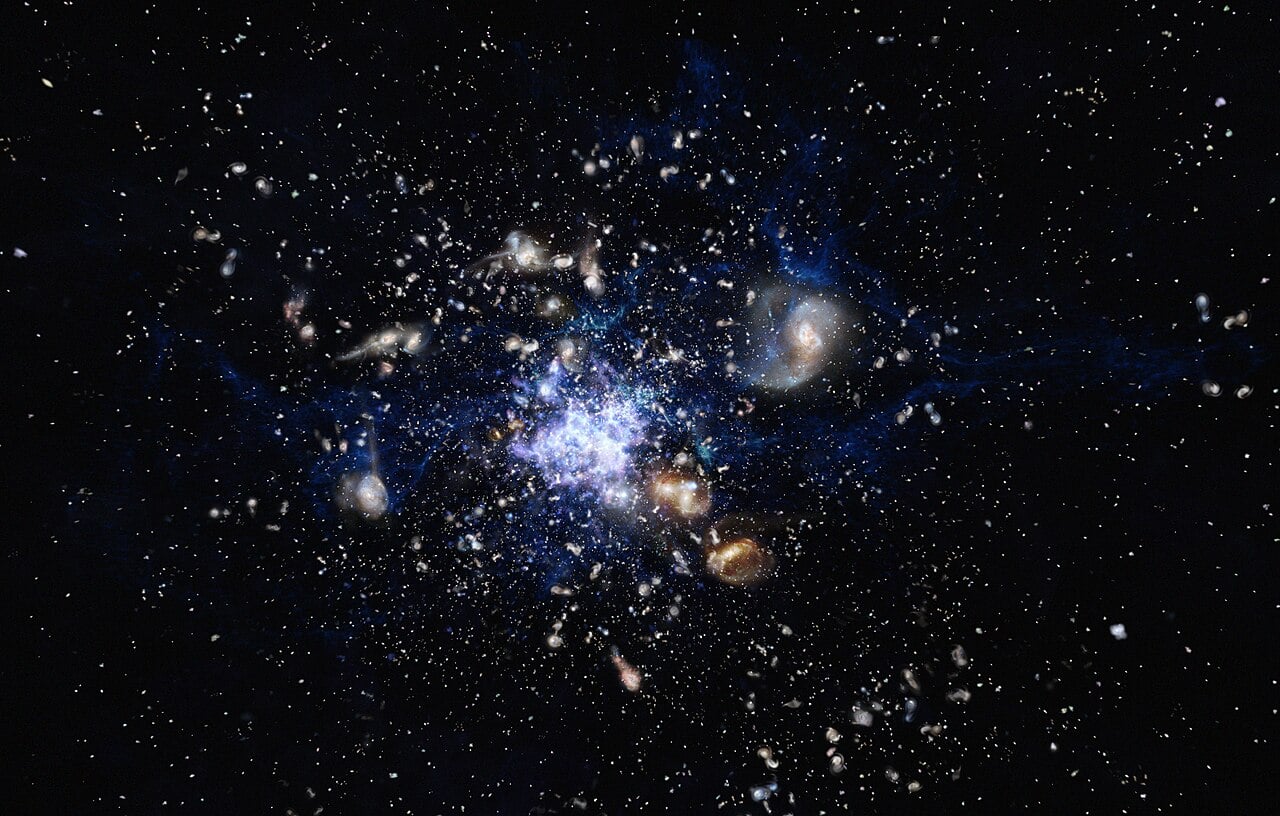
Imagine trying to study the foundations of an ancient city while it's still being built. The noise is deafening, the dust is everywhere, and the whole place is barely visible through the haze. That is almost exactly the challenge astronomers face when trying to understand how vast cities of hundreds of galaxies first came into being. A new discovery has just given them their best look yet.
Using two of the Very Large Array radio telescope in New Mexico and the ALMA telescope high in the Chilean Atacama Desert astronomers have uncovered a remarkable object called J0846. It is a protocluster, an early stage galaxy cluster where gravity is busy assembling what will eventually become one of the most massive structures in the universe. But this one has a very special trick up its sleeve.
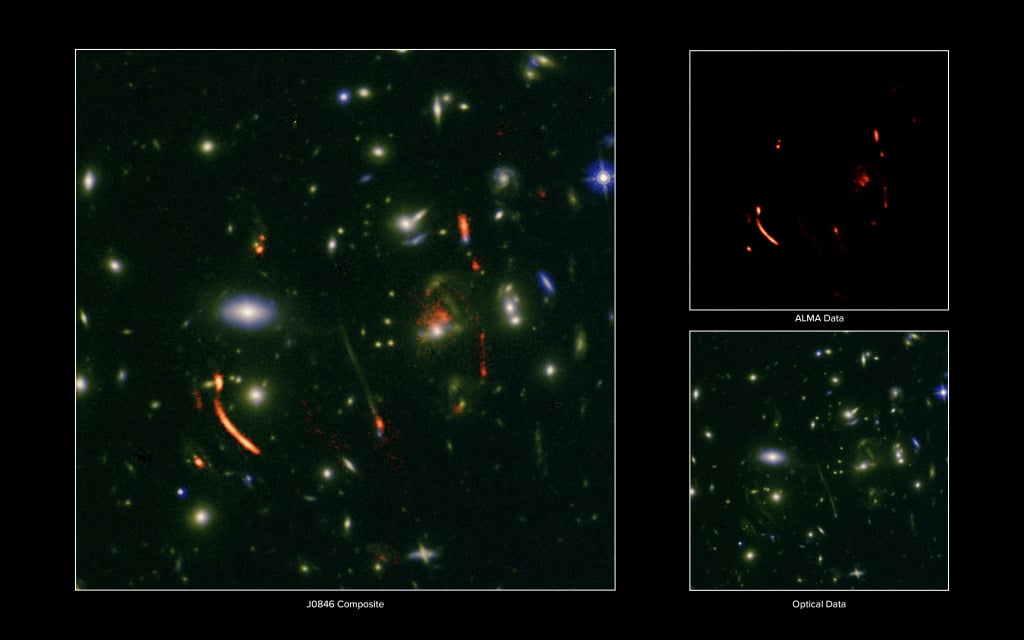 The galaxy cluster lens J0846 in optical light (bottom right), the ALMA view strongly lensed into bright arcs (top right), and a composite view (left) revealing at least 11 dusty galaxies in a compact protocluster core more than 11 billion light years away (Credit : NSF/AUI/NSF NRAO/B. Saxton; NSF/NOIRLab) gnified by the foreground cluster’s gravity. Credit: NSF/AUI/NSF NRAO/B. Saxton; NSF/NOIRLab
Sitting almost perfectly between us and J0846 is another, closer galaxy cluster and that cluster is acting as a gravitational lens. The immense mass of the foreground cluster bends and amplifies the light from the more distant protocluster behind it, making it appear far brighter and larger than it would otherwise. It’s the universe doing our job for us, providing a zoom lens that no human engineer could build.
The result is the first strongly lensed protocluster core ever discovered and when it was studied through the magnifying glass, they found something startling. What had previously looked like a single bright smudge of light in older telescope data turned out to be at least eleven separate galaxies, all crammed into a region of space smaller than the distance between our own Milky Way and the Andromeda Galaxy next door.
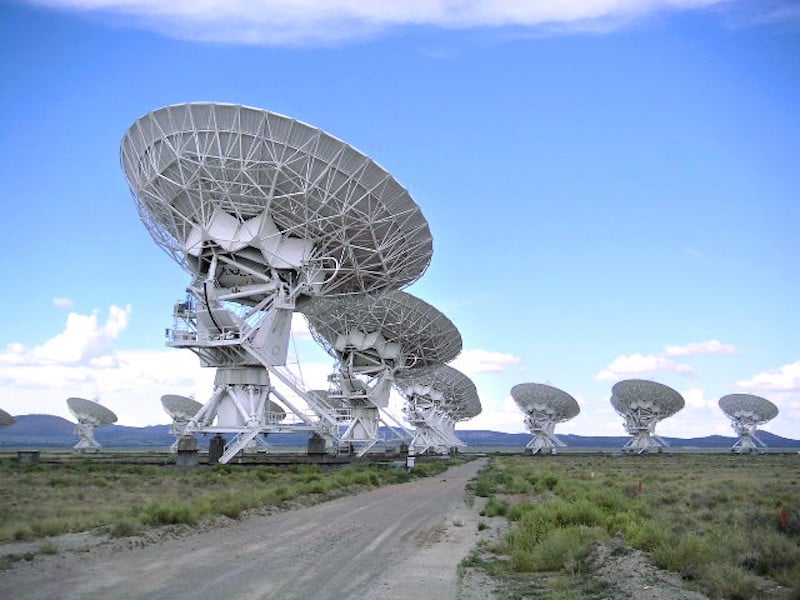 The Very Large Array in New Mexico (Credit : Hajor)
What makes these galaxies so dramatic is what they are doing. Each one is undergoing a starburst, a period of furious, almost frenzied star formation, pumping out new stars at a rate that would make our own Galaxy look thoroughly lazy. They are also absolutely shrouded in dust, which absorbs their visible light and hides them entirely from ordinary optical telescopes. ALMA's ability to detect the faint glow of cold dust and gas cuts straight through this cosmic fog, revealing the raw material being consumed to build all those stars.
The lead researcher, Nicholas Foo, a graduate student at Arizona State University, compared the whole scenario to an archaeologist digging through layers of history. The foreground cluster is the mature modern city, the protocluster behind it is the ancient settlement it grew from. The further back in space you look, the further back in time you see and in this case, astronomers are peering back more than eleven billion years to catch a galaxy cluster in its very first chapter. What was once just a faint smudge in old survey data has turned out to be one of the most extraordinary objects in the early universe.
Source : Cosmic Lens Reveals Hyperactive Cradle of Future Galaxy Cluster