 Universe Today

The Search for Extraterrestrial Intelligence (SETI) is mostly concerned with where to look for technosignatures from another civilization. Between 2012 and 2015, SETI's Project Phoenix targeted about 1,000 Sun-like stars for signs of Intelligent life. But where to look might not be as important as when to look, according to scientists at SETI.
In a new paper, scientists outline the effort to search for signals not only in the right place, but at the right time. The paper is "A Technosignature Survey Of The Anti-Solar Point: The SETI Institute's Largest-Ever Campaign With The Allen Telescope Array," and it was presented at the 77th International Astronautical Congress. The authors are Isabel Gerrard and Sofia Z. Sheikh. Gerrard is the Technosignature Researcher with Breakthrough Listen at the University of Oxford, and Sheikh is a SETI Institute Research Scientist.
“The challenge in SETI isn’t simply deciding where to point a telescope. It’s figuring out where and when another civilization might choose to transmit." - Dr. Sofia Sheikh, SETI Institute Research Scientist.
The new search effort doesn't do away with the "where" aspect of the search. Since life exists around stars, this search is still focused on stars, or rather the planets that orbit them. But it's different this time. This time it involves a point changes over time, called the antisolar point. It's the point in space-time that's directly opposite from the Sun from the perspective of an observer.
Imagine a line extending from the Sun, through an observer on Earth, and out the other side. It's not fixed in place; it's an abstract point defined by changing coordinates that shifts as the Earth orbits the Sun.
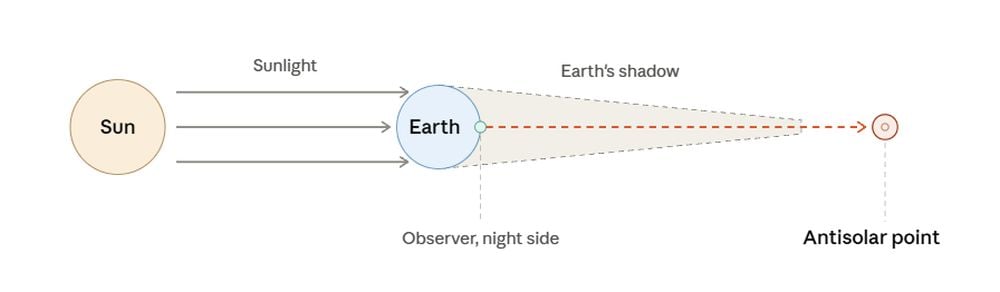 This simple static illustration shows the antisolar point. (created with AI)
This new SETI effort is also inspired by game theory. Game theory is a way of anticipating another player's moves in a game, when their moves are also based on their anticipations of your next move. The most well-known example of game theory is probably the Prisoner's Dilemma. In this case, the other player is another intelligent civilization conducting their own SETI-like effort.
What it boils down to is trying to predict when and where we can detect a purposeful transmission from another civilization and send our own, and also when and where they're doing the same.
"We borrow from game theory the concept of Schelling points to hypothesize spacetime coordinates where both we and an extraterrestrial agent might send and search for a signal," the authors write. Schelling points are also called focal points in game theory. "From the perspective opposite the Sun, an extraterrestrial agent could detect Earth transiting within the habitable zone, thus this Anti-Solar Point (ASP) poses a shared and salient Schelling point."
Resources are limited, and the better we or an alien civilization can use them, the greater the chances of success. If they can figure out the most effective time and place to send a radio signal, they increase their chances of success. The same is true for us. There's a synergy in it.
"A Schelling point is a default solution two agents both naturally arrive at, without communication, because of some shared cultural understanding of prominence in the given context," the authors write. "The predictability of a Schelling point relies on a common understanding of the prominent features in this context, and the mutual awareness of each other’s knowledge."
So without any prior communication, both we and another extraterrestrial agent would identify the same place to send and receive signals: the antisolar point. The choice is based on our shared understanding of astronomical transits, or what we call the transit method in the hunt for exoplanets. It's almost certain that another civilization would also use this method because it presents itself naturally.
"It follows that if an ETA (Extraterrestrial Agent) also used the transit method in their search for life, they would detect Earth against the Sun as habitable and classify Earth as an eligible target for interstellar communication," the researchers explain.

This simple animation shows how the antisolar point moves and how an exterrestrial observer would detect Earth's transit. (AI-generated)
At the midpoint of Earth's transit in front of the Sun, from the ETA's perspective, Earth would be directly between them and the Sun. "From the perspective opposite the Sun, once each year an extraterrestrial agent could detect Earth transiting within the habitable zone, thus this antisolar point poses a shared and salient time-coordinate Schelling point," the authors write.
The search using the Allen Telescope Array and the antisolar point is called the ATA-ASP survey. It's a multiyear effort, and its initial findings are already here. Because it's based on the ASP, the survey isn't constant, it's intermittent. As Earth orbits the Sun, the ASP keeps changing, and it takes several years to cover it.
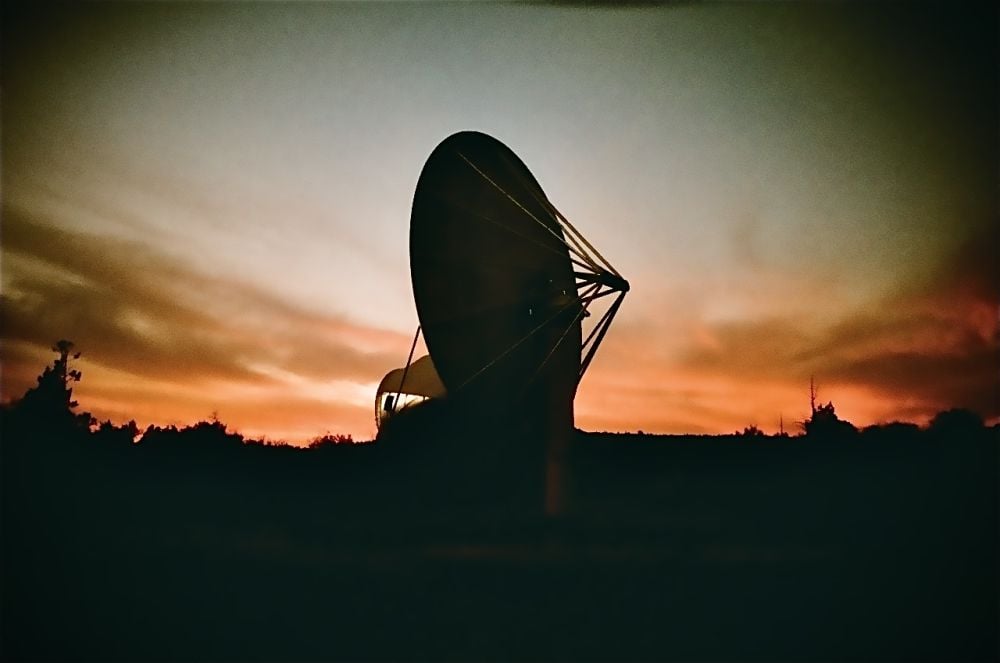 One of the Allen Telescope Array's dishes. The ATA-ASP survey will be the ATA's largest survey effort, collecting 11 petabytes of data over four years. Image Credit: Photo taken by Isabel Gerrard and edited by Ananya Kalapatapu
"Provided that half of the ecliptic is inaccessible in a year (the portion that is daytime), the campaign requires at least two years of observing sessions to sample every possible ASP along the ecliptic," the authors explain. "Furthermore, due to the ∼ 365.25 day orbit of the Earth (inciting the leap day every 4 years), the accessible nighttime portion of the ecliptic slightly precesses in successive years, ergo total survey coverage requires staggering observations over the course of four years." For these reasons, the ATA isn't solely occupied with the ATA-ASP survey.
The first pilot results are from August August 30th, 2024 until August 25th, 2026. Obviously, ATA-ASP didn't detect any alien signals or we would've almost certainly heard about them already. But for SETI, the results mark a milestone. Searching the ASP for signals was first proposed decades ago, and now they've finally done it.
ATA-ASP detected an enormous number of radio signals, about 1.9 million in 17 hours of observations. But they were all from human sources. Those detections were still an important test of the system though.
As things stand now, the ATA-ASP campaign has gathered another 121 nights of observations since the initial pilot. Those results haven't been shared yet.
“The challenge in SETI isn’t simply deciding where to point a telescope,” said co-author Sheikh. “It’s figuring out where and when another civilization might choose to transmit. The anti-solar point gives us a way to think about that problem from the perspective of a potential sender, rather than just the receiver.”

