 Universe Today
Artificial Intelligence (AI) and Machine Learning (ML) are making a growing contribution to astronomy. As powerful telescopes and large automated surveys become more commonplace, the vast quantities of data they generate demand equally powerful diagnostic tools. The Vera Rubin Observatory and its enormous data-generating capacity drive the point home. The observatory's Legacy Survey of Time and Space generates up to 20 terabytes of data each night, and that data is processed at a dedicated facility.
The Rubin Observatory is the current queen of data generation, but exoplanet hunting missions like Kepler and TESS generate their own data that needs analysis. Scientists are still processing it, and as time goes on, they're making more and better use of AI and ML to "mine" that data for unrevealed exoplanets.
One group of scientists have developed a ML tool aimed solely at TESS. It's called RAVEN, which stands for RAnking and Validation of ExoplaNets. The scientists who developed it describe RAVEN as "a newly developed vetting and validation pipeline for TESS exoplanet candidates."
In newly published research, a team of exoplanet researches used RAVEN to focus on TESS transit data for more than 2 million stars. It's titled "Automatic search for transiting planets in TESS-SPOC FFIs with RAVEN: over 100 newly validated planets and over 2000 vetted candidates," and it's published in the Monthly Notices of the Royal Astronomical Society. The lead author is Dr. Marina Lafarga Magro, a Postdoctoral Researcher at the University of Warwick.
"Despite the large number of confirmed exoplanets, there is an even higher number of candidates yet to be confirmed," the researchers write. "One of the main challenges in the confirmation of candidate transiting planets is the numerous false positives (FPs) common in these kinds of searches." False positives include eclipsing binary stars, signals from stellar variability or instrument systems, and "hierarchical systems producing transits in background or nearby stars." These can look like transiting planets and processing pipelines can get confused.
In this work, the researchers focused on exoplanets very close to their stars. "We aim to detect candidates with periods within 0.5 − 16 days," the authors explain. This includes planets with orbital periods of less than one Earth Day, called Ultra-Short Period planets (USP). These planets are interesting for may reasons. Scientists think they couldn't possible have formed where they now reside and think they must have migrated. Their atmospheres have also been blasted away by their stars. They're also easier to detect due to their tight proximity to their stars.
RAVEN's results are impressive.
“Using our newly developed RAVEN pipeline, we were able to validate 118 new planets, and over 2,000 high-quality planet candidates, nearly 1,000 of them entirely new,” lead author Magro said in a press release. “This represents one of the best characterised samples of close in planets and will help us identify the most promising systems for future study.”
Some exoplanet populations are in need of better understanding, and RAVEN validated members of several different populations. These include the USPs, multi-planet systems on close orbits, and exoplanets in the Neptunian Desert. The Neptunian Desert is a quirk in the exoplanet population. It's a region close to a star where exoplanets follow orbital periods of about 2 to 4 days. Astronomers have found very few Neptune-mass exoplanets in this zone.
TESS identified exoplanets by the dimming of the star as the planets passed in front of it. While effective, it's prone to false positives.
"The challenge lies in identifying if the dimming is indeed caused by a planet in orbit around the star or by something else, like eclipsing binary stars, which is what RAVEN tries to answer. Its strength stems from our carefully created dataset of hundreds of thousands of realistically simulated planets and other astrophysical events that can masquerade as planets. We trained machine learning models to identify patterns in the data that can tell us the type of event we have detected, something that AI models excel at.” said Warwick’s Dr Andreas Hadjigeorghiou, who led the development of the pipeline.
“In addition, RAVEN is designed to handle the whole process in one go, from detecting the signal, to vetting it with machine learning and statistically validating it. This gives the pipeline an additional edge over contemporary tools that only focus on specific parts of the workflow."
The researchers stress that RAVEN is more than just another automated machine-learning tool, and does more than build a list of potential exoplanet candidates. It's robust enough to "map the prevalence of distinct types of planets around Sun-like stars,” according to Dr David Armstrong, an Associate Professor at Warwick University and senior co-author.
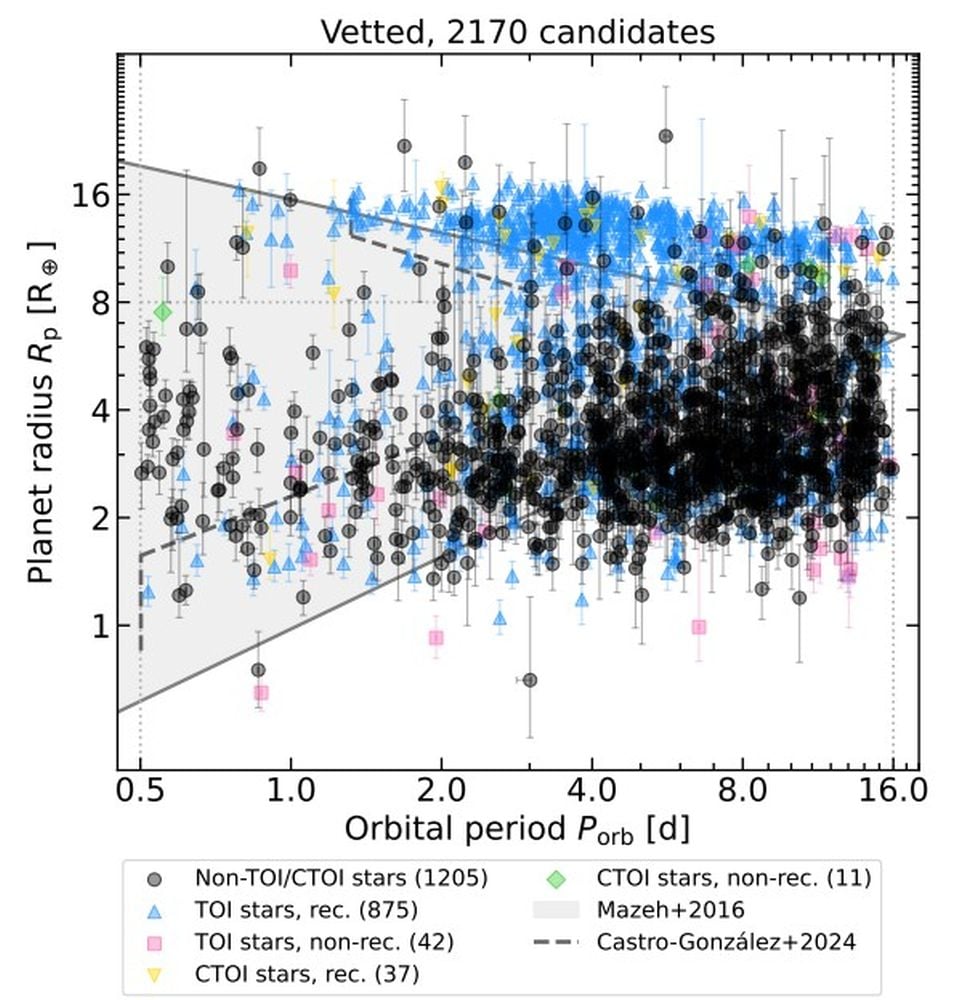 This figure shows the 2,170 candidates RAVEN found in the TESS data. Over half of them are new candidates, shown as non-Tess Objects of Interest / Community Tess Object of Interest. "Solid grey lines and grey-shaded area show the Neptunian desert limits, and dashed grey lines show the recently derived limits between the Neptunian desert, ridge, and savannah," the authors write. Those three features define the population of Neptune sized exoplanets with short orbital periods. Image Credit: M. Lafarga et al. 2026. MNRAS.
RAVEN's results let them map out orbital period and planet size in greater detail than previous efforts. This is critical in exoplanet science. Headlines often trumpet the discovery of a single new planet with intriguing properties, but those aren't representative of the exoplanet population. What scientists really desire is a more detailed understanding of the exoplanet population. Nature's true patterns only emerge from better data. How planets form, evolve, develop atmospheres and geological cycles—and even how they migrate—is the key to understanding how a world like Earth came to be, and how it has remained habitable for billions of years.
In that context, studying exoplanets that have no chance of being habitable is still relevant. The researchers were able to determine the frequency of close-in exoplanets around Sun-like stars and also to build a more thorough understanding of the Neptune desert.
The results show that about 8% to 10% of stars similar to the Sun host close-in planets. That agrees with the results from the Kepler mission, but in this case, RAVEN was able to very effectively reduce the uncertainty in the Kepler data.
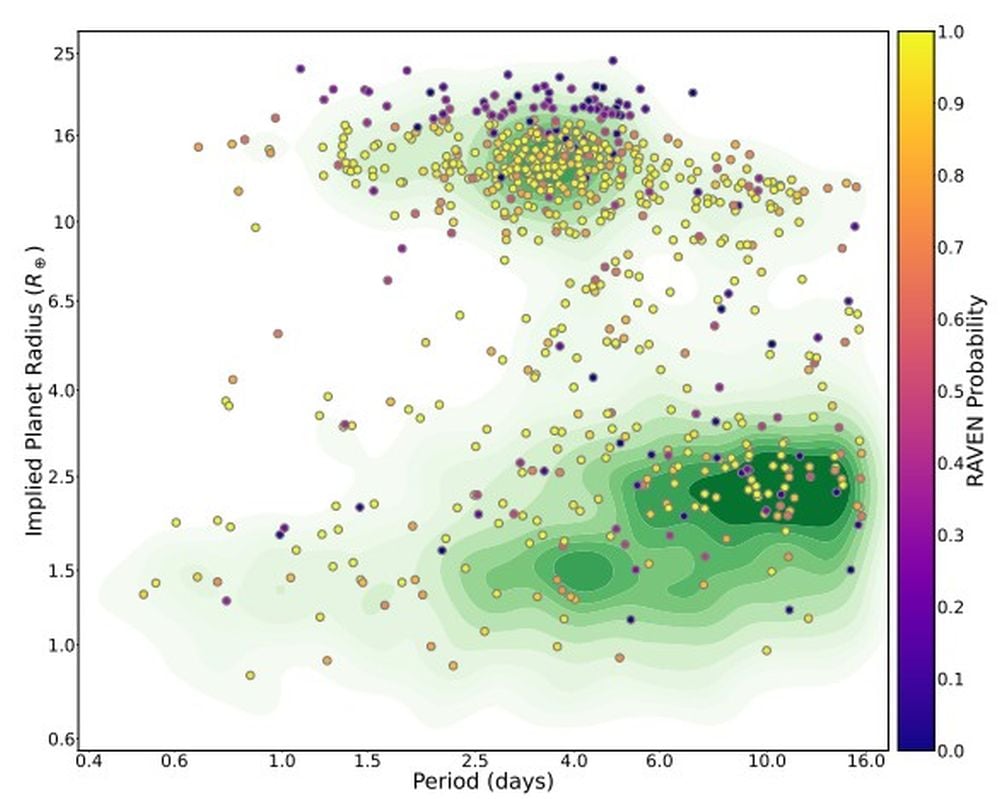 This figure is a Radius-Period plot in logarithmic scale for 705 Planet TOIs in the sample. They're overlaid over a density plot of the known planet population with orbital periods less than 16 days. The planet TOIs are shaded based on their RAVEN Probability to illustrate the tool’s performance across the parameter space. Image Credit: Hadjigeorghiou et al. 2026. MNRAS.
The results also show that the Neptune desert is indeed a nearly barren exoplanet wasteland. Only 0.08 % of Sun-like stars are orbited by a planet in the Neptune desert.
“For the first time, we can put a precise number on just how empty this ‘desert’ is,” said Dr. Kaiming Cui, a Postdoctoral Researcher at Warwick University. Cui is also the first author of a companion study titled "Demographics of close-in TESS exoplanets orbiting FGK main-sequence stars," also published in MNRAS.
“These measurements show that TESS can now match, and in some cases surpass, Kepler for studying planetary populations,” Cui said.

