Universe Today
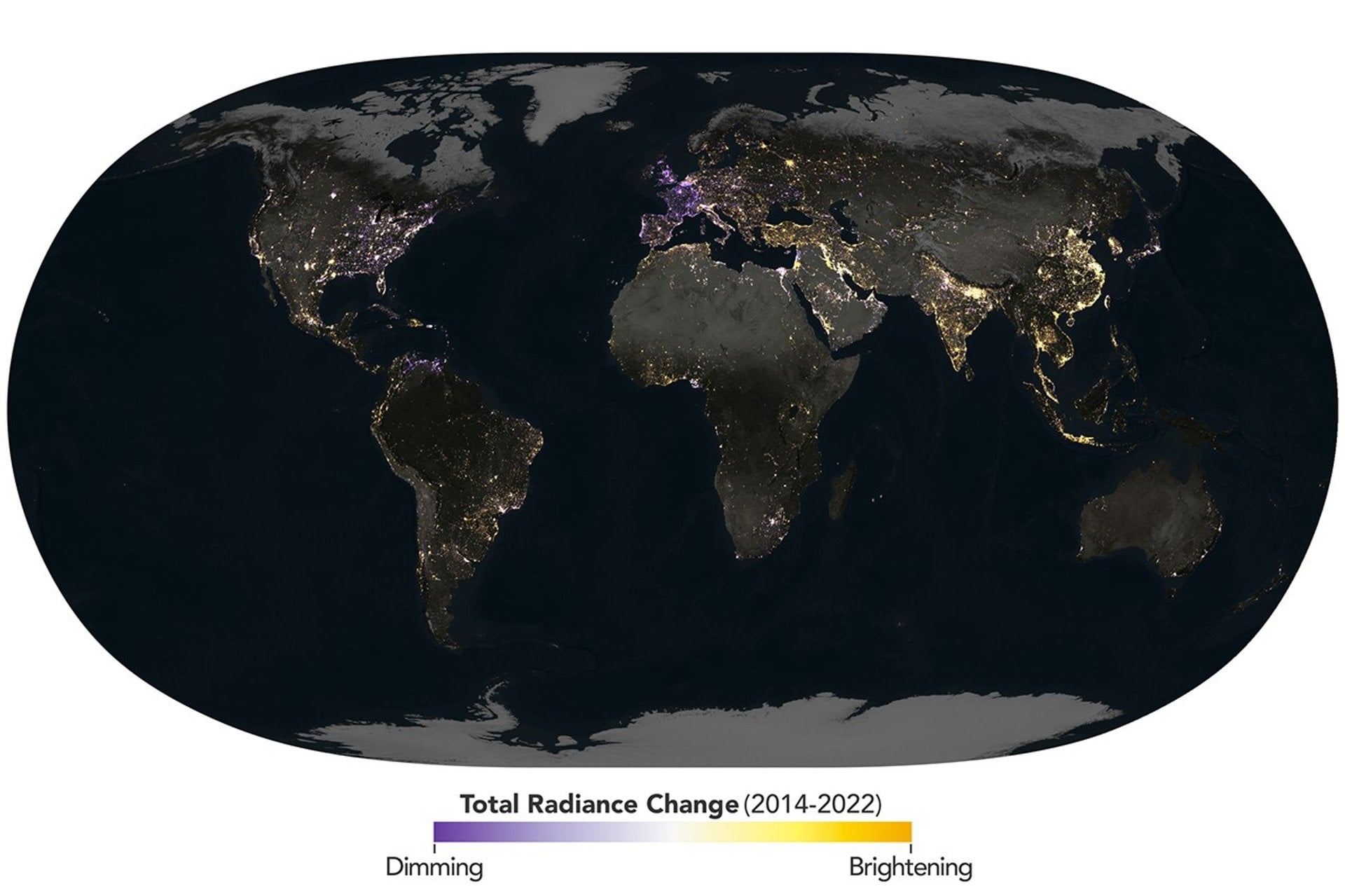
Light pollution is getting worse globally, according to a study of artificial light published in Nature last month. The story, however, is a complicated one, because that global increase hides a more nuanced tale of regional volatility in nighttime illumination.
Here’s the bare details: from 2014 to 2022, Earth’s nighttime radiance increased 34 percent, as measured by a network of three satellites. At the same time, dimming offset this increase by 18%. In other words, while many areas got brighter, a significant number got dimmer.
The study, pulled together by a team of more than 20 researchers, suggests that Earth’s nighttime lighting is dynamic, with frequent and sporadic changes rather than a steady march towards greater illumination.
Of the areas which saw a change in illumination, 51% of those changes were gradual – the kind you might expect from a growing population, for example. More than a third (35%) of these areas, however, saw both gradual and abrupt changes, with 14% experiencing only abrupt changes.
There are many things that can affect illumination at night. Natural disasters can knock out power grids, causing abrupt dimming, while forest fires can brighten large regions quickly. Armed conflict, such as the full-scale invasion of Ukraine in 2022, can similarly cause abrupt dimming. That particular conflict affected nighttime light across Europe, as it triggered an energy crisis which, in combination with COVID-19 lockdowns, a transition to LEDs, and new light pollution policies, contributed to a continent-wide dimming of 4% across Europe. That dimming was even more pronounced in some countries: France dimmed by 33%.
The most substantial brightening occurred in China and India, where massive new urbanization and industrial activities were the primary culprits.
Across the globe, most of the abrupt changes, in either direction, were industrial in nature.
“We found more than half of the abrupt brightening was driven by non-residential development and electrification, highlighting the role of infrastructure expansion and rural electrification in shaping short-term ALAN spikes,” the authors write. “By contrast, abrupt dimming was mainly attributed to reductions in gas flaring (46%), driven by government regulations, gas infrastructure upgrades and operational volatility.”
All of this data, collected into what is known as NASA’s Black Marble project, is a goldmine for studying global trends. But the authors caution against simplistic models. An increase in nighttime illumination is not a simple proxy for growing GDP in a country, for example. There are too many variables at play, from local regulations and policies to regional or global events like pandemics or war.
The story the authors want to tell is one of complexity. As they put it poetically:
“The overarching signal is unmistakable: the Black Marble of Earth is not merely growing brighter; it is pulsing with intensifying volatility, echoing the amplifying heartbeat of human activity.”