 Universe Today

If dark matter and dark energy were a part of our everyday lives, we would live in a perpetual state of dumbfoundedness. Imagine living in a world where 95% of the matter and energy were invisible and undetectable. It would be impossible to make sense of our surroundings.
Luckily, dark energy and dark matter aren't everyday concerns. They're interesting problems for people who are intellectally curious about Nature. But for physicisits, the questions surrounding dark matter and dark energy are much more acute. Some of them dedicate their entire lives to understanding dark matter and dark energy. They design and build special telescopes, instruments, and spacecraft to make progress toward an answer.
One of the spacecraft astrophysicists built to study dark matter and energy is the European Space Agency’s Euclid space telescope.
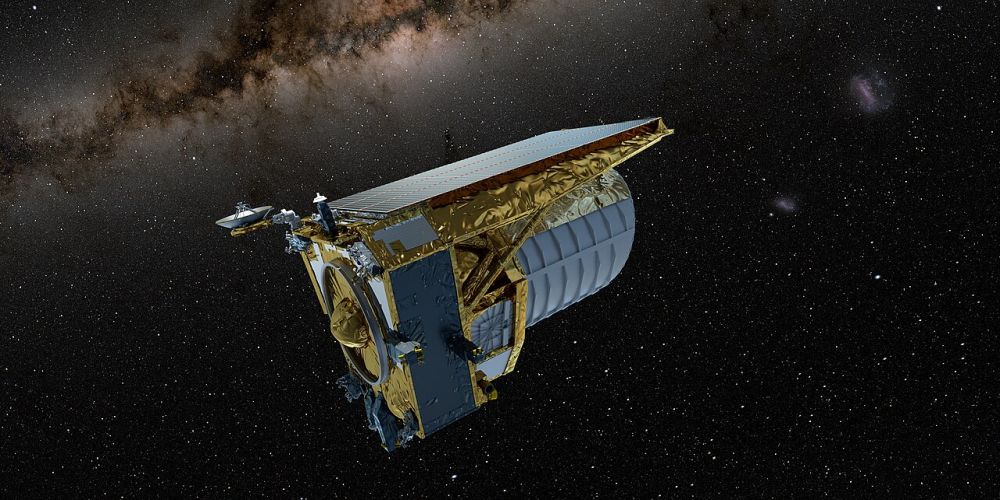 This artist's illustration shows the Euclid Space Telescope doing its thing in its halo orbit at L2. The telescope is on a six-year mission to create a 3D map of the sky, revealing how dark energy and dark matter shape the Universe. Image Credit: By ESA, CC BY-SA IGO 3.0, CC BY-SA 3.0 igo, https://commons.wikimedia.org/wiki/Special:Redirect/page/128347141
Dark matter and dark energy are foundational in our Universe. Dark matter doesn't interact with any light, but it's clearly there. It's some form of mass, but we don't know what. Dark matter is a placeholder term.
Dark energy is another placeholder term. It describes the force driving the expansion of the Universe. Like dark matter, we can measure its effect, but we don't know what it really is. And the puzzling thing is that dark matter and dark energy make up most of the Universe.
“It turns out, the stuff humans are made of is relatively rare in the universe,” said Dr. Douglas Scott, professor at the University of BC's department of physics and astronomy (PHAS) and member of the Euclid collaboration. “And what dominates — dark matter and dark energy — is invisible so we're not used to dealing with it. But it makes the universe what it is, it drives how the universe expands and what the past and future of the universe will be. Where did these things come from? What properties do they have? Euclid’s data gives us the potential to answer those questions.”
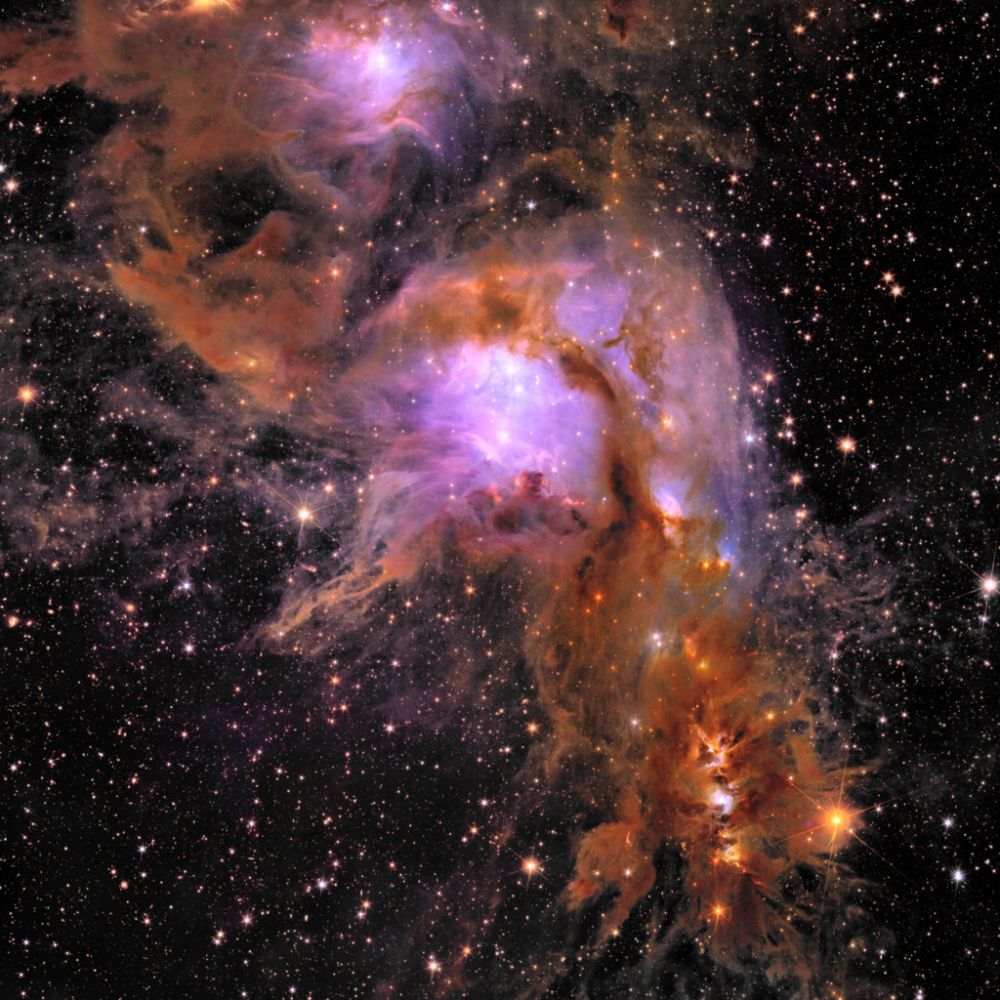 This image reminds us that Euclid does more than study dark matter and dark energy. It's a powerful camera, after all, and can also capture stunning images of regular, baryonic matter, the kind that stars, people, and planets are made of. This image is from Euclid's Early Release Observations, and shows the Messier 78 star formation region about 1300 light years away in Orion. This is the first time Messier 78 has been imaged with such width and depth, hallmarks of Euclid's observations. Image Credit: ESA/Euclid/Euclid Consortium/NASA, image processing by J.-C. Cuillandre (CEA Paris-Saclay), G. Anselmi
Euclid launched in July 2023 and orbits the Sun-Earth Lagrange point 2 (L2), roughly 1.5 million kilometers away from Earth, a popular spot for space telescopes. From that perch, it uses its wide-angle, 600-megapixel camera to capture visible light, and a photometer and a near-infrared spectrometer to measure the redshift of about 10 billion sources out to redshift 2. That's roughly equivalent to about 10 billion years ago, or about 3.7 billion years after the Big Bang.
Among these sources, Euclid is especially interested in strong gravitational lenses. These are massive objects like galaxies, galaxy clusters, and dark matter halos. These objects can magnify background objects that are otherwise beyond observing. But they're critical for mapping dark matter itself, because their lensing effect is based on the total mass of these objects, not just their visible mass. So strong gravitational lenses are a way to measure the presence of dark matter. But they're not easy to find.
Euclid delivered its first data release on November 12th, called DR-1 Foundation, and it holds a whopping 1.7 million gigabytes of data. The data revealed almost 5% of the night sky in 13 months of observations. That data holds 900 million galaxies, and 60 million quasars, which are the extremely luminous cores of far-away galaxies. Euclid also found 15,000 new strong gravitational lens candidates, a massive increase in the potential number.
"Strong lenses have been difficult to find — the odds were about one in 10,000,” said Hrishabh Srivastava, doctoral student in the UBC department of physics and astronomy (PHAS). “Before Euclid, we had less than a thousand confirmed strong lenses. Now we have 15,000 new candidates.”
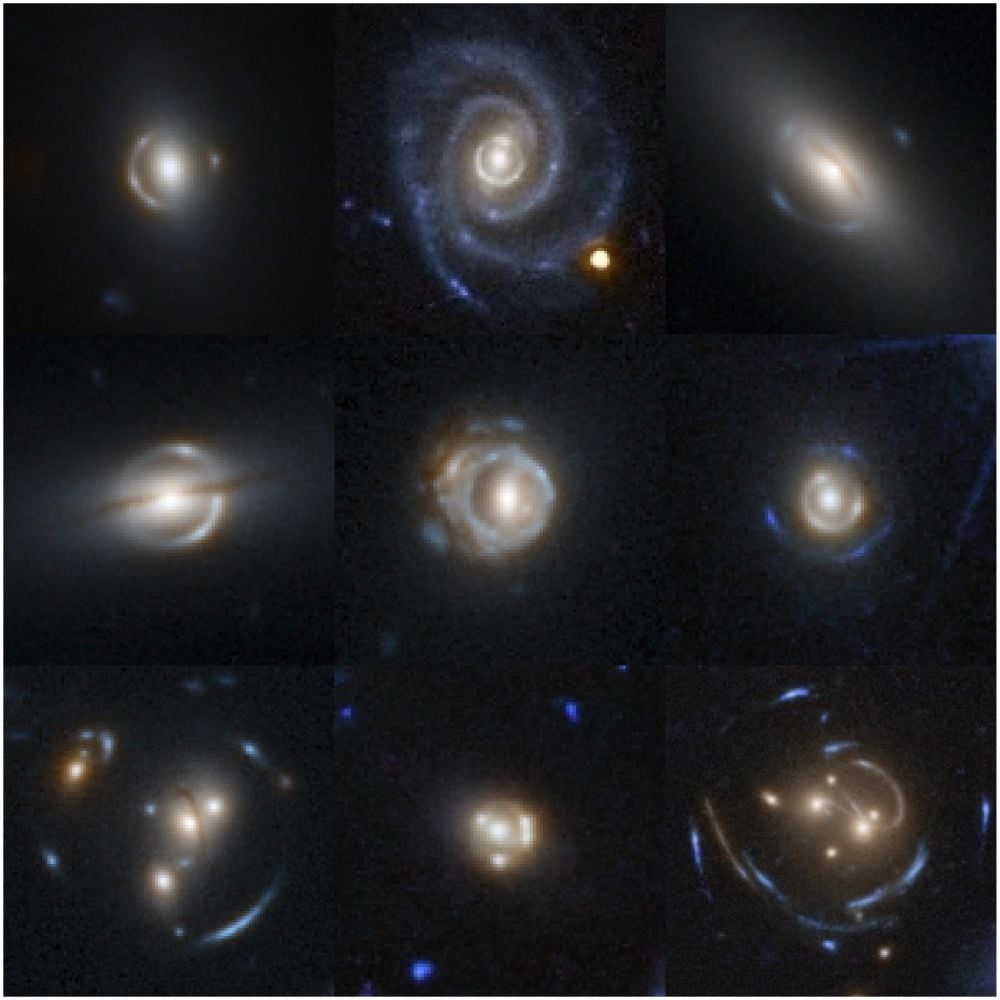 There's more than one type of gravitational lens. This is a collage of some of the different types of strong gravitational lenses Euclid has found so far. The top row shows, from left to right: a classic galaxy–galaxy lens, an Einstein ring in a face-on spiral lens, and an inclined dusty disc lens galaxy. The middle row shows an edge-on dusty lens galaxy, a lensed galaxy with visible star-forming regions, and a compound lens.The bottom row shows a galaxy group lens, a lensed quasar, and a galaxy group lens. Image Credit: ESA/Euclid/Euclid Consortium/NASA, image processing by N. Lines and T. Li. Licence: CC BY-SA 3.0 IGO or ESA Standard Licence
Overall, Euclid is expected to find more than 100,000 strong lenses over the course of its nominal six year mission. That would increase the number of known strong lenses by two orders of magnitude, a transformational advance for dark matter science.
“I like to call these gravitational lenses ‘nature's own magnifying glasses’ to probe the dark matter distribution of our universe,” said Srivastava.
Strong gravitational lensing is an important tool, but so is weak gravitational lensing. They can be used together to build a fuller picture of dark matter and dark energy. The weak gravitational lensing signature is most apparent around massive galaxy clusters. Since weak gravitational lensing extends beyond a cluster's virial radius, it can help constrain a cluster's overall mass.
Finding huge numbers of gravitational lenses is clearly important in the quest to understand the Universe, but Euclid has other tasks, too. It will slowly build a 3D map of the Universe that covers greater than one-third of the sky. This map will comprise the actual tool used to measure dark matter and dark energy. The map will show how matter is distributed, and then that map can be tested against models of the Universe, especially Lambda-Cold Dark Matter, which is the standard Big Bang model of cosmology.
Lambda-CDM predicts how matter, including dark matter, is spread throughout the Universe, and how its structure is shaped by dark energy, which drives the Universe's expansion. So Euclid's 3D map can test both facets of Lambda-CDM: dark matter and dark energy. Dark energy is directly tested, and dark matter is tested more indirectly.
Euclid's test of Lambda-CDM won't be in one big grand finale, where physicists around the world wait with bated breath to find out the answer. The test is ongoing. Each new data release will generate rounds of new research, as physicists and cosmologists dig into it. It'll be fuel for the different lines of detailed research that different teams of scientists pursue. It's like a process of elimination. Eventually, hopefully, the possible answers and explanations for dark matter and dark energy will be constrained and refined until only one is left standing.
Then, in all likelihood, Nobel prizes will be awarded.
But that won't be the end of cosmology. New questions will arise, intellectual curiosity will be piqued in new ways, and the quest to understand the Universe will continue.
But Euclid and its 3D map will be in history of science textbooks for a long time.