 Universe Today

Mercury remains one of our solar system’s most elusive and difficult planets to study. It's easier to send probes to the icy moons of Saturn or Jupiter, or even Pluto, than to land on our innermost planet of Mercury.
Ground-based optical observatories don’t risk turning their sights on Mercury, without potentially damaging their optics under the very nearby glare of the bright Sun. Thus, of the planets in our inner solar system, Mercury arguably remains both the least explored and most misunderstood.
NASA’s Mariner 10 performed three fly-bys of Mercury between 1974 and 1975. This was followed by a 2011 orbital insertion by NASA’s MESSENGER mission to Mercury which successfully orbited the planet for some four years.
But despite the European Space Agency's and the Japanese Space Agency’s long-anticipated joint BepiColombo mission to Mercury, we aren't likely to solve this strange little world's conundrums until someone figures out a way to send a lander. That is, one that can safely land and function for long enough to return data that would give us a much clearer indication of the surface of Mercury's surface composition, and its interior.
BepiColombo, which sees orbital insertion late next month, is currently our only chance to acquire new data about the planet. However, it’s not expected to start taking science data until April of 2027.
After BepiColombo, there's nothing on the drawing board, Paul Byrne, a planetary scientist at Washington University in St. Louis, told me via email. But a lander is the next natural step in the exploration of Mercury, even if it's a technically challenging and expensive proposition, Byrne told me.
Without a lander mission Mercury’s main science puzzles will remain.
They include:
--- The planet’s disproportionately large iron-rich core which is thought to make up some 85 percent of the planet’s radius.
We're beginning to find evidence for much larger, more massive rocky exoplanets that seem to have giant iron cores, says Byrne. So, he wonders if Mercury is a one-off freak, or a planetary outcome that's more common than we might think?
Two major hypotheses have been formulated to explain the presence of a large metallic core.
The first one posits that Mercury accreted from metal-rich building blocks; compared to other planets, such as the Earth, Anne Pommier, staff scientist and high-pressure experimentalist at the Carnegie Laboratory in Washington, D.C., told me via email. The second considers that Mercury was initially larger than today, with a crust and mantle core-ratio closer to that of Earth, Pommier told me.
Yet Pommier, who is a co-Investigator of the magnetometer instrument on BepiColombo, told me that large impacts likely stripped off a massive part of Mercury’s rocky mantle thus leaving with an anomalously large iron core.
But the presence of a large metallic core remains difficult to explain; Mercury challenges our understanding of planetary formation, says Pommier.
--- Aside from Earth, Mercury is the only other rocky planet in our solar system that has a global magnetic field.
Compared to Earth, Mercury has a weak magnetic field, and it is thought that the field is generated in the liquid portion of the core, says Pommier. This continuous motion creates electric currents, which in turn create a magnetic field dynamo that can be sustained for billions of years, she says.
A Global Magnetic Field
Mercury currently generates a global magnetic field that is dominantly dipolar at the surface, approximately 100 times weaker than Earth's surface field, the authors of a 2024 paper appearing in the journal Earth and Planetary Science Letters note. Remanent crustal magnetization with an inferred age of 3.7 to 3.9 billion years suggests the dynamo operated in Mercury's early history, the authors note.
Mercury does have a tenuous exosphere composed of very limited amounts of oxygen, hydrogen, sodium and helium.
But if Mercury has even a weak magnetic field, why can’t it hold onto a real atmosphere?
It's not enough to have a magnetic field: you need to be big enough to replenish an atmosphere and far enough away from your star to not have your atmosphere blown off, says Byrne. Mercury is relatively close to the Sun, which means it takes a pounding from the solar wind, he says.
Mercury Itself Is Shrinking
There is also evidence at the surface that the planet has been shrinking, says Pommier. This process is possibly due to core cooling but is not well understood, she says.
--- Finally, Mercury has some sort of enigmatic low reflectance material covering large areas of its surface.
This material possibly contains endogenic carbon, like graphite.
In some craters, it is expected to be hidden under layers of other deposits, so its presence is both at the surface and in the subsurface, says Pommier. One hypothesis regarding its origin is that it formed as part of the crystallization of a magma ocean, early in Mercury's history, she says.
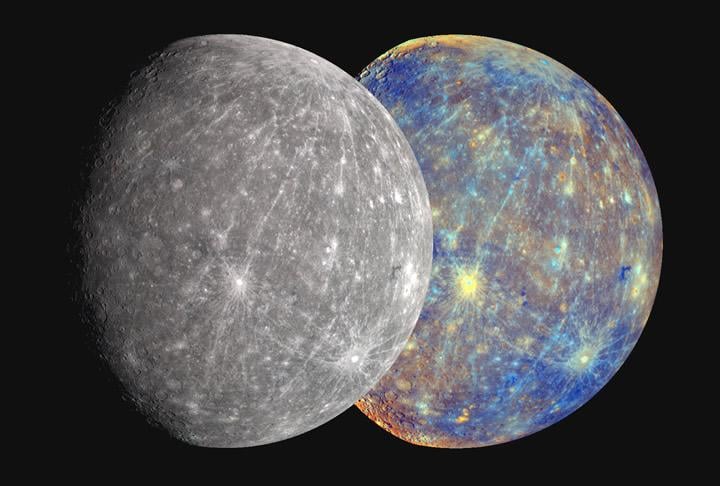 NASA’s MESSENGER (MErcury Surface, Space ENvironment, GEochemistry, and Ranging) spacecraft captured the image at left, an approximation of Mercury’s true color as might be seen by the human eye, on Oct. 6, 2008. The exaggerated color view at right uses all 11 filters in the visible and near-infrared, to highlight subtle color differences and aid geologists in mapping regions of different composition. The nature of color boundaries, color trends, and brightness values help MESSENGER geologists understand the discrete regions (or “units”) on the surface. Credit: NASA/Johns Hopkins University Applied Physics Laboratory/Carnegie Institution of Washington
A Unique Graphite Landscape?
This graphite might be the remains of a once-widespread and probably thin carbon-rich flotation crust which was likely all over the planet, says Byrne. Over time, with successive impacts churning up and redistributing crustal materials, as well as surface volcanism, most of this graphite-rich crust was buried, reworked, or removed into space, he says.
Are there any known Mercury meteorites here on Earth?
There are currently no officially confirmed meteorites from Mercury on Earth, despite several studies suggesting that some meteorites (such as enstatite chondrites) could come from Mercury, says Pommier.
But this is one reason why landing on the planet is so crucial.
Landing on Mercury and carrying out chemical analyses in situ would give us a much better idea of what to look for in the world's current meteorite collections, says Byrne. It's certainly possible that we already have unrecognized pieces of Mercury in these collections, he says.
The challenge is the time en route, the energy needed to slow the spacecraft down to do a successful orbital insertion and the landing. Dropping deep into the Sun's gravity well requires a massive change in velocity (or delta-V), even outstripping the amount of energy needed to send a probe to Pluto.
A 2020 NASA planetary mission concept study notes that a lander mission would have a ten-year cruise phase before touching down about 30 hours before Mercury sunset. The idea is for the lander to be fully operational during Mercury’s night, which spans some 88 Earth days. The lander would use LED lights to photograph Mercury’s surface and might even be aided by a diffuse glow from the planet’s sodium exosphere.
The Bottom Line?
A lander must first softly touch down on the surface of Mercury.
With no atmosphere, a lander can only rely on retrorockets; we have experience doing that for the Moon, but gravity on Mercury is about twice as high, says Byrne. So, the challenge is greater—and would necessarily happen after a much longer cruise phase than to the Moon or even Mars, he says.