 Universe Today
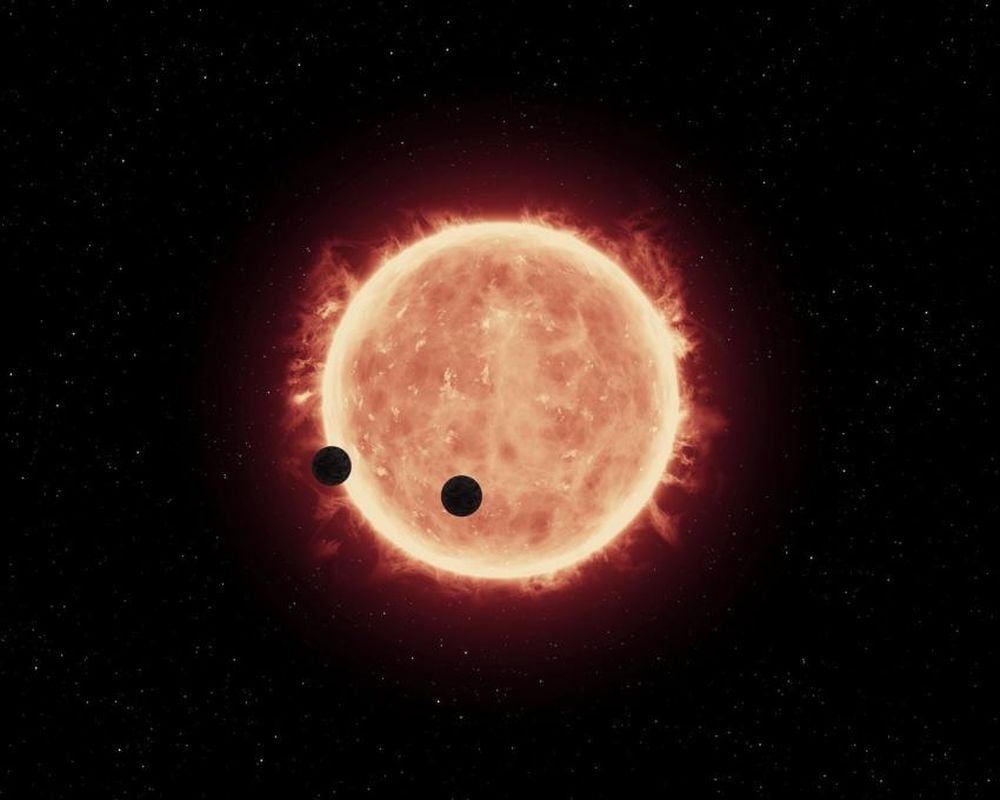
Astronomers know that stars can sometimes eat planets. This is expected in our own Solar System when the Sun leaves the main sequence in a few billion years. It will swell and become first a subgiant, then a full-blown red giant. When that happens, it will consume Mercury, Venus, and maybe Earth.
But this process plays out near the end of a star's life. Some stars are eating planets long before they leave the main sequence. New research found several red dwarf stars (M dwarfs) that have consumed planets, and the presence of lithium revealed their messy planetary meals.
The research is published in the Monthly Notices of the Royal Astronomical Society and is titled "Lithium-rich M-dwarfs at the ZAMS: evidence for planetary engulfment?" The lead author is Robin Jeffries, Professor of Astrophysics at Keele University.
The authors say that engulfment can happen normally, and there can be several causes. "Engulfment might happen as a result of migration processes in the protoplanetary disc; dynamical interactions and scattering, either with other planets or initiated by close encounters with other stars in clustered environments; combined with the dissipative effects of dynamical and equilibrium tides or magnetic torques," they write.
But even though there are all these potential causes, catching a star in the act is difficult.
Instead, astrophysicists have to look for the aftermath, which in this case, is "volatile-depleted planetary material." That basically means rocky material from rocky planets.
"This could lead to small but measurable observational signatures if the photospheric abundances of those stars can be carefully compared with siblings born as part of a multiple system or a cluster, assuming they were born with similar initial abundances," the authors write.
In this work, the researchers searched through thousands of stars in the Gaia-ESO Spectroscopic (GES) survey. It contains elemental abundances and other stellar parameters for more than 114,000 stars. They were seeking low-mass (M dwarf) stars enriched with lithium that are in clusters with their siblings.
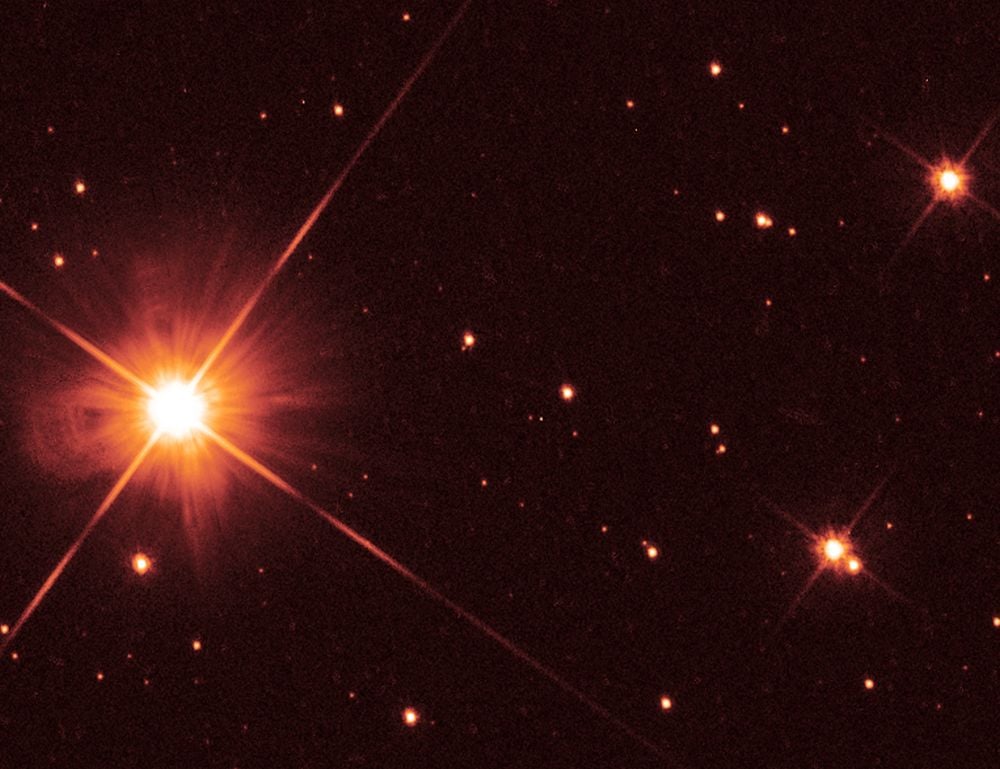 Red dwarfs are common in the Milky Way, as evidence by Proxima Centauri, our closest stellar neighbour. It's a red dwarf about 4.2 light years away, and while it's not part of this work and there's no evidence it engulfed a planet, it is orbited by three planets, two of which are probably rocky. Image Credit: NASA, ESA, K. Sahu and J. Anderson (STScI), H. Bond (STScI and Pennsylvania State University), M. Dominik (University of St. Andrews)
"We found that a few of the red dwarf stars we studied contained lithium, a chemical element that should not be there," explained lead author Jeffries in a press release. "Therefore even a small amount of lithium stands out clearly in these stars – a bit like throwing paint onto a blank canvas."
Why lithium? It has to do with the nature of lithium, which is a volatile element.
The authors say that if a red dwarf swallows between 3 and 10 Earth masses of rocky material at the right time, the lithium in that material is evidence of the engulfment. Since lithium is volatile, it doesn't stick around. Stars form with some lithiim, but rapidly deplete it prior to beginning their life on the main sequence, which is called Zero Age Main Sequence (ZAMS).
"Red dwarfs are smaller and cooler than our Sun but inside they are extremely hot," Jeffries said. "This heat should destroy all of their fragile lithium in nuclear reactions shortly after they form."
So if the star shows the presence of lithium, it had to come from elsewhere, and planetary engulfment is the likely cause. If that star can be compared with its siblings from the same natal cloud, and it shows more lithium relative to its siblings, that's evidence that it ate a rocky planet.
Jeffries and his co-researchers found six red dwarfs in three different clusters with elevated lithium abundances. "We identify six early M-dwarfs, in three open clusters (NGC 2451a, Blanco 1, and NGC 2516) at ages of 50–200 Myr, that are anomalously enriched in lithium compared with Li-depleted siblings of similar spectral type," the authors write.
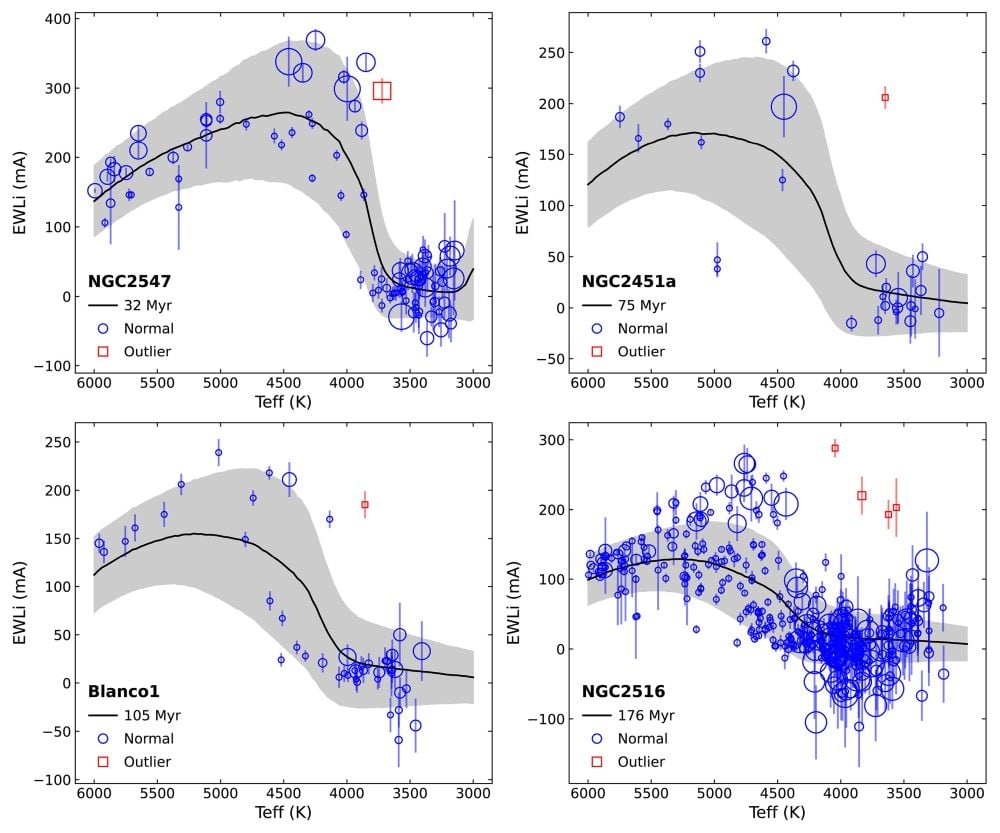 Each of these panels represents one of the four clusters in the study. The x-axes show stellar temperature, and the y-axis shows a lithium emission line. Blue markers are for stars with normal lithium signatures, and red markers are for lithium-rich outliers. While the figure shows seven outliers, one was discarded. Image Credit: Jeffries et al. 2026 MNRAS. https://doi.org/10.1093/mnras/stag815
The six red dwarf stars are basically indistinguishable from their fellows, except for their lithium abundances. "The Li-rich outliers represent 2–3 per cent of stars with in clusters at those ages but are otherwise indistinguishable in their positions, parallaxes, and kinematics from other cluster members," the authors write.
So is this a slam dunk? Have these stars definitely eaten rocky planets?
The authors point out that engulfment isn't the only explanation. Magnetic activity or rotation is one other potential cause of the lithium abundance.
"Dynamo-generated magnetic activity or just fast rotation could inhibit processes that lead to the mixing and burning of Li during the PMS (pre-main sequence) phase," they write. This seems unlikely because the six stars with elevated lithium were all slow rotators.
Pecularities during their formation could also be responsible. "The slow rotation of the outliers might implicate the earlier presence of a long-lived accretion disc," the researchers explain. A slower and longer-lived accretion disk could deliver lithium to the star later than expected, leading to its detection without planetary engulfment.
But the authors think that planetary engulfment is the most likely cause.
"Instead, it seems plausible that the outliers are direct evidence of planetary engulfment," the authors explain, adding that other researchers have developed models that predict this.
The results suggest that 2-3 percent of early M-dwarfs and late K-dwarfs have engulfed a planet, but that may be the low end. The lithium may not survive as long as thought, depending on the masses of the objects and on which model is used to estimate how long the lithium could survive. "This means that the observed frequency of the phenomenon (2–3 per cent) may represent the true frequency of engulfment if Li survival times are long, but could be a lower limit if they are shorter."
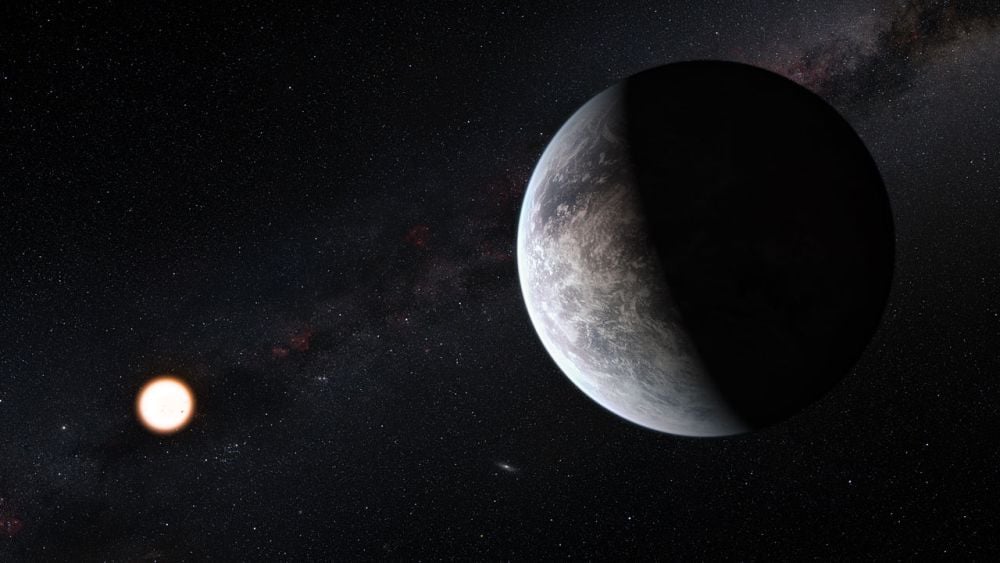 This artist's illustration shows the rocky super-Earth HD 85512 b, discovered in 2011. It's 3.6 times more massive than Earth, and exoplanet surveys show that these types of planets are common around red dwarfs. Image Credit: ESO/M. Kornmesser
Regardless of the actual occurrence rate, these results are evidence of planetary engulfment. Though they don't show that it's common, it's also not that extraordinary.
"Close-in Earth-like and Super-Earth exoplanets are common around M-dwarfs ..." the authors write. We know this from studies of the exoplanet population, with the TRAPPIST-1 system being the most well-known example. Planets with these masses can produce the lithium signal found in the six M-dwarfs when they're engulfed.
"It may be that total Li-depletion, which is the normal outcome of PMS evolution in the lower mass stars of open clusters, provides a blank canvas upon which the frequency and timing of the engulfment of fresh planetary material can be assessed," the authors conclude.

