Universe Today
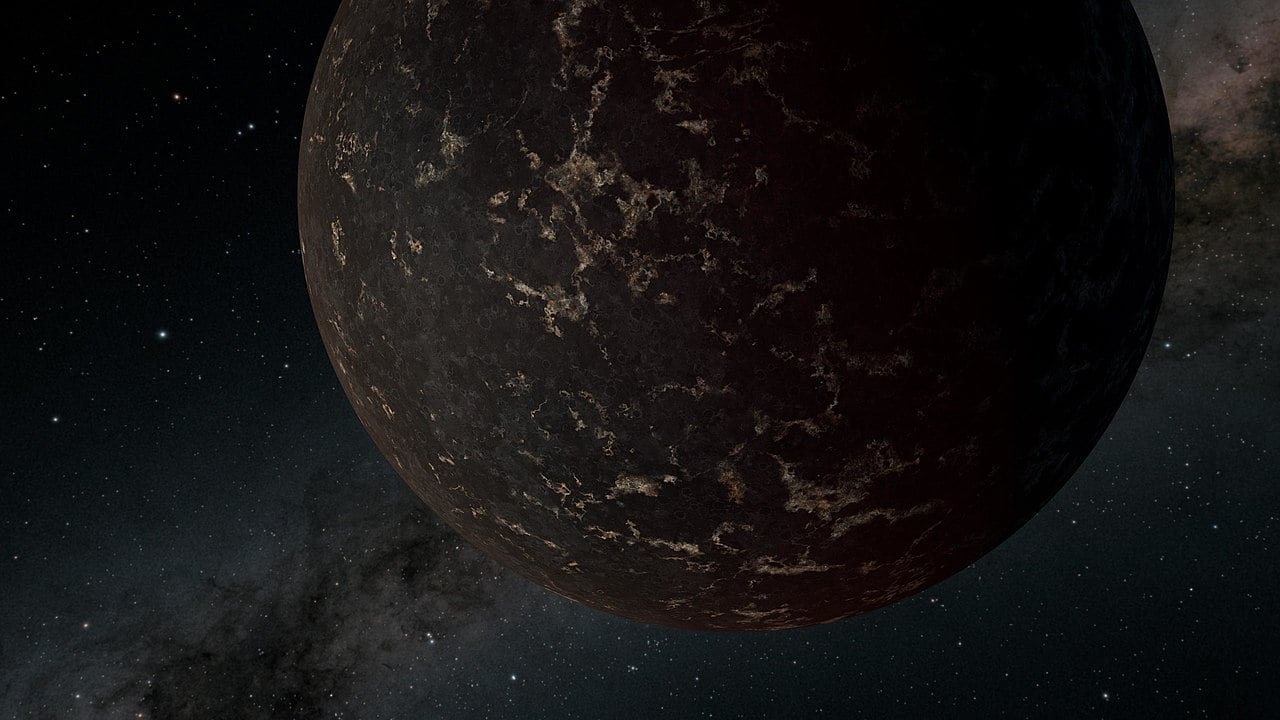
There's a planet out there called LHS 3844 b, orbiting a star about 48 light-years away. The Transiting Exoplanet Survey Satellite (TESS) found it in 2018 when the planet transited across the face of its star. The James Webb Space Telescope zxeroed in on the planet and found it to be a barren, rocky place with no atmosphere.
The planet, informally named Kua'kua, after a Central American Bribri word for "butterfly", is about 30 percent bigger than Earth (making it a super-Earth). It orbits its red dwarf star host (named Batsu), once every 11 hours and is in a tidally locked orbit. That means it shows the same face to its star all the time. That tight proximity means Kua'kua's dayside roasts under a constant 1000 Kelvin temperature. As you can imagine, that's not an environment like the Earth we know today. In fact, it may be more like Mercury, only bigger.
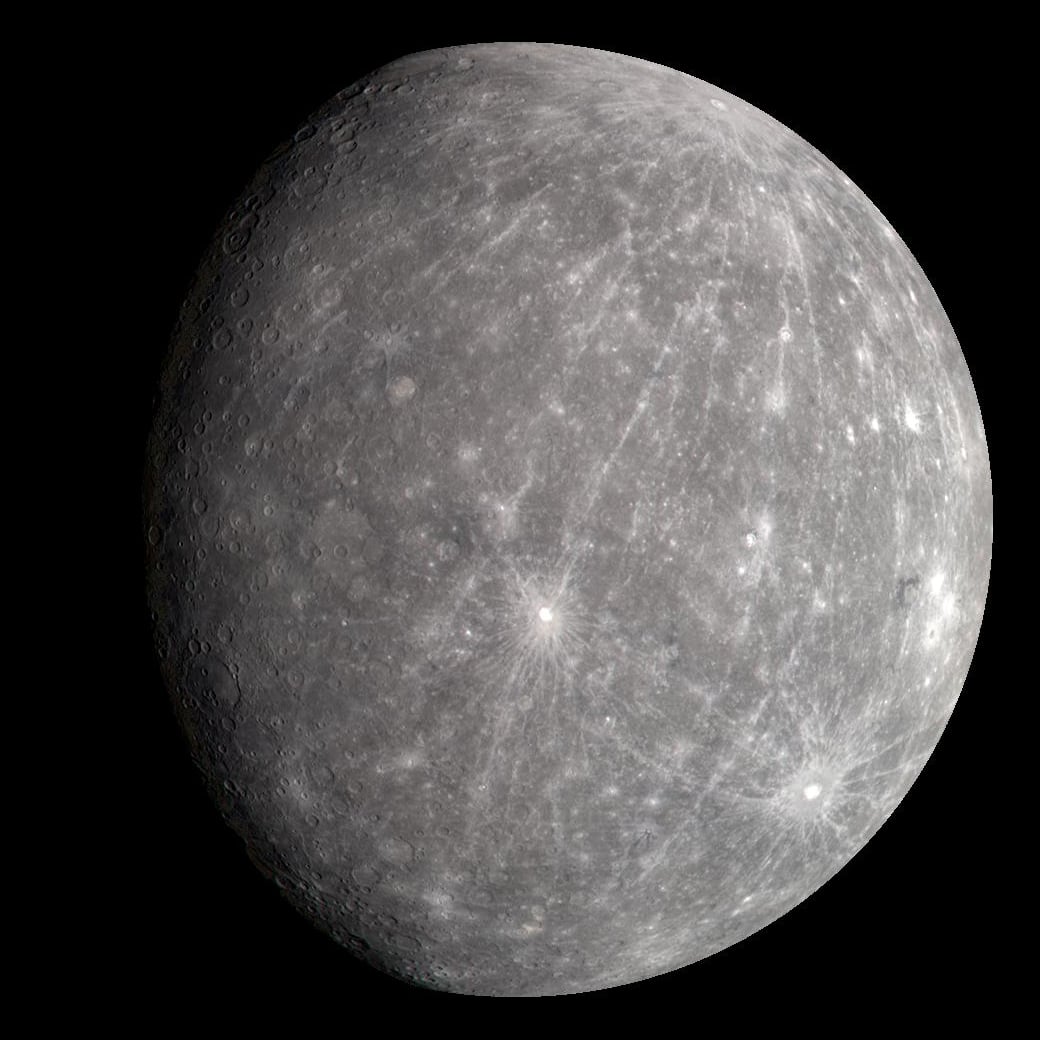 The exoplanet LHS 3844 b could have a surface appearance very similar to Mercury's (shown here). JWST observations allow scientists to get more information about distant worlds. Courtesy NASA.
A team of researchers led by Harvard CFA PhD student Sebstian Zieba and Laura Kreidberg, Max Planck Institute for Astronomy Heidelberg, used the Mid Infrared Intrument (MIRI) on JWST to analyze Kua'kua's surface composition. The instrument is often used to study exoplanet atmospheres, as well as the geological surface properties of such worlds. "Thanks to the amazing sensitivity of JWST, we can detect light coming directly from the surface of this distant rocky planet," said Kreidberg. "We see a dark, hot, barren rock, devoid of any atmosphere."
Understanding Kua'kua from JWST Data
JWST's MIRI studied the infrared radiation coming from the sizzling dayside of the planet to get a spectrum of the surface. Zieba and Kreidberg's team ran models and compared the JWST data to template libraries of rocks and minerals known from Earth, the Moon, and Mars. That gave them a good idea of what could be producing the infrared signatures seen at Kua'kua. Comparing observation-based data with team computations confidently ruled out that Kua'kua's surface is like to Earth’s crust (which is typically silicate-rich rocks such as granite).
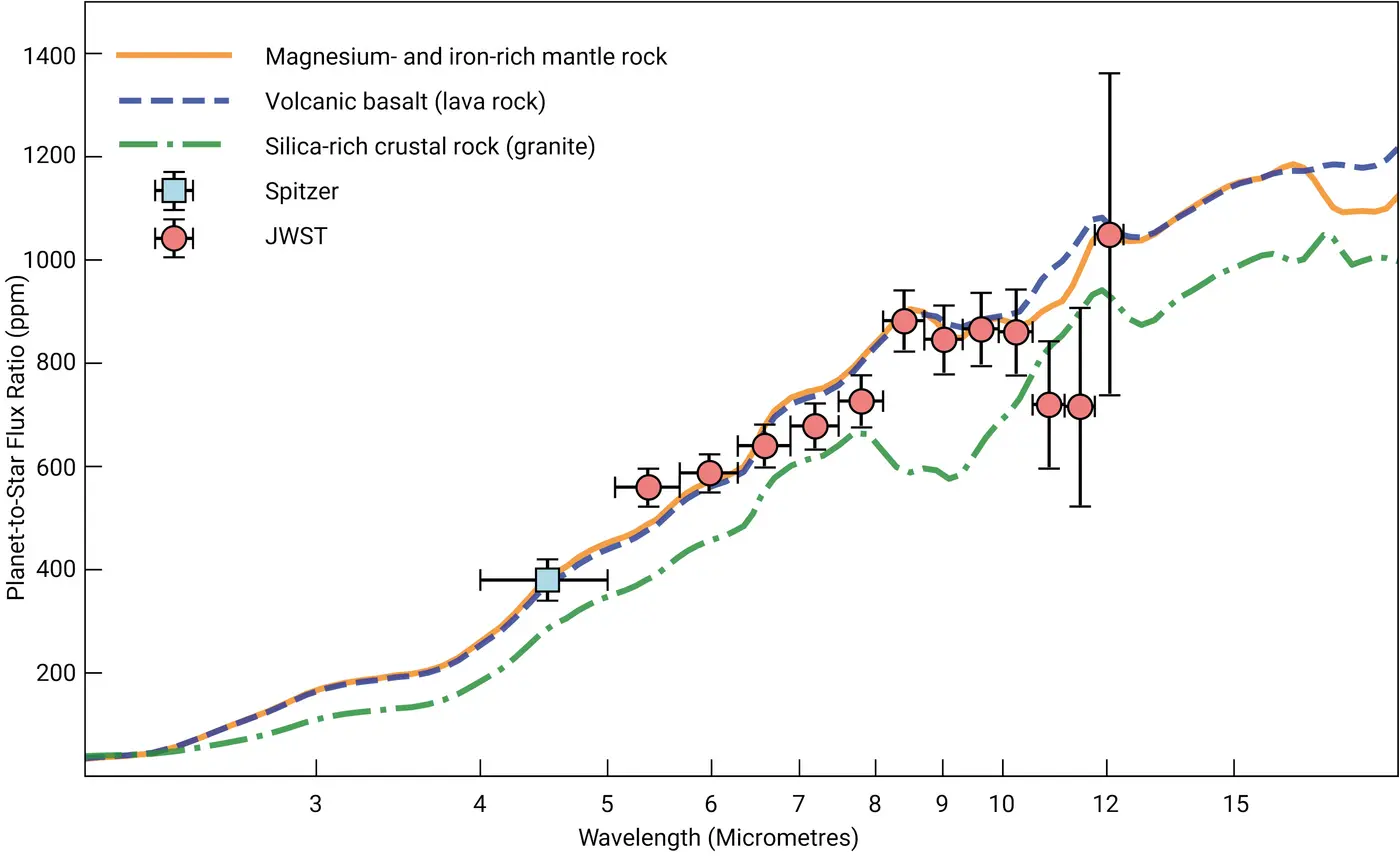 Infrared spectrum of LHS 3844 b’s hot dayside derived from the brightness contrast to its host star in ppm (parts per million = 0.0001%) at different wavelengths. The observational data obtained from the James Webb and Spitzer Space Telescopes are consistent with mantle or lava rock, whereas they rule out an Earth-like crust. Courtesy Sebastian Zieba et al./MPIA
The team's findings will ultimately reveal details of Kua'kua's geological history. Earth-like silicate-rich crusts are thought to form through a prolonged refinement process that requires tectonic activity and typically relies on water as a lubricant. The rocky material repeatedly melts and solidifies as it is mixed with mantle material, leaving the lighter minerals on the surface. “Since LHS 3844 b lacks such a silicate crust, one may conclude that Earth-like plate tectonics does not apply to this planet, or it is ineffective,” said Zieba. “This planet likely only contains little water.”
In addition, the lack of an atmosphere suggests that the planet hasn't been geologically active for a long time, since volcanism produces gases that help form atmospheres.
Walking on Kua'kua
What if we could travel across this planet's surface? What would it be like? The best idea so far is that it might look like terrestrial or lunar basalt, that is, volcanic in origin and rich in magnesium and iron. There could be a lot of crushed material, such as rocks or gravel. There probably isn't a lot of powdery or sandy stuff there, whereas grains or powders are inconsistent with the observations due to their brighter appearance, at least at first glance.
Without a protective atmosphere, planets are subjected to space weathering, predominantly driven by hard, energetic radiation from the host star and impacts from meteorites of various sizes. “It turns out, these processes not only slowly dissolve hard rocks into regolith, a layer of fine grains or powder as found on the Moon,” explained Zieba. “They also darken the layer by adding iron and carbon, making the regolith’s properties more consistent with the observations.”
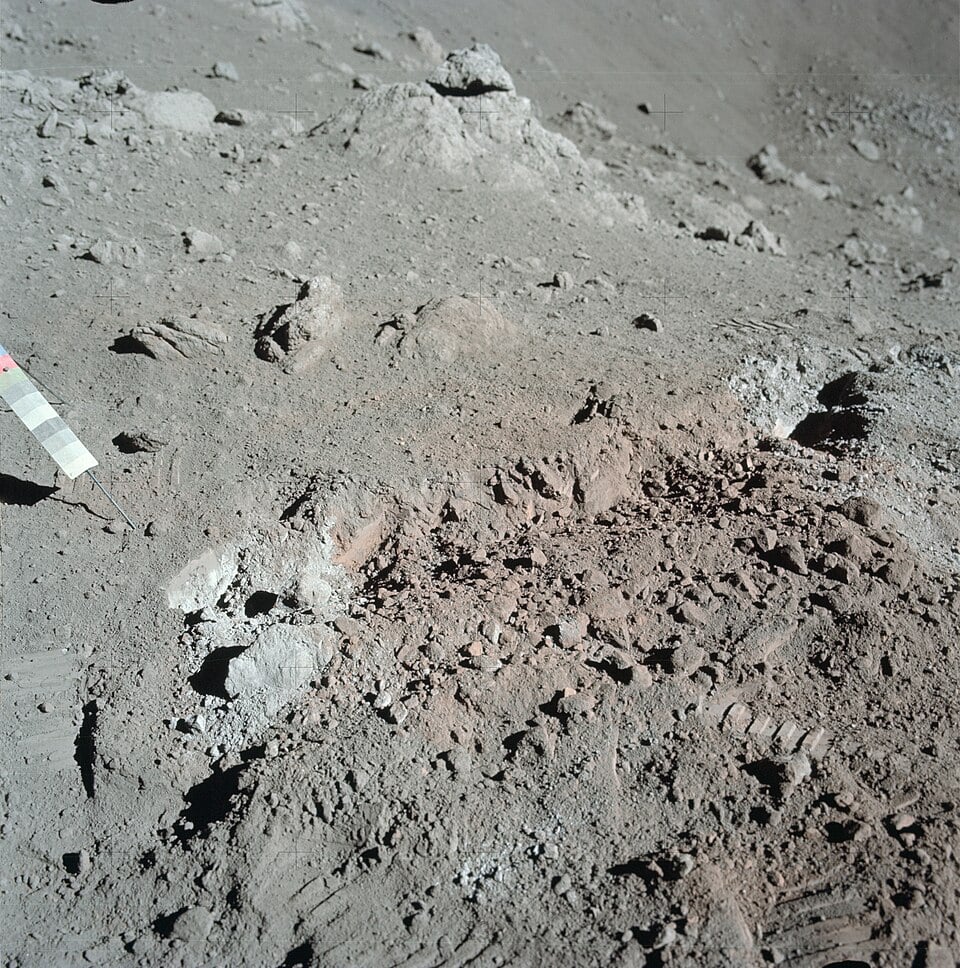 Regolith coats the surface of the Moon in a fine dust. It's created by constant bombardment by micrometeorites that crush rocks into dust. Courtesy NASA.
There are two scenarios of what it might be like on Kua'kua. The surface could be covered by dark, solid rock, maybe very recently laid down by volcanic activity. Since space weathering shows up quickly and looks bright in infrared, this supports the idea of a freshly deposited surface. On the other hand, it's also possible that such a dark surface could have been laid down long ago and undergone recent space weathering that covered it in darkened regolith layers. That's what exists on our Moon, and its surface is fairly ancient. If that's what Kua'kua's surface is like, then it may not have been volcanically active in recent times.
More Data Will Yield Better Understanding
Zieba, Kreidberg, and their colleagues are already on the case to explain the surface. Additional JWST observations will likely give them more information on the surface conditions so that they can discern between how solid surface slabs and powders emit or reflect infrared light. Surface roughness, for example, affects the amount of radiation received at a given viewing angle. So, continued observations will yield differing views of the same regions over time. This concept is successfully applied to characterizing asteroids in the Solar System. “We are confident the same technique will allow us to clarify the nature of LHS 3844 b’s crust and, in the future, other rocky exoplanets,” said Kreidberg.
For More Information
Astronomers Explore the Surface Composition of a Nearby Super-Earth
The Dark and Featureless Surface of Rocky Exoplanet LHS 3844 b from JWST Mid-infrared Spectroscopy