Universe Today
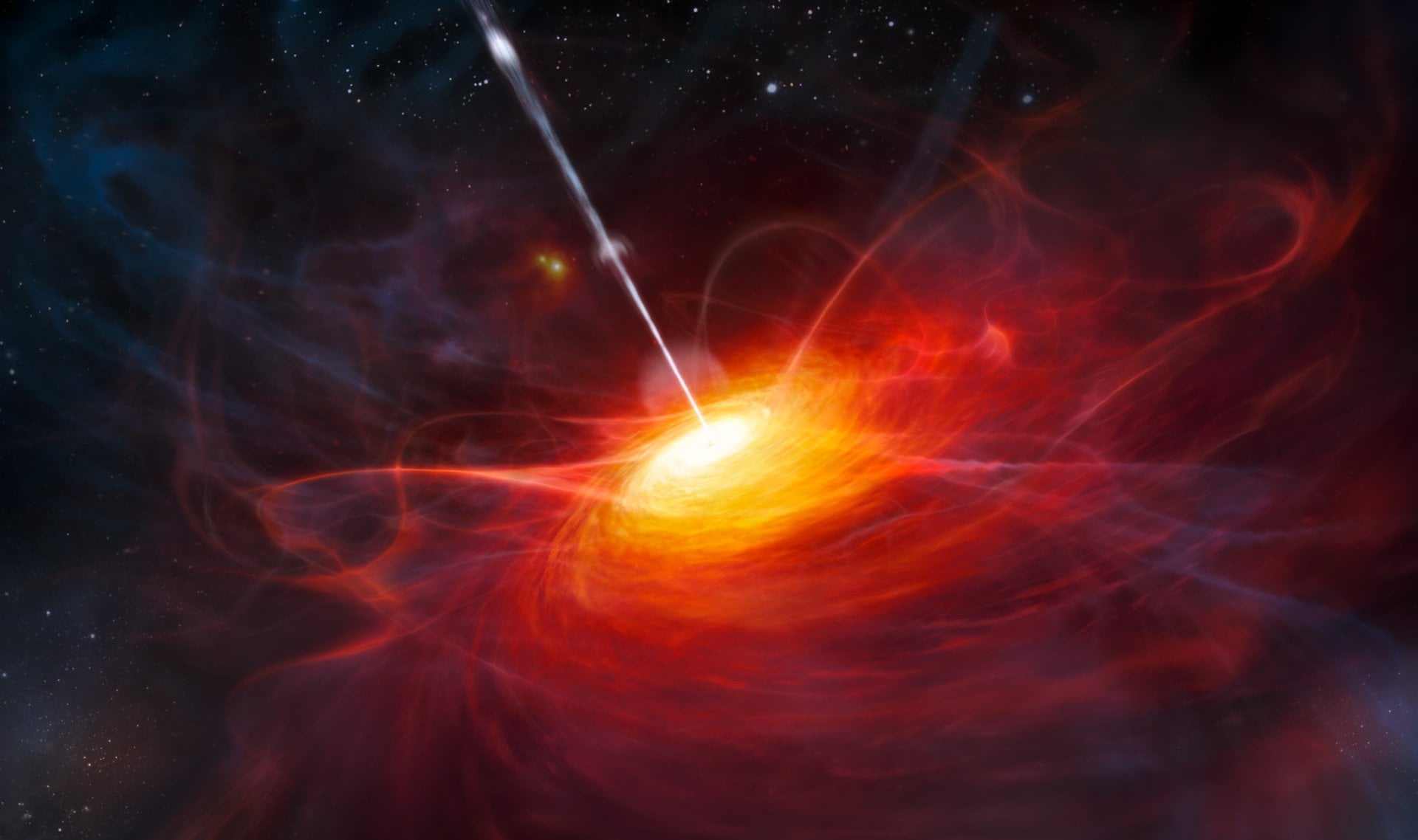
Among the rarest objects in the universe, high redshift quasars --- of the sort that formed before the universe was even a billion years-old --- offer clues to the formation of supermassive black holes thought to lie at the heart of every large galaxy.
Every large galaxy, like the Milky Way, has a supermassive black hole of a million even up to a few billion times the mass of the Sun, Daniel Mortlock, an astrophysicist at Imperial College London, told me in his office. These massive central black holes grow by having material fall into them, which heats up and glows and outshines all the stars in the galaxy, he told me. And that's what we see as a quasar, says Mortlock
In a paper just published in Astronomy & Astrophysics (A&A), the authors note that out of 31 new quasars detected during the first year and a half of the European Space Agency’s Euclid Space Telescope’s wide-angle survey, they have found two of the most distant ever observed.
Quasars aren't the sexy topic they used to be. But understanding these bizarre objects, particularly in the earliest universe, will be key to understanding how supermassive black holes helped spawn the massive spiral galaxies that populate the cosmos across all epochs of cosmic time.
The quasars detected in this most recent Euclid survey were selected from approximately 3000 square degrees of sky covered, note the A&A paper’s authors. Spectroscopic follow-up observations were carried out with the Keck, Magellan, and the Large Binocular Telescope (LBT) observatories, they write.
Radio Astronomy Sources
The study of quasars has come a long way since the 1950s and their first detection in the radio spectrum by a group of astronomers at Cambridge University in the U.K. At the time, no one had a clue as to what they might be. The researchers knew they appeared as point-like objects, but were very unlikely to be stars, as stars don't emit significantly in the radio spectrum.
But the late astrophysicist Donald Lynden-Bell, a former director of Cambridge University’s renowned Institute of Astronomy, realized that quasars were powered by supermassive black holes. And Lynden-Bell further asserted that most large galaxies, including our own Milky Way, could host a dead quasar in their nucleus, the Royal Society notes.
There are currently more than a million known quasars, all at extragalactic distances. Their name stems from Quasi-stellar radio source. But they really lie on the extreme end of Active Galactic Nuclei (AGN). That is, active supermassive black holes that lie at the center of galaxies and that emit jets and winds, says NASA.
In this most recent Euclid survey, the team found that the highest redshift quasar ever detected --- EUCL J172902.75+641018.1 --- lies at an approximate cosmological distance equal to when the cosmos was only 662 million-years-old, the authors write.
A Cosmic Puzzle
Astrophysicists are faced with a mystery that no one knows how to answer at the moment. What’s the mechanism for the formation of the first black holes?
Specifically, how did these massive black holes grow so comparatively rapidly to reach a billion solar masses all when the cosmos was only 650 million-years-old?
To see them as a quasar, you need some mechanism for that kinetic energy to be turned into heat and then light, says Mortlock.
That happens by forming what's called an accretion disk. This takes place when large amounts of material falling into the event horizon of the black hole collides and forms a disk instead. That disk in turn gets very dense and heats up to thousands of degrees Kelvin before converting its kinetic energy into heat and light.
That disk of material which is only about the size of our solar system outshines an entire galaxy full of stars, says Mortlock.
And even though these billion solar mass black holes are extremely massive, they still only represent a tiny fraction of the mass of a large galaxy.
As for how these high-redshift quasars are actually detected?
Quasar emission is primarily in the ultraviolet and the optical, says Mortlock. But the expansion of the universe has redshifted the quasars’ light from the ultraviolet all the way through the optical, and so we observe them in the infrared, he says.
So, the key thing that astronomers look for is an object that's bright in the infrared but completely absent in the optical because all its light is redshifted to the infrared.
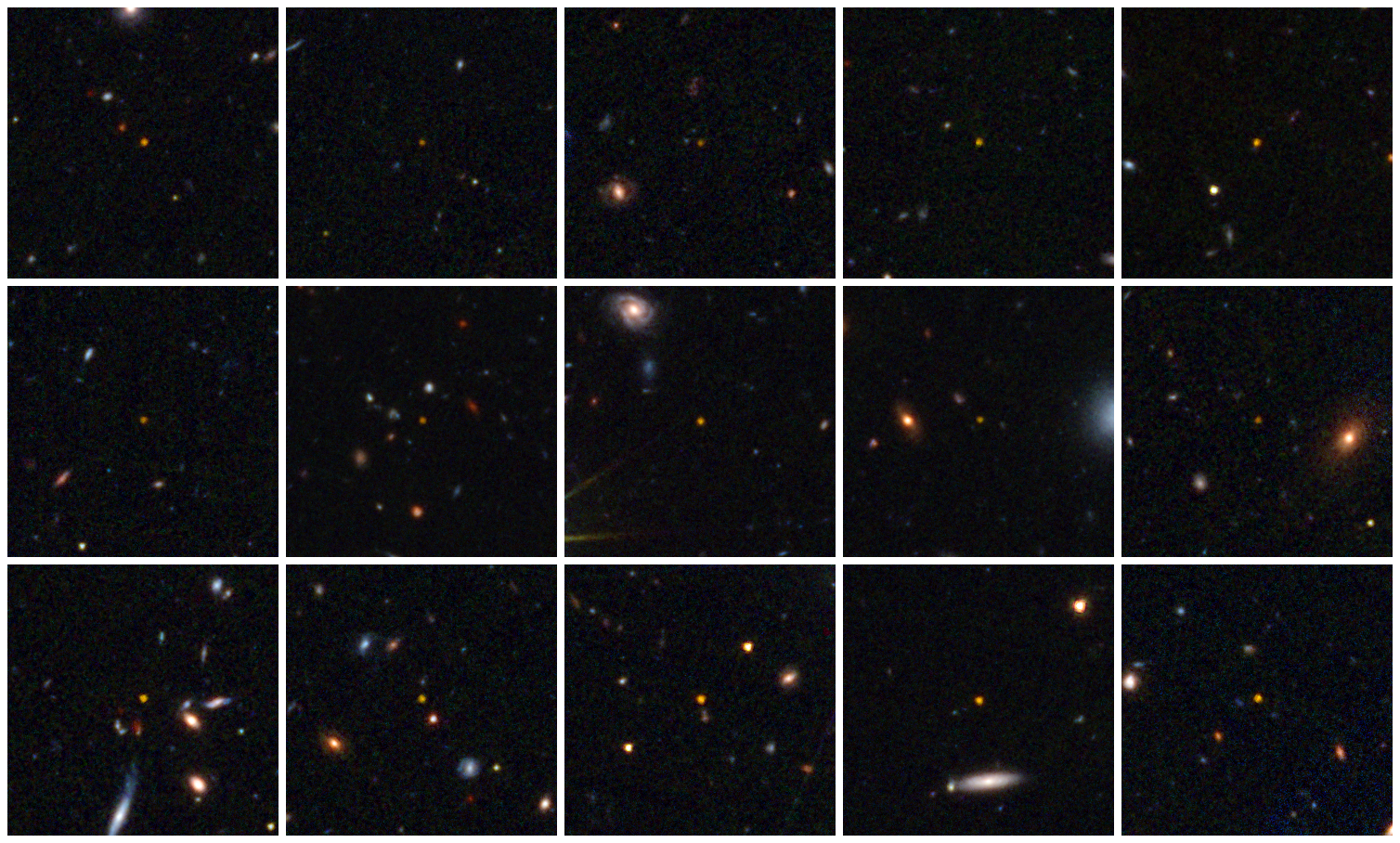 A collage showing 15 of 31 newly discovered quasars discovered by the ESA Euclid telescope. Credit: ESA/Euclid/Euclid Consortium/NASA, image processing by the Euclid Science Ground Segment and Antoine Basset (CNES)
As for the origins of their perpendicular jets?
Magnetic forces are generally accepted as the additional ingredient which produces the jets, says Mortlock.
But it’s not entirely clear which physical mechanisms dominate this process.
The difficulty is that so many distinct aspects of physics are in operation: magnetism, hydrodynamics and turbulence, all operating in a curved space time, says Morlock. So, solving the resultant equations is at the very limit of current computational techniques, he says.
The Bottom Line?
We're pushing back to earlier times than ever before, says Mortlock. But we're still finding these billion solar mass black holes with even less time to grow them than the examples that we had previously, he says.