 Universe Today
Treaties are powerful tools to get nations to align on important issues. They've shaped human history from the time of the first fledgling states up to our current age. Mostly, treaties are easy to enforce because it's clear when one partner isn't living up to treaty obligations.
But what about when treaty-breaking activities can't be seen? This can be a problem when it comes to space.
In 1967, the United Nations drafted the Outer Space Treaty and negotiated with member states to have them sign the treaty. As the decades have passed, more countries have signed on, and now, all major spacefaring nations are signatories to the treaty. The treaty's main provision is to keep space open to exploration by all nations by prohibiting any claims of sovereign ownership. But importantly, it also bans nuclear weapons in space.
Since the Cold War was in full swing in 1967, the nuclear weapons ban, or weapons of mass destruction ban, could've been contentious. But both the USA and the USSR had just gone through the Cuban Missile Crisis, which had created a risk of accidental escalation and potentual nuclear conflict. For a brief period of time, both nations were wary and decided to sign the treaty. Practicality was part of it, since putting nuclear weapons in space or on the Moon was not only impractical, but any attempt would be enormously expensive. Who knows what other behind-the-scenes machinations accompanied the treaty signing.
Fast forward to today, and the Cold War is in the history books, along with the USSR. But the USA and Russia still have enormous stockpiles of atomic weapons, and are still, for the most part, adversaries. As atomic weapons have grown in explosive power and as spaceflight has become an everyday thing, the risk of atomic weapons in space is being reconsidered.
One episode from a few years ago puts it into focus. In 2022, only weeks before Russia invaded Ukraine, Russia launched a satellite into space called Cosmos2553. Russia claimed it was just another regular satellite. But a couple years later, a US official warned that this launch may have carried a weapon into space. "All of us should be concerned with the prospect of Russia putting a nuclear weapon in space, posing a threat to satellites operated by countries and companies around the globe, as well as to the vital communications, scientific, meteorological, agricultural, commercial, and national security services upon which we all depend," said Vipin Narang, Acting Assistant Secretary of Defense for Space Policy, in 2024.
The deeper context of this statement is that as their war against Ukraine raged on, Russia issued an increasing number of threats to use nuclear weapons. They hoped to deter any other nations, especially those in NATO, from interfering and supporting Ukraine. The idea that these threats also applied to space weapons had to be considered.
But this whole issue highlights a problem with the Outer Space Treaty. There's no way to confirm if the Russian satellite launch placed an atomic weapon in space. So there's no way to confirm if they've broken the treaty, putting other signatories in a dangerous and compromised situation.
Now, a researcher at the Massachusetts Institute of Technology (MIT) is proposing a new method to detect atomic weapons in orbiting satellites. He's published his work in Nature and it's titled "Verification of the Outer Space Treaty with cosmic protons." His name is Areg Danagoulian, and he's an Associate Professor of Nuclear Science and Engineering at MIT.
"Recently, the US government has raised worries that Russia is testing nuclear-armed anti-satellite weapon (ASAT) components, with the possibility that it will place a nuclear weapon in space," Danagoulian writes. "Such a device, if detonated, would destroy most of the satellites in the low Earth orbit."
Low Earth Orbit (LEO) is densely packed with satellites. Environmental monitoring satellites like the ESA's Sentinel and NASA's GOES satellites reside there. Space weather monitoring satellites are in LEO. Starlink constellations are also in LEO, as are the Hubble, the ISS, China's Tiangong space station, and many other satellites. Losing these would be catastrophic.
"This danger is compounded by the lack of a verification mechanism for the OST," Danagoulian writes, adding that no detection methodologies have been proposed in open scientific literature. "Here a concept and feasibility study is presented for verifying a satellite’s compliance to the OST by observing the neutrons induced by spallation from the approximately GeV protons in the inner Van Allen radiation belts," he writes.
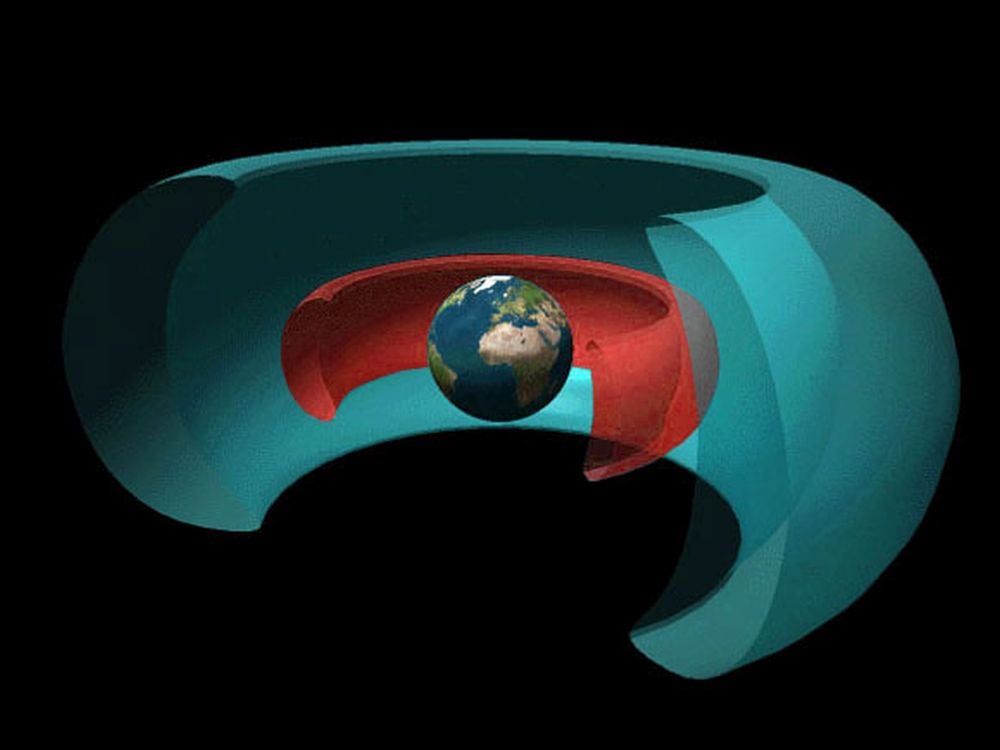 This illustration shows Earth's inner Van Allen belt in red, which is dominated by protons, and the outer belt in blue, which is dominated by electrons. Image Credit: By JHUAPL, NASA, recoloured by cmglee - http://www.nasa.gov/content/goddard/van-allen-probes-reveal-zebra-stripes-in-space, Public Domain, https://commons.wikimedia.org/w/index.php?curid=37587765
Cosmos2553 was launched into the upper reaches of LEO, within the inner Van Allen belt. This is an unusual location for a satellite, but makes perfect sense if you want to test how long a satellite can withstand radiation. Earth's Van Allen radiation belts hold trapped protons with MeV-GeV energies that can damage electronics. This is part of what led to warnings about it the satellite carrying an atomic weapon.
"The Russians launched this satellite in a very strange and unusual orbit because it goes through the most hostile environment possible around the planet,” Danagoulian explained in a press release. “No one puts satellites there because it’s highly radioactive. Why would you put a satellite in that orbit? Well, that location is likely the best point for trapping electrons if you were to detonate a thermonuclear weapon.”
The main danger of an atomic weapon in space isn't the blast itself. Instead, it's high energy electrons. Trapping them creates an artificial radiation belt that can disable satellites, rather than letting them dissipate into space.
The problem is with detecting these weapons beforehand. Danagoulian's method is based on the spallation of fissile material in weapons.
“When an energetic proton slams into elements with a high atomic number, like uranium and plutonium, each proton may knock out something like 40 neutrons,” Danagoulian explained. “That’s a ridiculously large number. We’re talking about millions of protons per second per square centimeter, with many of them generating 40 neutrons. The question is can you detect some of those neutrons?”
Some neutrons are present naturally in LEO and have nothing to do with uranium or plutonium. And a normal satellite also emit neutrons, though not near as many as fissile material with high atomic numbers. So there needs to be a way to differentiate between them.
“Most neutron detectors are very sensitive to protons, so you have to come up with some smart ways to reject protons but keep neutrons,” Danagoulian said. “You also have to tell the difference between naturally occurring neutrons and neutron spallation from the satellite.”
Danagoulian envisions an inspector satellite that would come close to a target satellite. The inspector satellite would have special detectors with two panels of neutron sensors known as scintillators. They're sandwiched between other diamond detectors that can distinguish between natural protons and electrons and neutrons coming from radioactive material. Since it has two panels, the system can detect the direction the neutrons are coming from. If they're coming from the target satellite, it contains fissile material.
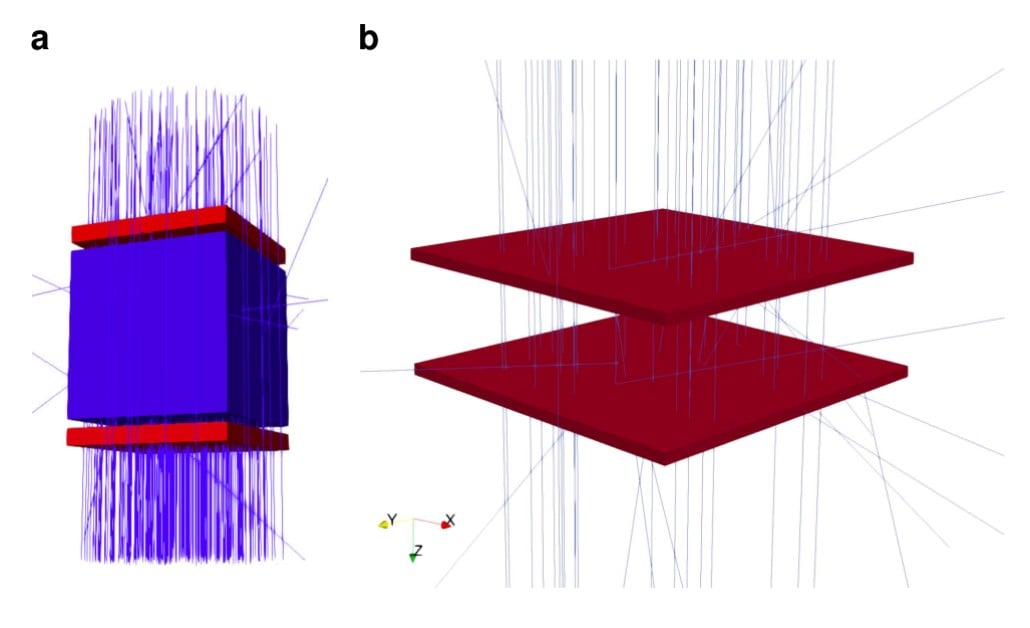 These drawings illustrate the detector system. (A) shows a simulation of a single pixel of the array. The red volumes correspond to the diamond veto detectors. (B) is a rendering of the full system of the two detector planes. Image Credit: Areg Danagoulian 2026. Nature.
Though it's a hazardous situation overall, Danagoulian says the observer satellite could work. "The calculations show that a 9U-CubeSat-sized detection platform can identify a thermonuclear weapon from a distance of 4 km in approximately one week of observation," he writes in his paper.
But it could detect a weapon much sooner if it was closer. It would take only about one hour to detect a weapon if it can get to within 1000 m of its target. That's basically a single flyby. It's also possible to design a system with multiple inspector satellites.
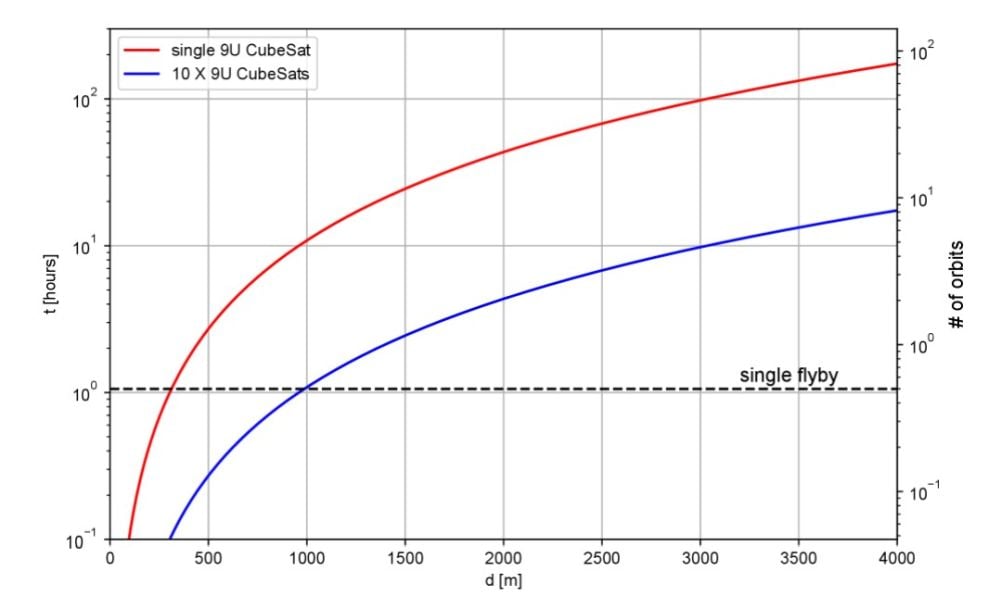 The dependence of the estimated observation time necessary for confirming the presence of a hypothetical thermonuclear device carried by a suspect satellite vs. the measurement distance. The calculation is performed for two scenarios: a single 9U CubeSat; a constellation of 10 such CubeSats. Image Credit: Areg Danagoulian 2026. Nature.
“I say in the paper this isn’t a completely proven system,” he says. “The purpose of the paper is to show the scientific community that it’s scientifically possible to do this. But there are many more practical considerations to be made to actually build these detectors.”
Nations are suspicious of each other, and that doesn't seem likely to change. But if a verifiable detection method were developed and acknowledged, it could chip away at the paranoia and suspicion that arises between nations. Danagoulian thinks a system like this could help to limit nuclear proliferation, and reduce the risk of accidental escalation in the long run.
Right now, nations like the USA and Russia rely on intelligence to know what the other is doing. And as we know from history, intelligence can get things wrong.
“You can fake intelligence,” Danagoulian said, “but you can’t fake physics.”
