Universe Today
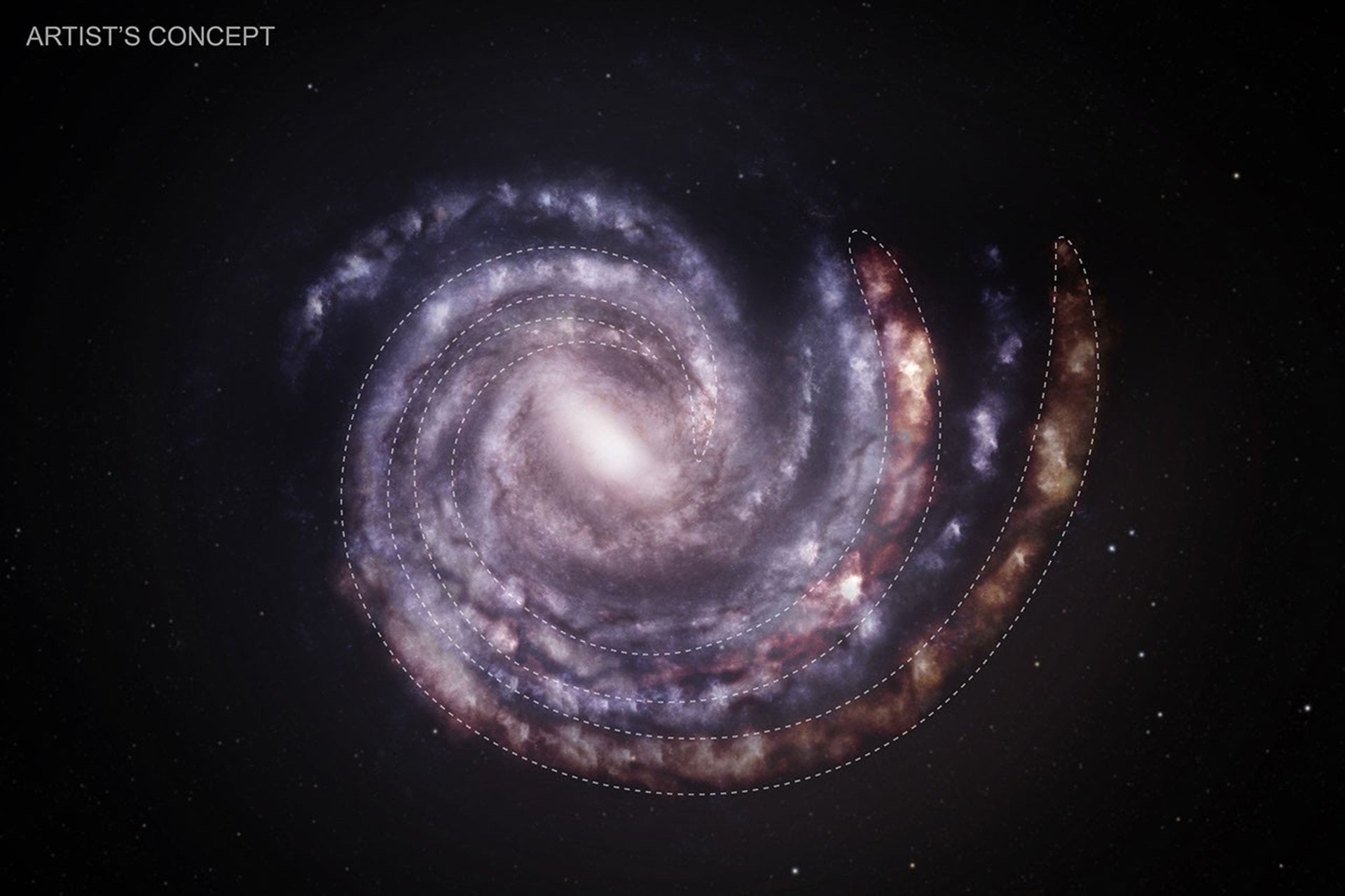
Because of our Solar System's location in the Milky Way's galactic disk, astronomers have a harder time determining the true extent of the Milky Way than they do galaxies millions or even billions of light-years away. And whereas distant galaxies can be well-constrained using optical telescopes, astronomers must rely on instruments that capture light at other wavelengths (radio, infrared, ultraviolet, and X-ray) to better understand the Milky Way's properties.
This includes the Milky Way's outer arms, whose true distances have remained somewhat unclear until recently. Using NASA's Chandra X-ray Observatory and ESA's XMM-Newton satellite, a team of astronomers recently made precise distance measurements to dust clouds in the Milky Way’s spiral arms. Their findings suggest that they may be wider than previously thought, causing astronomers to rethink prevailing theories about our home galaxy's structure.
The results are described in a new paper published in the journal Astronomy & Astrophysics. The team's distance measurements relied on a technique that utilizes light echoes, where they observed rings created by gamma-ray bursts (GRBs) bouncing off of dust clouds in the spiral arms. These GRBs were released by the collapse of massive stars (supernovae) or the merger of neutron stars (kilonova bursts). The diameters of the rings in X-rays provide distance measurements, with larger rings being generated by dust clouds closer to us.
"This is a very direct way — relying only on geometry — to precisely measure distances to the Milky Way’s spiral arms," said lead author Beatrice Vaiai, a postdoctoral researcher at INAF-IASF Milano who led the study while a PhD student in a joint program between the Scuola Universitaria Superiore (IUSS) Pavia and the University of Trento in Italy. "Most other methods rely on assumptions about how the Milky Way rotates, which become increasingly uncertain in the outer regions of our galaxy."
The team's approach consisted of using three different GRBs and the rings they created in three of the Milky Way's spiral arms. In order of distance from the Galactic Center, they are the Perseus and Outer Scutum-Centaurus arms. In the latter two arms, the GRB shells they observed indicated that they are about 10% farther than originally thought. The data also led the team to estimate the diameter of the dust cloud in the most distant arm (3,500 light-years).
This showed that their measurements apply to the full thickness of the spiral arm, not just to isolated dust clouds. "The differences are small, but any revision of these distances is important because they are so fundamental for understanding our galaxy," said co-author Ilaria Fornasiero, also a research at INAF-IASF Milano and IUSS Pavia. "For example, this could mean that astronomers have to revise estimates of the mass of the galaxy, because that affects how wide the arms stretch."
This technique provided major improvements in measuring distances within the Milky Way, highlighting how powerful, transient phenomena (GRBs, fast radio bursts, etc.) can be used to probe cosmic distances. However, the technique is also limited because bright GRBs visible through the plane of the galaxy are quite rare. “We’re relying on the universe to provide us with these events, and so far, over 25 years, we’ve only found a handful that we can use,” added co-author Andrea Tiengo of IUSS Pavia. “That said, we will continue to be on the lookout for more.”
Further Reading: NASA, Astronomy & Astrophysics.