Universe Today
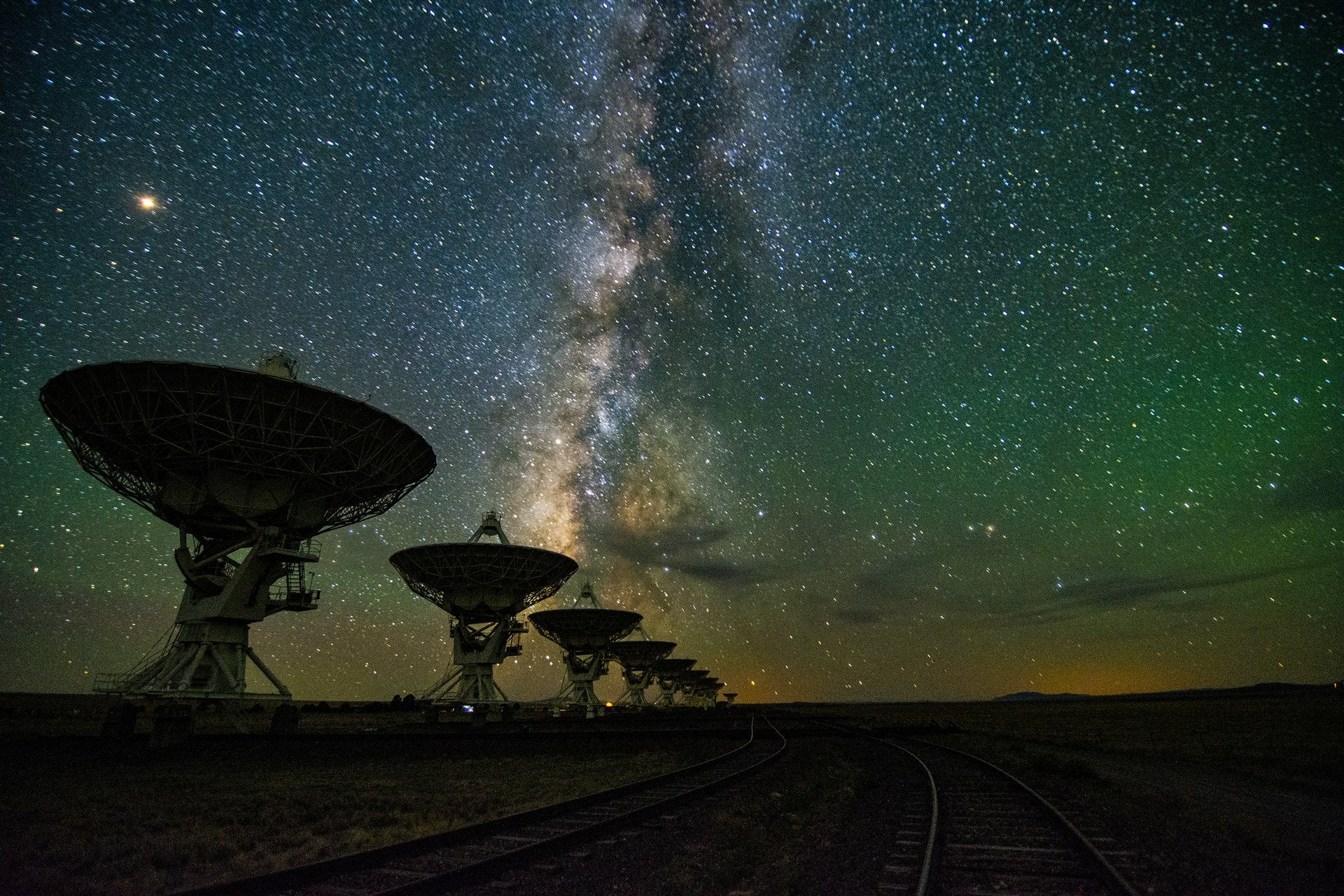
More than sixty years ago, Dr. Frank Drake and his colleagues conducted the very first experiment dedicated to the Search for Extraterrestrial Intelligence (SETI). Since then, astronomers have continued to scan space for signs of alien transmissions, predominantly in the radio spectrum. In more recent years, the search has expanded to include thermal signatures and optical flashes, and additional forms of technological activity ("technosignatures") are already being incorporated. So far, all these experiments have produced null results, prompting SETI researchers to consider what they might be missing.
One possibility that repeatedly comes up is the notion that we are not looking in the right places. This certainly makes sense, since all SETI surveys to date have only covered a limited range of the radio spectrum. Following that logic, could it be that Earth has already received signals, but we didn't realize it because we weren't listening on the right frequency? According to a new study by Claudio Grimaldi, a researcher at the Laboratory of Statistical Biophysics at the Swiss Federal Technology Institute of Lausanne (EPFL), it's unlikely that we have.
The study, "Undetected Past Contacts with Technological Species: Implications for Technosignature Science," recently appeared in The Astrophysical Journal. Using Bayesian Analysis, a statistical technique that updates probabilities based on evolving data sets, Grimaldi examined how undetected past signals would have implications for current SETI surveys. In particular, he examined how past signals would increase the odds of detecting one today, and the likely source of those transmissions.
 The Milky Way galaxy, showing the central bulge at its center. Credit: NASA
As a starting point, he modeled technosignatures as active emissions or artifacts from an advanced civilization that then spread at the speed of light, lasting for brief periods (a matter of days) or for very long ones (millennia). He also considered how detection would only happen if the transmission is within range for the signal to be strong enough for our instruments to detect. He also considered omnidirectional signals (waste heat from megatructures) and highly focused signals (beacons, laser flashes, etc.). The resulting model addressed three possible elements:
- The number of past contacts with Earth
- The typical lifetime of technosignatures
- The distance range that current or near-future instruments can probe
For "contact optimists," the results were not encouraging, suggesting that a very large number of undetected signals would have had to reach Earth in the past for there to be a high probability of detecting technosignatures closer to our Solar System today. In some cases, the number of signals exceeded the number of potentially habitable planets within a few hundred to a few thousands light-years from Earth, making any past or future signals highly unlikely. However, the results were different when extended to much greater distances.
Assuming technosignatures are long-lived and propagate across the entire Milky Way, detection becomes more likely at distances of several thousand light-years or more. However, the number of detectable signals across the entire galaxy at any given time remains very low. These results indicate that our inability to detect signals in the past does not mean detection will likely occur in the near future. Instead, they suggest that transmissions from advanced civilizations are likely to be rare, distant, and long-lasting, rather than local and frequent.
In other words, the field of SETI appears to be destined for a long wait before any discernible technosignatures (intentional or the result of "spillover") will be detected. Far from discouraging SETI efforts, however, the results suggest that future SETI efforts should focus on deeper, broader surveys that scan large parts of the Milky Way rather than individual stars or star clusters located a short distance away (in cosmic terms).
Further Reading: EPFL