Universe Today
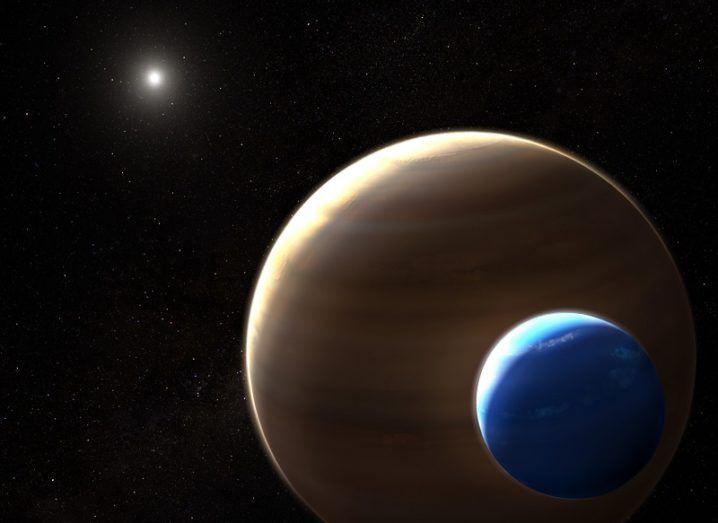
Our solar system hosts almost 900 known moons, with more than 400 orbiting the eight planets while the remaining orbit dwarf planets, asteroids, and Trans-Neptunian Objects (TNOs). Of these, only a handful are targets for astrobiology and could potentially support life as we know it, including Jupiter’s moons Europa and Ganymede, and Saturn’s moon Titan and Enceladus. While these moons orbit two of the largest planets in our solar system, what about moons orbiting giant exoplanets, also called exomoons? But, to find life on exomoons, scientists need to find exomoons to begin with.
Now, a collaborative team of researchers from the United States and United Kingdom look to push the boundaries of discovering exomoons in a recently accepted study to The Astrophysical Journal. For the study, the team introduced a novel method that NASA’s planned Habitable Worlds Observatory (HWO) could use to identify and confirm the existence of exomoons orbiting gas giant exoplanets. The team used a series of computer models to simulate how Earth-like exomoons could be identified orbiting Jupiter-sized worlds through the light the exomoon reflects from the exoplanet as the former passes behind the exoplanet.
Since HWO would be observing from Earth, it would see the exoplanet transit in front of its star, with the starlight reflecting off the exoplanet on the star-facing side. Therefore, the researchers postulate that this reflected starlight could also reflect off the atmosphere of Earth-like exomoon passing behind the exoplanet, with HWO detecting this atmospheric reflection. In the end, the researchers’ models found that HWO could potentially observe an Earth-like exomoon orbiting a Jupiter-sized exoplanet at 1 astronomical unit (AU) from the reflection as far away as 12 parsecs (39 light-years) from Earth. For context, 1 AU is the distance of the Earth from the Sun.
“Exomoons are a place where we should think ‘outside the box’ about what HWO can find,” the study notes. “Practically, that argues for (1) keeping stars with habitable-zone giant planets on the target list; (2) planning how to conduct a search for habitable exomoons; and (3) determining how we will characterize any candidates once found. Lunar eclipses may not be the only—or even the best—approach for searching. They are very sensitive but time-inefficient for a blind search. However, dedicated monitoring of large giant planets for lunar eclipses is likely to be scientifically productive, particularly if HWO is sensitive to moons as small as 0.5R⊕ [Earth radius].”
Given the vast diversity of our own solar system, specifically regarding the large number of moons, finding exomoons could equally provide insight into the diversity of exoplanetary systems. While only a handful of moons in our solar system could potentially host life, this presents the potential that exomoons orbiting gas giant exoplanets could also support life. However, despite confirming the existence of more than 6,000 exoplanets, scientists have yet to confirm the existence of a single exomoon. However, there are presently several top exomoon candidates that scientists continue to analyze data to confirm their existence. These candidates include Kepler-1625b I, Kepler-1708b I, Kepler-90g moon candidate, Kepler-80g moon candidate, and WASP-49b moon candidate.
Of these, four are hypothesized to orbit gas giants while the Kepler-80g moon candidate could potentially orbit an exoplanet slightly larger than Earth. Also, the candidacy of these exomoons continues to be debated and analyzed, as the existence of Kepler-1625b I and Kepler-1708b I were questioned in a 2023 study published in Nature Astronomy then a 2025 study published in Nature Astronomy concluded their existence remains open.
As noted, HWO is a planned NASA mission whose primary objective is will be to search for and identify Earth-sized habitable exoplanets, with secondary objectives include studying galaxy growth, elemental evolution, and solar system objects. While HWO isn’t currently scheduled to launch until 2041, this gives scientists plenty of time to debate what other scientific objectives HWO could achieve, including searching for potentially habitable exomoons.
What new insight into habitable exomoons will researchers make in the coming years and decades? Only time will tell, and this is why we science!
As always, keep doing science & keep looking up!