Universe Today
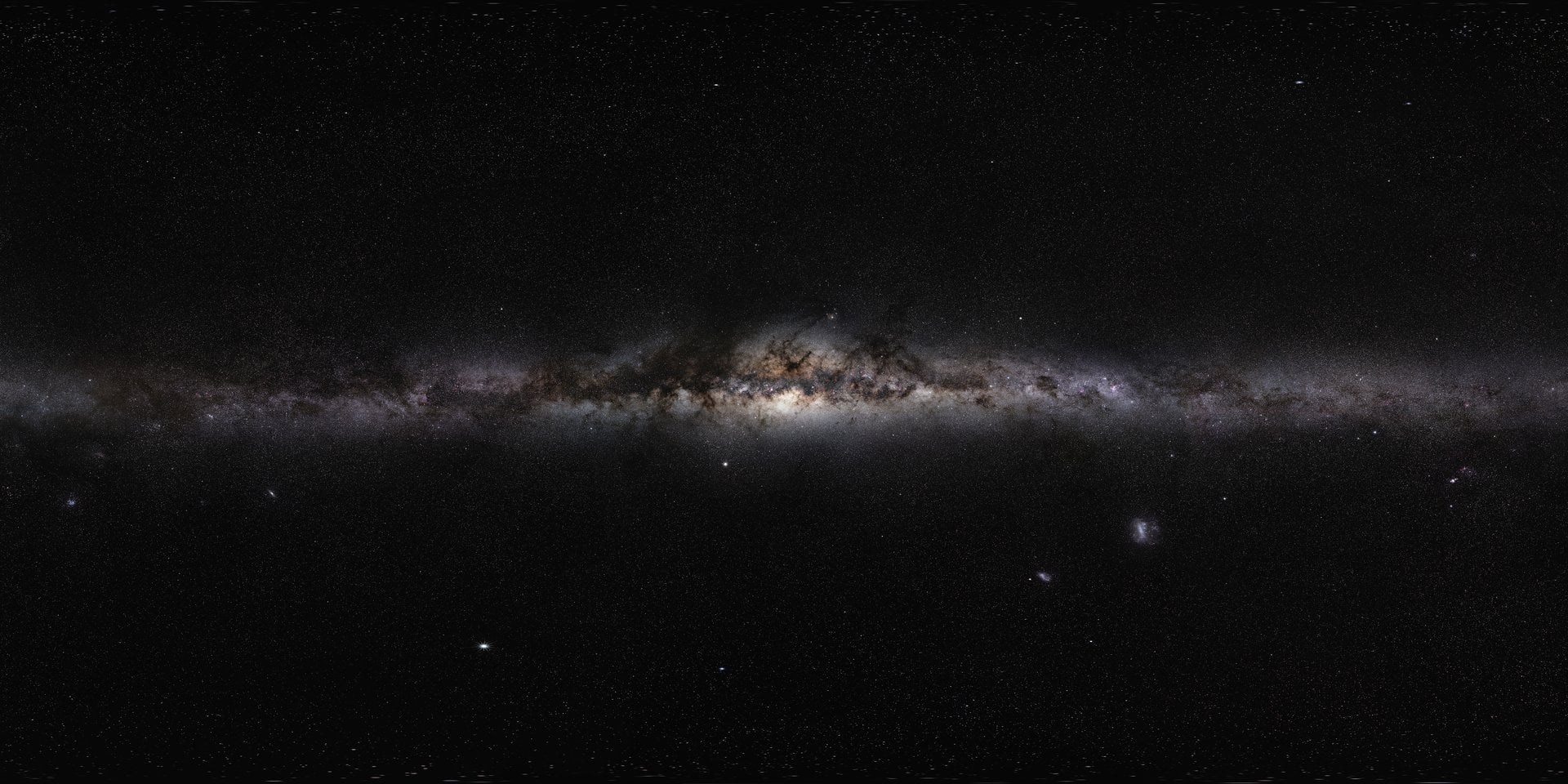
According to Einstein's Theory of General Relativity and the Standard Model of Cosmology, galaxies like the Milky Way are bound together by gravity and the mysterious mass known as Dark Matter. However, magnetic fields are also vital for maintaining galactic balance through a process known as Faraday rotation. This phenomenon, discovered by Michael Faraday in 1845, describes the magneto-optical effect in which polarized light rotates as it passes through a medium subjected to magnetic fields parallel to its path.
For some time, astronomers have sought to map the magnetic field of the Milky Way to gain insight into how it prevents the galaxy from collapsing. Using the new telescope at the Dominion Radio Astrophysical Observatory, run by the National Research Council (NRC) of Canada, a team of astronomers has mapped the northern sky across different radio frequencies. The result is a comprehensive dataset obtained through the Global Magneto-Ionic Medium Survey (GMIMS) project.
The research was led by Dr. Jo-Anne Brown, a professor of physics and astronomy at the University of Calgary, and Dr. Anna Ordog, a professor of computer science, mathematics, physics, and statistics at the University of British Columbia, Kelowna (UBC). They were joined by researchers from the GMIMS project, an international collaboration of scientists dedicated to probing the three-dimensional structure of magnetized, ionized gas in the interstellar medium of the Milky Way Galaxy. To this end, they have been surveying the entire sky with large single-dish radio telescopes since the project's inception in 2008.
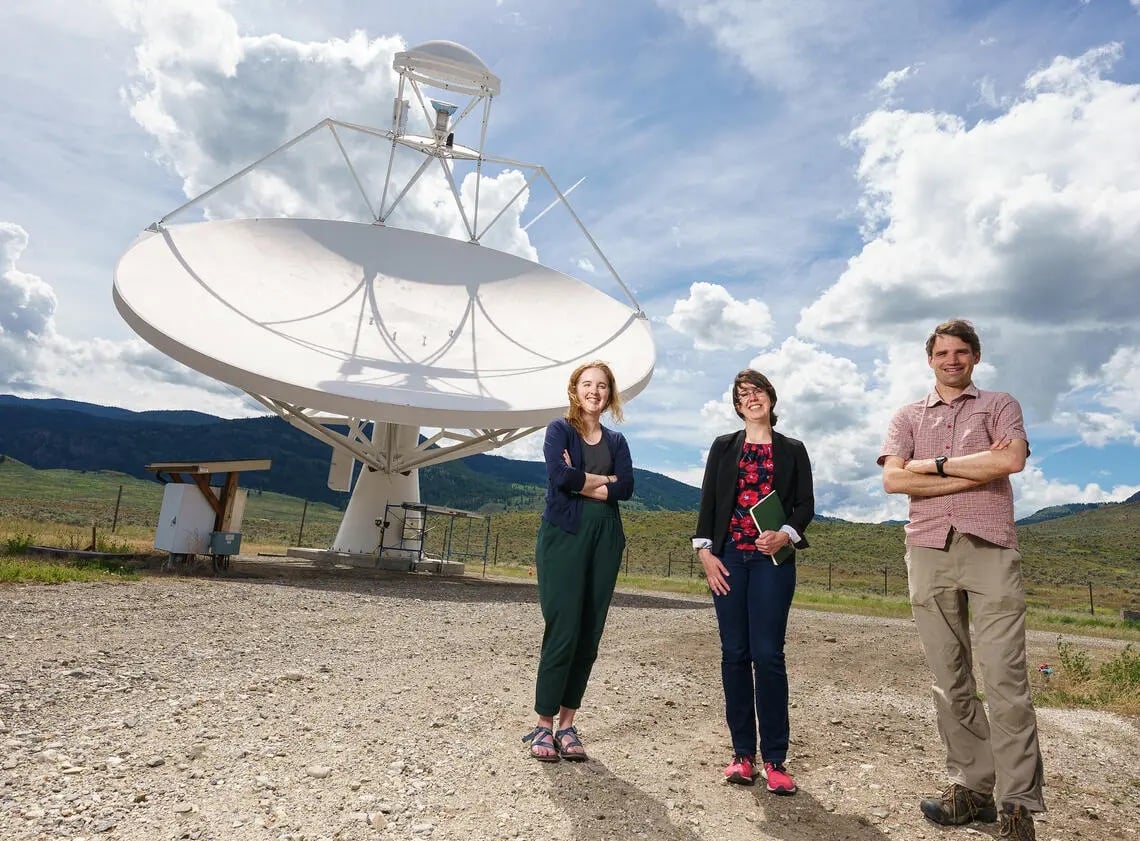 Researchers, from left, Rebecca Booth, Anna Ordog, and Alex Hill, next to the telescope used to collect the data for their study. Credit: NRC/Conseil National de Recherches Canada
The results, which were published in two papers appearing in the Astrophysical Journal and The Astrophysical Journal Supplement Series, include a complete dataset (which is available to astronomers worldwide) and a new model that will inform theories of how the magnetic field of the Milky Way evolved. "Without a magnetic field, the galaxy would collapse in on itself due to gravity," Brown said in a UCalgary News release. "We need to know what the magnetic field of the galaxy looks like now, so we can create accurate models that predict how it will evolve."
As noted, the data collected by the GMIMS project were used to track Faraday rotation in the Milky Way. Rebecca Booth, a PhD candidate working with Brown and the lead author of the second study, specifically examined the Sagittarius Arm, which has a unique feature in the form of a reversed magnetic field. Booth followed up on Ordog's discovery using the dataset. to create a new three-dimensional model for the magnetic field reversal. When viewed from Earth, the field would appear diagonal, as the observations showed. Said Brown:
If you could look at the galaxy from above, the overall magnetic field is going clockwise. But, in the Sagittarius Arm, it’s going counterclockwise. We didn’t understand how the transition occurred. Then one day, Anna brought in some data, and I went, 'O.M.G., the reversal's diagonal!'
This work is significant not only for its contribution to long-standing questions about the Milky Way and the role of magnetic fields in galactic evolution, but also for its implications for galactic evolution. It is also significant because the three scientific leads are all women, showcasing the growing role diversity plays in the advancement of knowledge. This is especially important in a time when these very ideals are under assault by regressive political attitudes.
Further Reading: UCalgary