Universe Today

The combustible sedimentary rock, better known as coal, was not only crucial to the onset of advanced technology here on earth, but it should also be key to the development of advanced E.T.s residing on any given exoearth. Or so say the authors of a new paper just published in the International Journal of Astrobiology.
The authors argue that we needed large amounts of shallow, energy-dense coal to enable the technology necessary to first forge steel. Steel drill bits were crucial for extracting deep seated reserves of fossil fuel which provided the technology necessary to develop the kind of 20th century technology required to build radio telescopes capable of communicating over interstellar distances. And as the authors of this new paper assert, the same will be true for advanced alien civilizations.
For the past seven decades, the search for extraterrestrial intelligence (SETI) has focused on highly advanced civilizations that could communicate over interstellar distances via the radio or optical spectrums.
Without access to coal, our own civilization would never have been able to harness deep deposits of oil and gas and in turn generate enough heat and electricity to melt steel. This enabled the development of radio telescopes that today dot our own planet which can send and receive messages across interstellar space.
At first blush, this argument seems a bit far-fetched, but there are good reasons why this planetary caveat may limit the number of advanced technological civilizations (ATCs) out there that can initiate and deliver interstellar communications. That is, send radio or optical signals over vast interstellar distances.
Without the massive input of energy-dense fossil fuels, it’s doubtful whether human civilizations would ever have been able to acquire the technological capability to build detectable infrastructure like powerful radar, the authors note.
Coal-derived energy made it possible to heat blast furnaces to high enough temperatures to make steel to extract vast amounts of oil and gas needed to drive the 20th century’s technological advances.
Early coal shaft mines had depths frequently less than 100 feet, while oil wells were typically about 3,500 feet below the surface, the authors note.
But because of its portability, and effectively unlimited supply, we make the case that coal (needed to make coke for steel production) was essential for pre-industrial society to transition to an advanced industrialized society, Lincoln Taiz, the paper’s lead author and a professor emeritus of Plant Biology at the University of California, Santa Cruz, told me via email. This led to the ability and desire to communicate with ATCs on other planets, Taiz told me.
How can we go about detecting such coal-rich exo-societies?
The detection of atmospheric signals based on the combustion products of coal could indicate the presence of an Industrial Revolution on an exoplanet, the authors write. But the simultaneous detection of a combination of persistently high carbon dioxide, sulfur dioxide, nitrogen oxides, heavy metals and unusual particulates like soot would be hard to generate by natural means, they note. However, the coal-burning phase of an industrial civilization would presumably be relatively brief, and any residual techno signals would quickly disappear, drastically reducing the chances of detection, they write.
The Need For Energy-Dense Coal
Perhaps as much as 90 percent of the coal that fueled the Industrial Revolution in England, Europe and North America was deposited during a roughly 70-million-year window spanning the Carboniferous and Permian periods, some 330 to 260 million years ago, as the authors note.
But in addition to the energy-dense strains of coal that were needed, earth was also fortuitous in the fact that it benefited from global plate tectonics (the dynamics of giant lithospheric plates as they move, collide and subduct atop our earth’s outer mantle). This process, in turn, helped enable the formation of large deposits of coal that remain to this day.
In fact, plate tectonics and continental drift were crucial in producing the down-dropped basins (such as the modern-day basin and range topography of western North America) where plant growth and accumulation occurred, the authors note.
Thus, any ATC will likely need large amounts of bituminous coal to jumpstart their technology.
For those who wonder if the initial use of fossil fuels could be circumvented by using energy generated from nuclear, solar, wind or water, that’s a scenario that’s highly unlikely. That’s because there’s no doubt that early use of fossil fuels enabled the development of precision steel manufacturing and the sort of engineering and advanced metallurgy from which all these alternative fuel technologies evolved.
But there also needs to be the right timing in the creation of a planet’s coal and the evolution of intelligent life forms that might harness it.
On earth, the maturation of large amounts of energy-dense bituminous coal preceded the evolution of Homo sapiens by more than a 100 million years, in time to spark the Industrial Revolution, the authors note. This might not have happened if humans (or some other highly intelligent species) had evolved much earlier, before Carboniferous coal had progressed from peat to bituminous, they note.
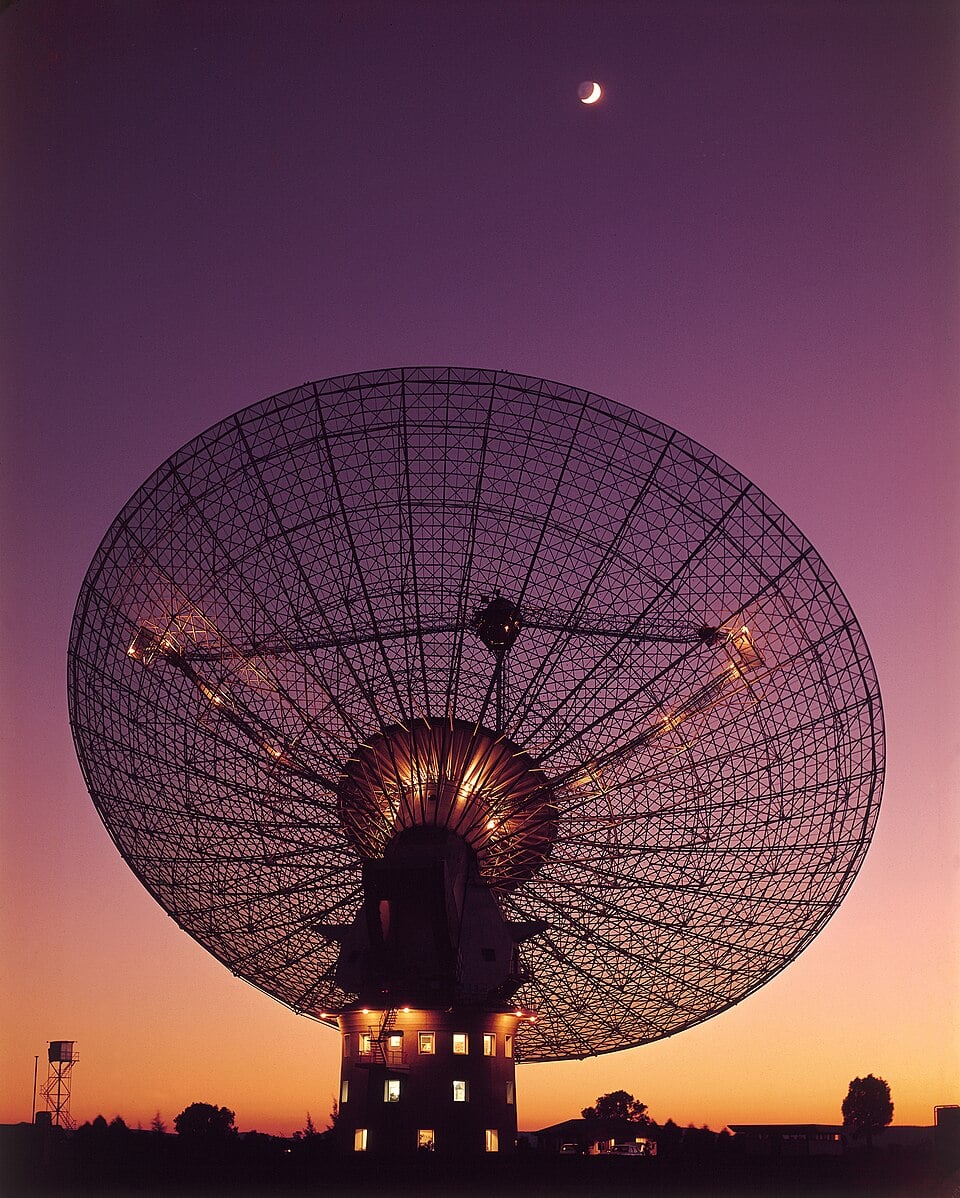 The 64-meter radio telescope at Parkes Observatory as seen in 1969, when it was used to receive live televised video from Apollo 11, Credit: CSIRO via Wikipedia
We assume that an ATC would be most likely to form on an Earth-like planet, but there are an enormous number of contingent events, starting with the evolution of oxygenic photosynthesis itself, that must be replicated before you get to bituminous coal, says Taiz. Add to this the need for synchronicity between the maturation of coal and the evolution of intelligent life and replicating earth’s history precisely becomes even more difficult, he says.
The Bottom Line?
All this suggests that our own advanced technological civilization may be even rarer than the ‘Rare Earth Hypothesis’ that Peter Ward and Donald Brownlee first proposed, says Taiz.