Universe Today
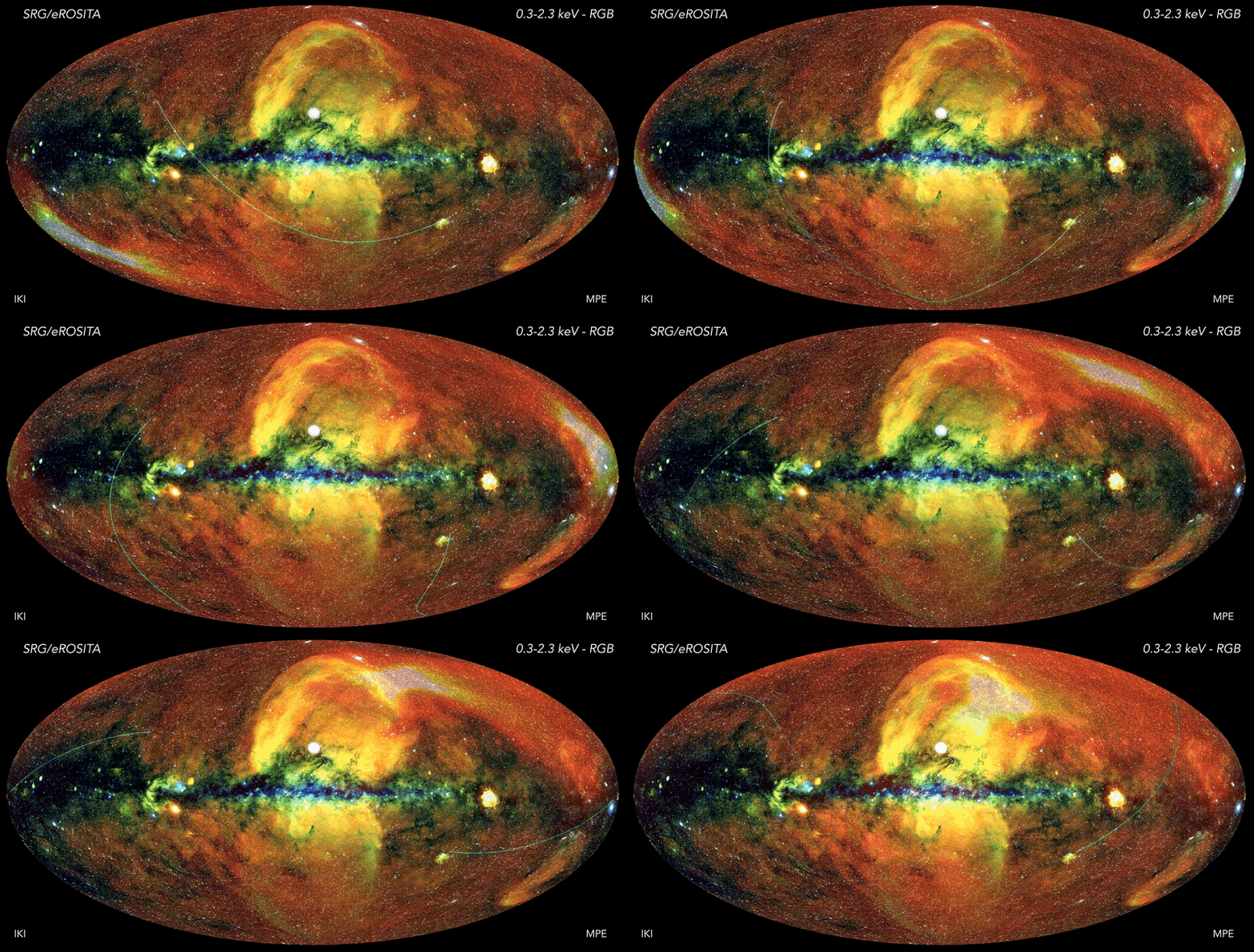
The Universe looks mighty impressive when visualized with X-ray instruments. More importantly, X-ray images provide vital scientific insights by revealing features in the Universe that are not observable in visible light. The same is true of our Solar System, which has been difficult because of the challenges of separating local emissions from the rest of the Milky Way galaxy. In a recent study, a team from the Max Planck Institute for Extraterrestrial Physics (MPE) managed, for the first time, to disentangle the X-ray glow of our Solar System from deep space.
This was based on data obtained by the extended ROentgen Survey with an Imaging Telescope Array (eROSITA), an instrument aboard the Russian-German Spectrum-Roentgen-Gamma (SRG) observatory, between 2019 and 2021. The four sky maps produced from this enabled the extraction of solar wind charge exchange (SWCX) emissions from the cosmic background, providing the clearest view of the Solar System's soft X-ray glow to date.
The soft X-ray glow arises when highly charged solar wind ions (like carbon and oxygen) capture electrons from neutral atoms in Earth's upper atmosphere (geocorona) and elsewhere in the heliosphere. Based on data collected between 2019 and 2021. Previously, scientists believed that the SWCX was merely signal interference since it affected every study of the X-ray sky, skewing temperature and density measurements. These are vital to cosmological models, which makes the new data vital to our understanding of how the Universe has evolved over billions of years.
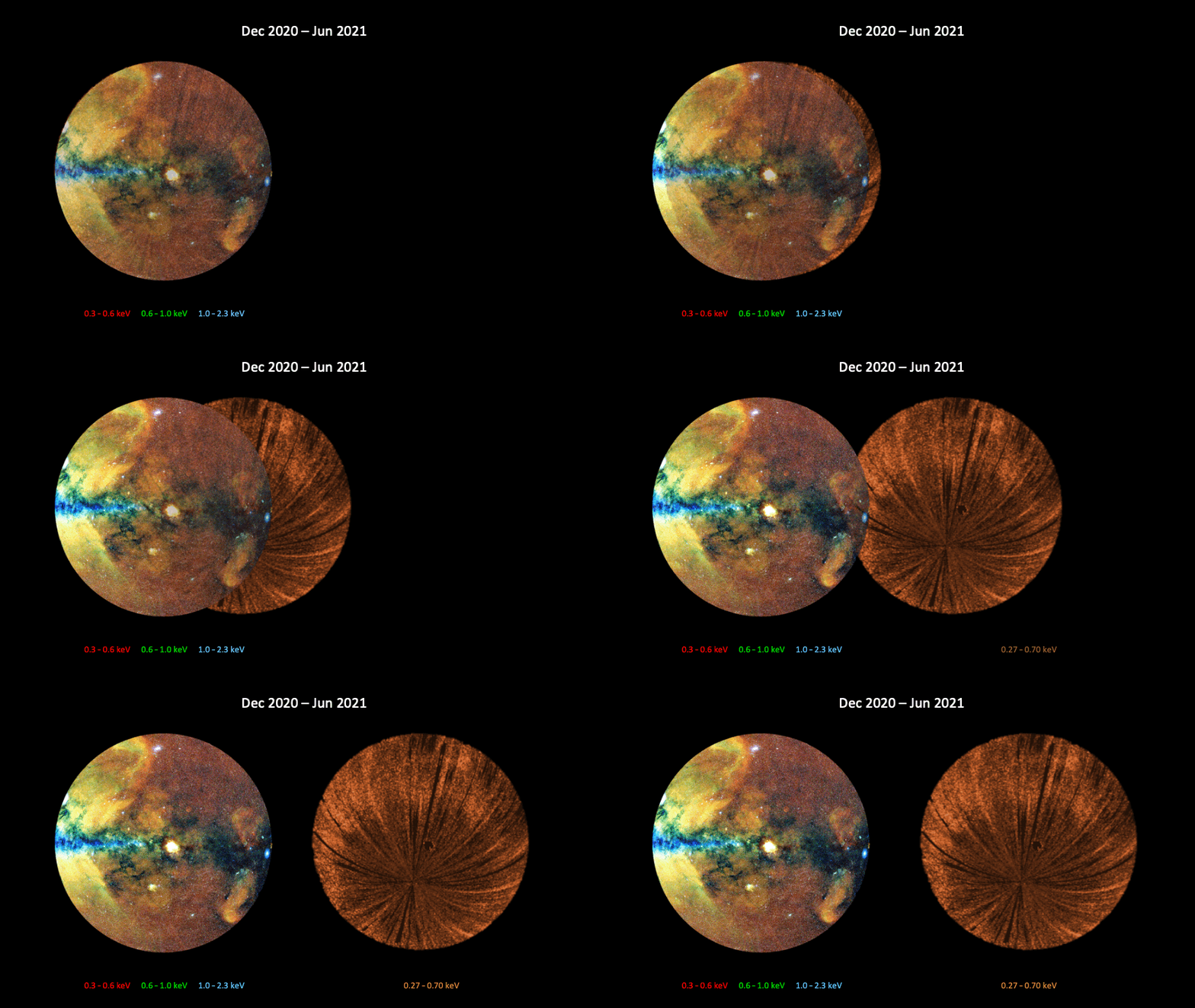 Illustration of the separation of the SWCX foreground emission from the cosmic X-ray sky, for the Western Galactic hemisphere. Credit: K. Dennerl (MPE)
The SRG/eROSITA telescope enabled this through the telescope's unique location (around the L2 Lagrange Point), which avoids X-ray interference from Earth's geocorona. Its ability to conduct long-term observations from solar minimum onwards also allowed researchers to track changes in X-ray levels driven by solar activity. By comparing observations, the team isolated the heliospheric component and reconstructed the soft X-ray sky as it would appear from outside the Solar System.
They also enable (for the first time) the study of the heavy-ion content of the solar wind, how it variability, and its interaction with the interstellar medium (ISM). The data also revealed an evolution of X-ray emissions, with increased solar activity leading to observable changes at different latitudes. This confirms previous research showing reduced X-ray emissions around the Sun's polar regions at solar minimum, a phenomenon known as a "polar hole" that closes as activity increases.
Further analysis of the data revealed a localized region near Earth's orbit with enhanced X-ray emissions that doesn't orbit the Sun. This is the result of the "interstellar breeze," helium atoms that pass through the Solar System as it moves through the Milky Way. This confirmed yet another prediction dating back to the 1970s: that the Sun's gravity creates a "helium focusing cone." In essence, the Sun's gravity bends the trajectories of these atoms, creating a concentrated stream on the "downwind" side.
By combining solar wind measurements and data on the distribution of matter in the ISM, the team produced time-resolved three-dimensional models of the SWCX emissions. This revealed that emissions originate predominantly from spiral structures driven by variations in solar wind speed, primarily within Mars' orbit, which (when averaged over time) show the cone clearly. These findings represent a paradigm shift in soft X-ray astronomy, turning what was considered a contaminating nuisance into a powerful diagnostic tool. As team lead Konrad Dennerl noted in a MPE press release:
Tracking how the solar wind modifies the appearance of the X-ray sky over time not only allows us to clean up observations of the distant universe but also provides unprecedented insights into solar physics and heliospheric dynamics. Understanding our Solar System’s X-ray emission is the key to properly interpreting observations of the diffuse X-ray sky.
The paper describing their findings, "Determination of the Solar System contribution to the soft X-ray sky," recently appeared in the journal Science.
Further Reading: MPE