 Universe Today
Liquid water is the primary ingredient for life as far as we can determine. The search for habitable exoplanets focuses on this fact. Exoplanet scientists sift through data trying to determine which worlds might be in their stars' habitable zones, a zone with just the right amount of star energy to maintain liquid surface water.
But exoplanets and their water isn't a binary issue. Determining habitability isn't as simple as determining if an exoplanet has water or doesn't have water. An exoplanet with a scant amount of water may not be hospitable whether it's in the habitable zone or not. Earth, the only habitable planet we know of, depends on its carbon cycle to maintain habitability. The carbon cycle depends on water, and exoplanets without enough water aren't likely to sustain their carbon cycles, making the prospects for long-term habitability bleak. But how much water is enough?
New research in The Planetary Science Journal examines the water content that desert-like exoplanets likely need to support habitability. It's titled "Carbon Cycle Imbalances on Arid Terrestrial Planets with Implications for Venus." The lead author is Haskelle White-Gianella, a doctoral student of Earth and space sciences at the University of Washington.
"Arid terrestrial exoplanets are potentially abundant and are thus interesting targets in the search for life," the authors write. "On modern Earth, there is enough surface water for a balanced geologic carbon cycle, meaning silicate weathering balances the volcanic outgassing of CO2. However, on arid planets, there may not be enough surface water for this silicate weathering thermostat to maintain habitable conditions."
Water vapour in Earth's atmosphere combines with carbon dioxide to create carbonic acid. Carbonic acid is weak and unstable, but it makes all rainwater slightly acidic. Over geologic time scales it plays a critical role in Earth's carbonic acid-silicate weathering cycle, also called the Urey cycle. It's a branch of the planet's carbon cycle.
This cycle is what removes carbon from the atmosphere over long time periods. The weak acid dissolves silicate rocks and the runoff finds its way into the oceans. It sinks to the ocean floor, where plate tectonics eventually pulls it underground. This is how atmospheric carbon becomes sequesterd in Earth's rock. Without this cycle, carbon would continuously build up in the atmosphere, leading to a runaway greenhouse climate (hello Venus).
Earth has plenty of water to keep the cycle going. But what about arid worlds, which are, as the authors write, "potentially abundant." How do arid planets, water content, and the Urey cycle affect our search for habitability?
“When you are searching for life in the broad landscape of the universe with limited resources, you have to filter out some planets,” said lead author White-Gianella in a press release.
“We were interested in arid planets with very limited surface water inventory — far less than one Earth ocean. Many of these planets are in the habitable zone of their star, but we weren’t sure if they could actually be habitable,” White-Gianella said.
The researchers developed detailed models to try to understand arid planets and their ability to maintain the critical carbonate-silicate cycle. "We model the evolution of the geologic carbon cycle by tracking the fluxes of water and carbon between the interior and the atmosphere–ocean system," the authors write.
The modelling is based on 18 variables, including factors like the atmospheric escape rate of hydrogen, the rate of volcanic outgassing, the fraction of a planet's surface covered by land, overall temperature, the concentration of minerals in fresh rock, the porosity of rock, the fraction of rain water converted to runoff, and many more. The modelling is based on our growing understanding of Earth's carbon cycle and how it maintains its temperature.
"These sophisticated, mechanistic models of the carbon cycle have emerged from people trying to understand how Earth’s thermostat has worked — or hasn’t — to regulate temperature through time,” said senior author Joshua Krissanen-Totton, a UW assistant professor of Earth and space sciences.
Unfortunately for desert worlds, most of them lack enough water to maintain the Urey cycle.
"Our results show that arid terrestrial planets may have unbalanced geologic carbon cycles due to runoff-limits to weathering, which can lead to a loss of habitability and runaway warming. Even if a planet is in the HZ, it can transition to an uninhabitable state if it does not have enough initial surface water to balance outgassing and weathering fluxes," the authors explain.
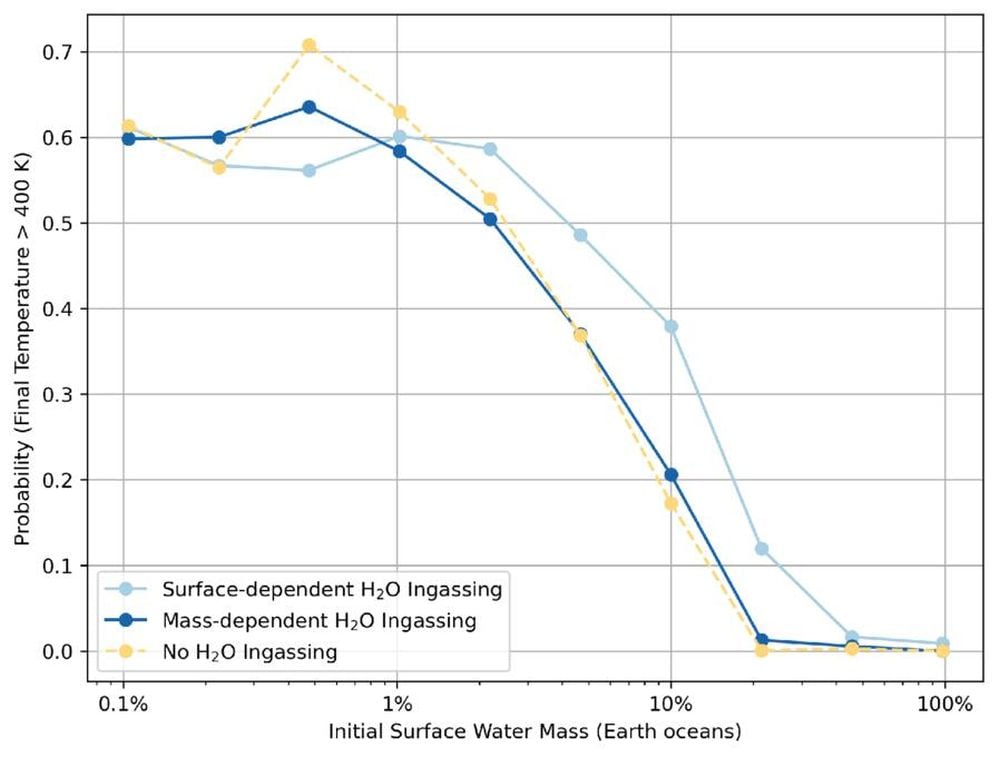 This figure illustrates some of the research results. Each line on this graph represents 10,000 model runs. The vertical axis shows probability of extreme heat while the horizontal axis reflects liquid surface water inventory. The likelihood of lower surface temperatures improves when water inventory exceeds 20%. Image Credit: Planetary Science Journal/White-Gianella and Krissansen-Totton
“So that unfortunately makes these arid planets within habitable zones unlikely to be good candidates for life,” White-Gianella said.
An arid planet could still support the all-important Urey cycle. They don't need to have as much water as Earth does, but they still need a significant amount.
"Here, we show that arid planets enter a regime where weathering cannot keep up with volcanic degassing of CO2," the authors write. "Using a coupled model of the geologic carbon cycle, we find that terrestrial Earth-like planets require an initial surface water inventory of at least ∼20%–50% of Earth’s ocean mass to maintain a balanced geologic carbon cycle and temperate surface temperature over 4.5 Gyr of evolution."
These results have something to tell us about the well-known TRAPPIST-1 exoplanets. They're important because four of the seven appear to be in their star's habitable zone. They could have limited surface water, but it's not clear if they do, or how much they might have. They could serve as test cases for this type of inquiry, or could at least help provide some constraints.
Unfortunately, it's very difficult to determine what's happening on distant arid exoplanets. This brings us to Venus.
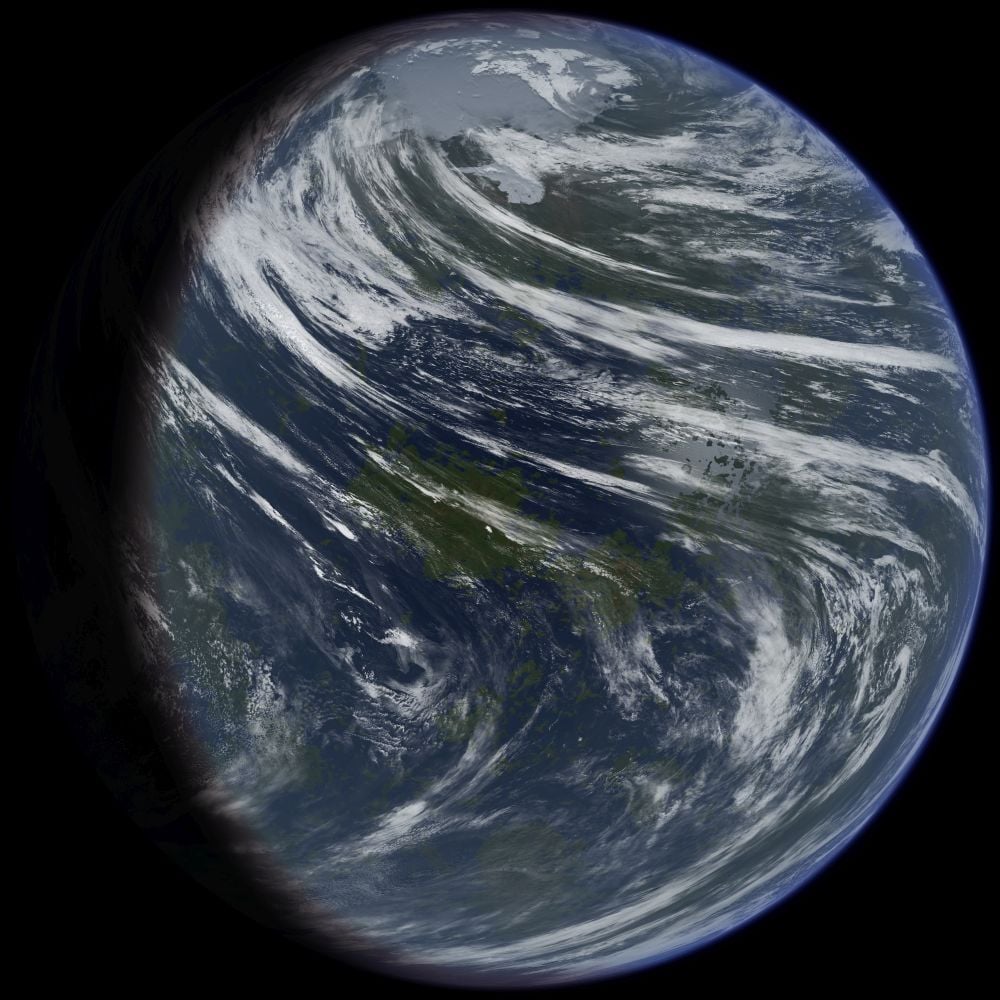 An artist's illustration of Venus could look like if it had significant water. Image Credit: Ittiz, CC BY-SA 3.0, https://commons.wikimedia.org/w/index.php?curid=2440739
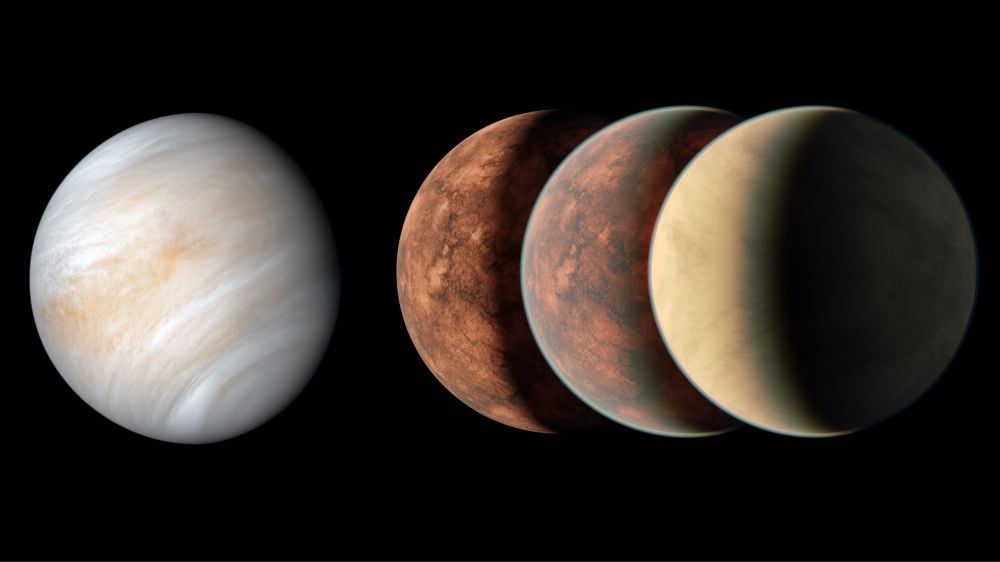
Venus may have started with some water. But the authors point out that since it's much closer to the Sun, it may have started with less than Earth. That meant that the planet's geologic carbon cycle was unbalanced. Without rainfall, carbon built up in Venus' atmosphere, raising the surface temperature. So Venus eventually lost its water, and if there was any simple life on the planet, it disappeared.
This work shows how our simple definition of the habitable zone is only a starting point. There's far more to habitability than proximity to a star, it's just that that's all we can really measure at this point. "Even if a planet resides in the habitable zone of its star, if arid, it may transition to an uninhabitable state due to an unbalanced carbon cycle," the researchers write.
These results are consistent with a growing understanding that many planets may be habitable for shorter periods, and could even develop simple life. But for the type of long-term habitability that leads to complex life, and to civilization-building species like ours, water is critical.
Understanding this issue beyond modelling is difficult because we don't have access to arid exoplanets. We can only gaze at them from a distance and try to measure their atmospheres. That could change if NASA builds the Habitable Worlds Observatory. "Our results linking the size of the water reservoir with long-term climate will potentially be testable with the upcoming Habitable Worlds Observatory, which will constrain surface habitability and land fraction via reflected light spectroscopy," the authors write.
But Venus could provide a better opportunity.
“It’s very unlikely that we will land something on the surface of an exoplanet in our lifetime, but Venus — our nextdoor neighbor — is arguably the best exoplanet analog,” White-Gianella said.
The researchers hope that results from future missions will help validate the results of their modeling. “This has implications for a lot of the potentially habitable real estate out there,” Krissanen-Totton said.
But as it stands now, the results can help us shape our search for life elsewhere.
"More broadly, arid terrestrial exoplanets are less likely to remain habitable on long timescales, and may thus be poor candidates for biosignature searches," the authors write.

