 Universe Today
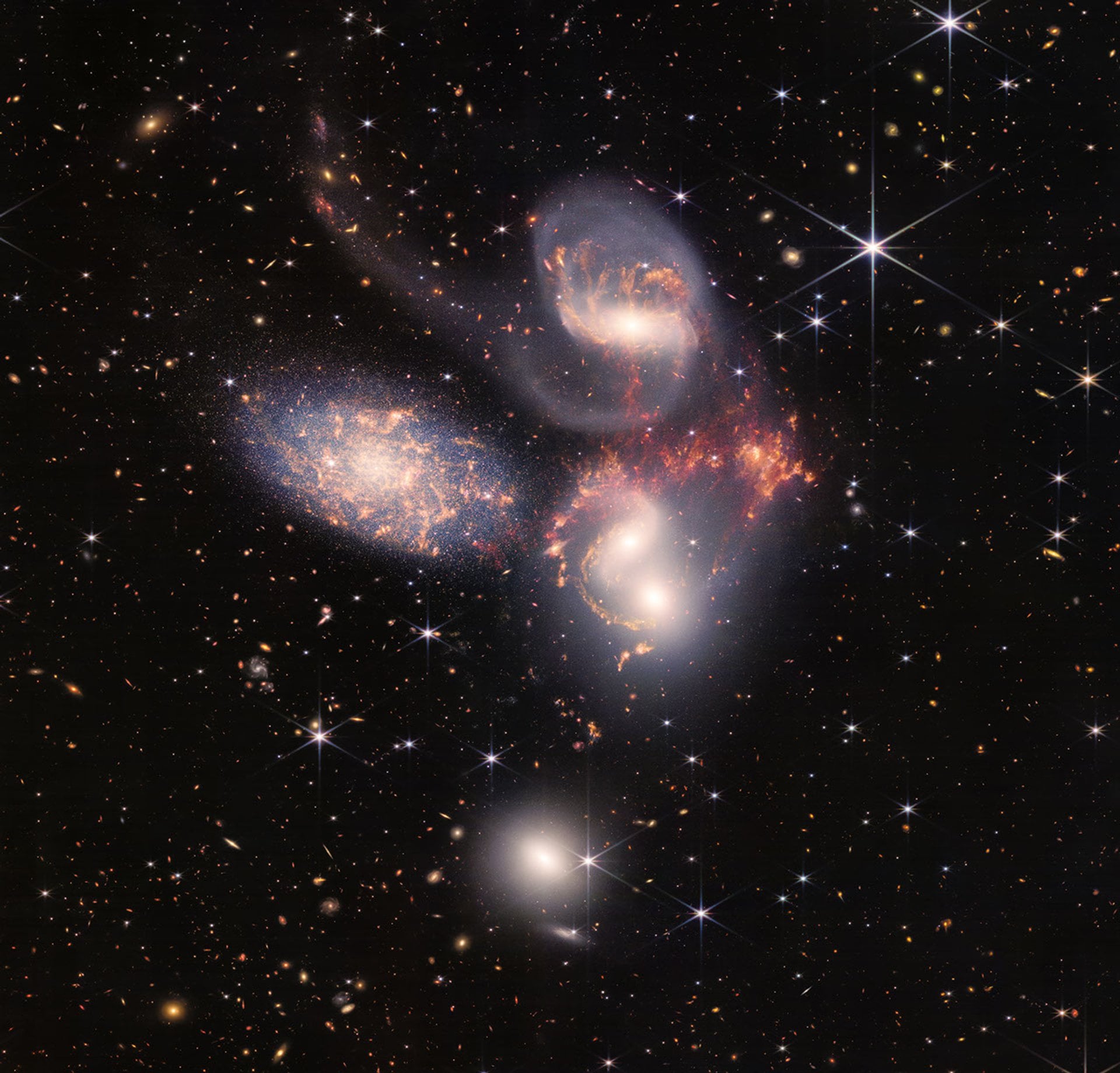
Scale in the universe is hard to understand from a purely human perspective. Many times the math just doesn’t sit well with our brains that evolved to capture and process data about the world around us rather than groking the complexities of stellar dynamics and galaxy mergers. But every once in a while astronomers find something that, if we can wrap our heads around the numbers, gives a sense of just how big the universe is. That is precisely what a new paper, available in preprint on arXiv from a group of astronomers led by Z.L. Wen of the Chinese Academy of Sciences, hopes to do when it describes a merger of not one, not two, but six supermassive galaxies and the active dynamics they’re subject to.
Admittedly, this paper isn’t the one that originally found the cluster. That was done back in 2018 by several all-sky surveys, including the Two Micron All Sky Survey, WISE, and SuperCOSMOS. But it was the first to identify that the cluster contained a group of six merging galaxies at its heart. That tidbit was hidden away in Dark Energy Spectroscopic Instrument (DESI) Legacy Imaging Surveys data. Using the Mayall, Bok, and Blanco telescopes in Arizona and Chile, they resolved a group of six massive galaxies all merging into one supermassive galaxy, which astronomers commonly called the Brightest Cluster Galaxy - in effect, the brightest galaxy in a cluster of galaxies.
Surrounding this massive merging galaxy, the DESI survey also found a 310 kpc shroud of Intracluster Light (ICL). Essentially this is a glowing “fog” of stars that were stripped away from their host galaxies by the violent dynamics of the merger. The astronomers that found the cluster had to strip away the light from the galaxies themselves before they could see the afterglow effect of their merger.
Fraser talks about whether Supermassive Black Holes or galaxies came first. Credit - Institute of Astronomy, University of CambridgeSo far the numbers in this article haven’t been that fantastical. 6 galaxies doesn’t sound like a lot, and, though kiloparsecs has that pesky greek modifier in front of it, it still sounds like something Han Solo could do as part of the Kessel Run. But looking at the size of the galaxies themselves hints at how big this merger actually is.
Five of the galaxies have a mass of more than 10^11 Suns. In other words, each has something on the order of 100 billion stars. And there are 5 of them, all being thrown together at once, with a sixth, slightly smaller one thrown in for good measure. The estimated combined mass of the completely merged galaxy is 1.16x10^12 solar masses - around 2.6 standard deviations higher than what our traditional scaling pattern for these types of clusters would predict. Granted, that merger will take something on the order of 800 million to 1.9 billion years to complete, but once it does it will form one of the largest galaxies we know of.
That might make sense in terms of scale, but what about another type of number - probability. The authors of the new arXiv paper provide another important number in that context, though it’s much smaller: 1/52,803. They surveyed 52,803 nearby galaxy clusters (using data from the DESI survey), and found that of those, only one—WHY J0501+01—contains more than 4 merging galaxies. Even “quadruple” mergers are relatively rare, with only 12 known examples, as compared to the 2,233 binary mergers in that same sample set.
University of Cambridge video talking about new results of galaxy clusters, including the one mentioned in the paper (though it wasn’t included in the survey).In addition to doing that math, the new paper points out a key feature of the galaxies in the cluster - that they are “unrelaxed”. That is a very blasé term to describe the catastrophic dynamics going on at the merger point of these six massive galaxies, where they are flinging stars out of each other at incredible rates. To prove this, they used the new Einstein probe’s Follow-up X-ray Telescope (EP-FXT), which found a huge amount of “sloshing” going on in the ultra-hot plasma surrounding the merger, proving the active dynamics of the system. They also found a “tail” of plasma that was likely also caused by the collision.
Ultimately, these types of detailed surveys of extreme cases - like a 1/52,803 galaxy cluster - help us understand how some of the largest galaxies in the universe form. Since these mergers take a relative eye-blink in cosmic time to complete, capturing one in the act will allow us to watch it as it progresses, and hopefully improve our understanding of galaxy mergers more generally, as our own cluster may eventually undergo. Given what appears to have happened to the galaxies involved in WHY J’s merger, it’s probably better we get a chance to look at one from the outside first.
Learn More:
Z. L. Wen et al - A rare sextuple-merging brightest cluster galaxy system in a disturbed galaxy cluster observed with the Einstein Probe Follow-up X-ray Telescope

